![[Marketing] Primeira Questao](https://storage.estuda.com.br/banners/0_6e09902a8e108d73cce3c7b9272eb1de_simulado_home_treineiro_desk.png)
Questão 35 - USP FUVEST - Simulado Oficial - 1ª Fase (2ª edição) 2027
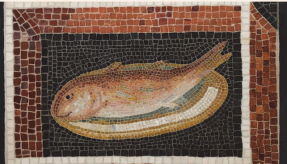
A fish on a platter depicted in a Roman mosaic dating from the 2nd century AD.
Until relatively recently, our knowledge of the realities of daily life in the Roman empire relied heavily on literary sources. They inevitably focused on the imperial elites.
The past 40 years, however, have seen an explosion in the discovery of new material and textual evidence.
The meticulous triangulation of all this new evidence by scholars has birthed a new, data-driven school of ancient history that has yielded an extraordinarily detailed picture of the lives and livelihoods not just of the empire’s privileged upper classes but of everyone else as well.
The result is thrilling, because it overturns so many earlier assumptions.¬¬ It used to be thought that the harsh living conditions of most ancient Romans must have taken a terrible toll on their health. Yet new bio-archaeological techniques reveal that skeletal signatures of childhood disease were twice as high in Victorian London as in Roman British cities. Dental records do reveal an alarming deterioration in oral health coincident with Roman rule. The Romans’ relative good health probably had something to do with their diet.
Here, it is the assumption that most scraped by on a subsistence level which new data consigns to history. In fact, even slaves enjoyed typical daily calorific intakes nearly twice the subsistence level. Urban and rural diets were surprisingly rich and varied — bone analysis reveals a healthy mix of seafood, meat, dairy and legumes — even in the farthest-flung corners of the empire.
The economic irrelevance of women and girls is another misconception. Textiles were a vast industry, employing up to half of all the labour in the empire, and what women could earn from spinning rivalled some male monthly wages. Thus, for an enormous number of Roman households, the female members were economically just as important as the males.
Financial Times. 10 January 2026. Adaptado.
O emprego do adjetivo “thrilling” (4º parágrafo) para caracterizar os resultados da pesquisa

Sua aprovação tá logo ali. Só falta um clique
Cadastre-se grátis e libere o acesso a um mundo de estudos com:
- Questões filtradas por matéria, prova e dificuldade
- Comentários explicativos para aprofundar seus estudos
- Conteúdo exclusivo que te dá vantagem na reta final