![[Marketing] Primeira Questao](https://storage.estuda.com.br/banners/0_6e09902a8e108d73cce3c7b9272eb1de_simulado_home_treineiro_desk.png)
Questão 12 - Mackenzie 1 Dia 2026
Harriet Tubman: The fearless abolitionist who led hundreds to freedom
Published on Feb. 21, 2025, by Wiam Milles
“Every great dream begins with a dreamer. Always remember, you have within you the strength, the patience, and the passion to reach for the stars to change the world.” –
Harriet Tubman
Harriet Tubman was more than just a conductor on the Underground Railroad; she was a strategist, a freedom fighter, and a leader who defied the brutal institution of slavery. She risked her life time and time again to lead enslaved people to freedom, served in the American Civil War, and continued fighting for justice until the end of her life.
As the U.S. celebrates Black History Month, it’s the perfect time to reflect on Tubman’s remarkable legacy. What made her so effective? How did she outmaneuver slave catchers and military forces? And why does her story still resonate today?
From slavery to freedom: Tubman’s escape
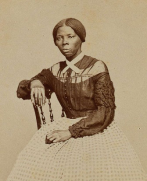
Portrait of Harriet Tubman, abolitionist and Underground Railroad conductor, Auburn, USA
Born Araminta Ross around 1822 in Maryland, Harriet Tubman grew up in harsh conditions. She was enslaved from birth, forced into hard labor, and suffered extreme physical abuse.
One life-changing event happened when an overseer threw a heavy iron weight at another enslaved person, but it struck Tubman instead. The injury caused her to have lifelong seizures, headaches, and sudden blackouts. However, it also triggered what she saw as divine visions—dreams and messages she believed guided her mission.
In 1849, she made the dangerous decision to escape to Pennsylvania.
She followed the Underground Railroad, a secret network of safe houses, abolitionists, and freed Black individuals who helped enslaved people flee. After securing her freedom, she could have lived out her life in safety. But she didn’t stop there.
The Underground Railroad: Risking it all to rescue others
Freedom wasn’t enough for Tubman. She knew that others were still trapped, so she made the extraordinary decision to return to the South to help them escape. Then, for the next ten years, she made around thirteen dangerous trips back, rescuing at least seventy people, including her family members (Bordewich, 2006).
Tubman strategically planned her missions, traveling at night, using the North Star as her guide, and avoiding major roads where she might be recognized. She changed her routes constantly to stay ahead of slave catchers and used disguises to avoid suspicion. She even carried a pistol, partly for protection but also to stop anyone in her group from panicking and turning back. Because of those missions, she was given the nickname “Moses”, a reference to the biblical figure who led his people to freedom. She never lost a single passenger. While many abolitionists preferred a slow approach, she demanded action. Tubman didn’t wait for laws to change; she freed people by herself.
Tubman’s role in the Civil War: leading an army to freedom
When the American Civil War broke out in 1861, Tubman didn’t stand aside. She joined the Union Army, working as a nurse at first but later becoming a scout and spy. Her knowledge of Southern landscapes and secret escape routes made her invaluable to military operations.
Her most famous mission was the Combahee River Raid in 1863, in which she helped lead a raid on plantations, freeing over 750 enslaved people in one night. She became the first woman in US history to command a military raid. (Clinton, 2004).
Despite her service, Tubman was never properly paid or recognized by the government. She had to fight for years to receive a pension, a reflection of the racial and gender inequalities that persisted long after slavery had ended.
Life after the war: A new battle for justice
Even after slavery was abolished in the United States, Tubman’s work wasn’t over. She settled in Auburn, New York, where she became an active supporter of the women’s suffrage movement (Larson, 2004), believing that true freedom meant equality for everyone.
She also turned her attention to helping those who had suffered under slavery. Recognizing that many formerly enslaved people had nowhere to go and no support, she established the Harriet Tubman Home for the Aged, providing care for elderly and vulnerable Black people.
Despite all her sacrifices, Tubman struggled financially for most of her life. She never received the rewards she deserved, but she remained committed to her mission until the end. She died in 1913, leaving behind a legacy that continues to inspire.
Tubman’s legacy: Why she still matters today
Harriet Tubman’s impact is undeniable. She was a woman who took action when others hesitated, refused to accept oppression, and believed that justice could not wait. Her name lives on in schools, monuments, and historical sites. Her life was a testament to what it means to fight for freedom. She didn’t wait for permission. She didn’t wait for a better time. She acted.
Harriet Tubman’s life is a testament to courage, resilience, and action. She didn’t just talk about freedom, she fought for it, over and over again, against impossible odds. Her legacy challenges us all to be bold, take action, and stand for justice, no matter the cost.
Adapted from: https://www.elizabethheyrick.org/news/harriet-tubman-the-fearlessabolitionist-who-led-hundreds-to-freedom. Access on Oct 17, 2025.
It is possible to infer from the text that:

Sua aprovação tá logo ali. Só falta um clique
Cadastre-se grátis e libere o acesso a um mundo de estudos com:
- Questões filtradas por matéria, prova e dificuldade
- Comentários explicativos para aprofundar seus estudos
- Conteúdo exclusivo que te dá vantagem na reta final