![[Marketing] Primeira Questao](https://storage.estuda.com.br/banners/0_6e09902a8e108d73cce3c7b9272eb1de_simulado_home_treineiro_desk.png)
Questão 32 - Sírio-Libanês Prova 2 2026
Read the text to answer the question.
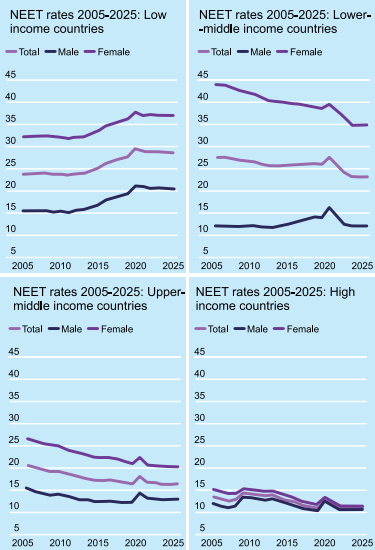
The International Labour Organization (ILO) estimates that in 2025 around 262 million — or one in four — young people aged between 15 and 24 — are neither employed nor studying: they are, in other words, Not in Employment, Education or Training (NEET). In 2015, the United Nations adopted a Sustainable Development Goal (SDG) to substantially reduce the NEET rate — the way in which progress towards achieving the effective integration of young people into the world of work is to be measured internationally. Using this indicator, however, progress until now has been rather modest. According to the ILO’s latest Global Employment Trends for Youth, 2024 edition, 110 countries — where a little over one half of the world’s youth live — are on track to fulfil the SDG goal. In contrast to the rest of the world, low-income1 countries as a whole have experienced a sustained increase in NEET rates in the years following the covid-19 pandemic (figure 1).
Figure 1: NEET rates by sex, by country income group, 2005-2025
Young NEETs comprise the unemployed — or rather, all young unemployed people who are not at the same time in education — as well as a much larger group of young people who do not have a job and are not engaged in any formal learning activity but who are also, for one reason or another, not actively looking for work.
(Niall O’Higgins. www.ilo.org, 12.08.2025. Adaptado.)
1 income: money that is earned from doing work or received from investments.
In the excerpt from the first paragraph “Using this indicator, however, progress until now has been rather modest”, the underlined words refer to the

Sua aprovação tá logo ali. Só falta um clique
Cadastre-se grátis e libere o acesso a um mundo de estudos com:
- Questões filtradas por matéria, prova e dificuldade
- Comentários explicativos para aprofundar seus estudos
- Conteúdo exclusivo que te dá vantagem na reta final