![[Marketing] Primeira Questao](https://storage.estuda.com.br/banners/0_6e09902a8e108d73cce3c7b9272eb1de_simulado_home_treineiro_desk.png)
Questão 47 - UFU 1 Fase 2025/2
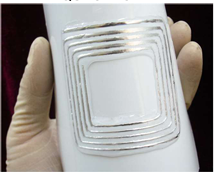
A radio-frequency-identification (RFID) antenna printed on paper.
Jing Liu, of the Chinese Academy of Sciences in Beijing, said his team's advance—published May 9 in the journal Scientific Reports—could be a leap forward in the booming business of printed electronics. “This brand-new technique offers a vital opportunity to realize rapid fabrication of inexpensive, disposable, conveniently portable circuits and functional components," he said, adding that the process could help "pave the way toward personal printed electronics." […] Jing and colleagues developed a new metal-based ink that could work at room temperatures. Their initial formula caused the ink to ball up into droplets, which made it difficult to apply and adhere to the paper. So the team modified the ink by injecting the liquid metal alloy with oxygen, making it more suitable for printing on the kind of paper used for book covers, labels, and advertising stock. A newly developed brush—like a porous pinhead—was also developed to deliver the slow-flowing ink that would clog more conventional printers. While most electronic inks solidify after printing, the one employed by the researchers remains liquid and is encapsulated by a second coating of silicone rubber—this creates a channel to hold the ink.
Disponível em: https://www.nationalgeographic.comasserção. Acesso em: 26 Jan. 2025.
According to the text,
I. In the future, you may be able to manufacture electronic circuits yourself using your desktop printer.
II. The new metal-based ink developed by Jin's team still faces adhesion issues with the paper.
III. The brush developed was designed to deliver the right amount of ink for printing book covers.
IV. Creating a channel to hold the ink was made possible by a coating of silicone rubber.
Assinale a alternativa que apresenta apenas asserções CORRETAS.

Sua aprovação tá logo ali. Só falta um clique
Cadastre-se grátis e libere o acesso a um mundo de estudos com:
- Questões filtradas por matéria, prova e dificuldade
- Comentários explicativos para aprofundar seus estudos
- Conteúdo exclusivo que te dá vantagem na reta final