![[Marketing] Primeira Questao](https://storage.estuda.com.br/banners/0_6e09902a8e108d73cce3c7b9272eb1de_simulado_home_treineiro_desk.png)
Questão 44 - UFU 1 Fase 2025/2
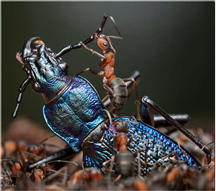
Wildlife photographer Ingo Arndt discovered his first enormous ant mound as a child exploring the forest with his father near their home in Germany almost 50 years ago. The mound was covered with a thick layer of spruce needles and throngs of tiny red ants.
Outfitted with a high-resolution camera and macro lenses that allow you to focus on small objects up close, he began photographing the mounds and sharing his imagery with researchers for a scientific perspective. It turned out the mound makers were indeed special. They were red wood ants—scientifically classified as a group within the genus Formica—one of the smallest of all so-called keystone species.
[…] the ants generate formic acid in a venom gland at the rear of their abdomen. As they build a nest, the insects will gather tree resin, which has been shown to possess antimicrobial properties, and spray it with their acid, which has its own antimicrobial properties. The result is a more potent agent that the ants place throughout the structure to fight against bacterial and fungal pathogens.
Formic acid also powers the species’ pest-control role. The fluid can be weaponized to take down other insects, like wood-boring beetles, one of the most destructive vermin in spruce forests. The fighting tactic, Seifert explains, involves “biting them and then spraying formic acid into the wounds.” Reducing the number of beetles that weaken and destroy trees improves conditions for aphids living in them. The ants “milk” the aphids to excrete honeydew, which becomes their primary food source.
Disponível em: https://www.nationalgeographic.com/. Acesso em: 18 jan. 2025.
What has Ingo Arndt discovered about the role of ants in our environment?

Sua aprovação tá logo ali. Só falta um clique
Cadastre-se grátis e libere o acesso a um mundo de estudos com:
- Questões filtradas por matéria, prova e dificuldade
- Comentários explicativos para aprofundar seus estudos
- Conteúdo exclusivo que te dá vantagem na reta final