![[Marketing] Primeira Questao](https://storage.estuda.com.br/banners/0_6e09902a8e108d73cce3c7b9272eb1de_simulado_home_treineiro_desk.png)
Questão 50 - ESPM 2024/2
GEN Z NEVER LEARNED TO READ CURSIVE
How will they interpret the past?
By Drew Gilpin Faust
(1) It was a good book, the student told the 14 others in the undergraduate seminar I was teaching, and it included a number of excellent illustrations, such as photographs of relevant Civil War manuscripts. But, he continued, those weren’t very helpful to him, because of course he couldn’t read cursive.
(2) Had I heard him correctly? Who else can’t read cursive? I asked the class. The answer: about two-thirds. And who can’t write it? Even more. What did they do about signatures? They had invented them by combining vestiges of whatever cursive instruction they may have had with creative squiggles and flourishes.
(3) In 2010, cursive was omitted from the new national Common Core standards for K–12 education. The students in my class, and their peers, were then somewhere in elementary school. Handwriting instruction had already been declining as laptops and tablets and lessons in “keyboarding” assumed an ever more prominent place in the classroom. Most of my students remembered getting no more than a year or so of somewhat desultory cursive training, which was often pushed aside by a growing emphasis on “teaching to the test.” Now in college, they represent the vanguard of a cursiveless world.
(4) Although I was unaware of it at the time, the 2010 Common Core policy on cursive had generated an uproar. Defenders of script argued variously that knowledge of cursive was “a basic right,” a key connection between hand and brain, an essential form of self-discipline, and a fundamental expression of identity. Its disappearance would represent a craven submission to “the tyranny of ‘relevance.”
(5) Within a decade, cursive’s embattled advocates had succeeded in passing measures requiring some sort of cursive instruction in more than 20 states. At the same time, the struggle for cursive became part of a growing, politicized nostalgia for a lost past. In 2016, Louisiana’s state senators reminded their constituents that the Declaration of Independence had been written in cursive and cried out “America!” as they unanimously voted to restore handwriting instruction across the state.
(6) Yet the decline in cursive seems inevitable. Writing is, after all, a technology, and most technologies are sooner or later surpassed and replaced.
(7) By the turn of the 20th century, the typewriter had become sufficiently established to prompt the first widespread declarations of the obsolescence of handwriting. But it would be a long demise. In 1956, Look magazine pronounced handwriting “out-of-date,” yet cursive still claimed a secure place in the curriculum for decades.
(8) Given a current generation of students in which so few can read or write cursive, one cannot assume it will ever again serve as an effective form of communication. I asked my students about the implications of what they had told me, focusing first on their experience as students. No, most of these history students admitted, they could not read manuscripts.
(9) I continued questioning: Didn’t professors make handwritten comments on their papers and exams? Many of the students found these illegible. Sometimes they would ask a teacher to decipher the comments; more often they just ignored them. Most faculty, especially after the remote instruction of the pandemic, now grade online. But I wondered how many of my colleagues have been dutifully offering handwritten observations without any clue that they would never be read.
(10) What about handwriting in your personal lives? I went on. One student reported that he had to ask his parents to “translate” handwritten letters from his grandparents. I asked the students if they made grocery lists, kept journals, or wrote thank-you or condolence letters. Almost all said yes. Almost all said they did so on laptops and phones or sometimes on paper in block letters.
(11) During my years as Harvard president, I regarded the handwritten note as a kind of superpower. I wrote hundreds of them and kept a pile of note cards in the upper-left-hand drawer of my desk. They provided a way to reach out and say: I am noticing you. This message of thanks or congratulations or sympathy comes not from some staff person or some machine but directly from me. I touched it and hope it touches you. Now I wonder how many recipients of these messages could not read them.
(12) All of us, not just students and scholars, will be affected by cursive’s loss. The inability to read handwriting deprives society of direct access to its own past. We will become reliant on a small group of trained translators and experts to report what history—including the documents and papers of our own families—was about. The spread of literacy in the early modern West was driven by people’s desire to read God’s word for themselves, to be empowered by an experience of unmediated connection. The abandonment of cursive represents a curious reverse parallel: We are losing a connection, and thereby disempowering ourselves.
(13) On the last day of class, a student came up to me with a copy of one of my books and asked me to sign it. I wrote an inscription that included not just his name and mine, but thanks for his many contributions to the seminar. Then I asked, a little wistfully, if he’d like me to read it to him.
Adapted from https://www.theatlantic.com/magazine/ archive/2022/10/gen-z-handwriting-teaching-cursive- -history/671246/ Accessed on 31/01/2024.
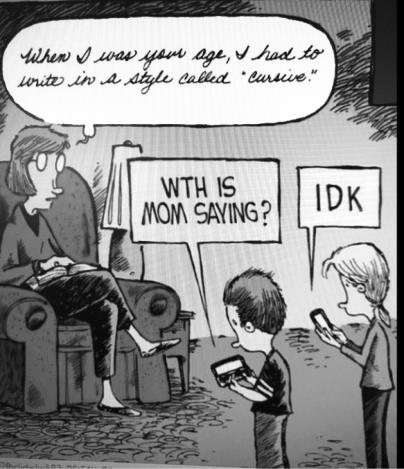
(https://twitter.com/GSammonWrites/status/ 1553713452853641217)
The cartoon above shows:

Sua aprovação tá logo ali. Só falta um clique
Cadastre-se grátis e libere o acesso a um mundo de estudos com:
- Questões filtradas por matéria, prova e dificuldade
- Comentários explicativos para aprofundar seus estudos
- Conteúdo exclusivo que te dá vantagem na reta final