![[Marketing] Primeira Questao](https://storage.estuda.com.br/banners/0_6e09902a8e108d73cce3c7b9272eb1de_simulado_home_treineiro_desk.png)
Questão 38 - UPE SSA 2ª Fase - 1° Dia 2023
Text 02
The Myth of Sustainable Fashion
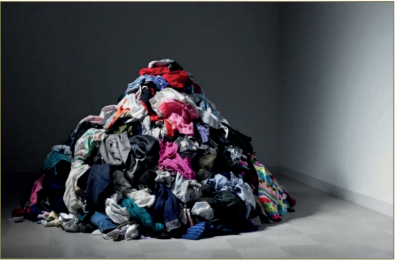
1 Few industries proclaim their sustainability credentials more forcefully than the fashion industry. Products ranging from swimsuits to wedding dresses are marketed as carbon positive, organic, or vegan while yoga mats made from mushrooms and sneakers from sugar cane dot retail shelves. New business models including recycling, resale, rental, reuse, and repair are sold as environmental life savers.
2 The sad truth however is that all this experimentation and supposed “innovation” in the fashion industry over the past 25 years have failed to lessen its planetary impact — a loud wake up call for those who hope that voluntary efforts can successfully address climate change and other major challenges facing society.
3 Take the production of shirts and shoes, which has more than doubled in the past quarter century — three quarters end up burned or buried in landfills. This feels like a personal failure of sorts. For many years, I was the COO of Timberland, a footwear and clothing brand that aspired to lead the industry toward a more sustainable future. The reasons for the industry’s sustainability letdown are complicated. Pressure for implacable growth summed with consumer demand for cheap, fast fashion have been great contributors.
4 The precise negative environmental impact of the fashion industry remains unknown, but it is enormous. The industry’s boundaries spread globally and its multitiered supply chain remains complex and opaque. Thanks to trade liberalization, globalization, and enduring cost pressures, very few brands own the assets of their upstream factories, and most companies outsource final production. “There are still very, very few brands who know where their stuff comes from in the supply chain, and even fewer of them have entered into active relationships with those suppliers to reduce their carbon footprint,” says environmental scientist Linda Greer. Estimates of the industry’s carbon impact range from 4% to 10% of overall global carbon emissions.
5 Like all industries, fashion is nested in a broader system. It is a system premised on growth. While serving as an executive in the industry, never once did a CFO ask me if the business could contract to yield a more durable customer base. This obstinate pursuit of growth, of “more,” drives strategies that are specific to the fashion industry.
6 Despite the improvements in technology and communications, predicting demand across tens of styles that are launched seasonally is much easier than doing the same for thousands of styles released monthly. Therefore, fashion inventories inevitably accumulate, and 40% of fashion goods are sold at a markdown. “The urge to sell more and get consumers to buy more is still in the DNA of the industry,” says Michael Stanley-Jones, co-secretary for the UN Alliance for Sustainable Fashion. “Clothes have a very short life span and end up in the dump.”
7 The speed of this hedonic treadmill continues to ramp up exponentially. Five years ago, McKinsey reported that shorter production lead times enabled by technology and revised business systems enabled brands to “introduce new lines more frequently. Zara offers 24 new clothing collections each year; H&M offers 12 to 16 and refreshes them weekly.” This acceleration and proliferation of “newness” served as a constant draw to bring consumers back to sites and stores. (…)

(PUCKER, Kenneth P. Harvard Business Review. Disponível em: https://hbr.org/2022/01/the-myth-of-sustainable-fashion. Acesso em 20 jun. 2022. Adaptado.)
Considerando o contexto e as regras de gramatica da língua inglesa, assinale a análise linguística CORRETA.

Sua aprovação tá logo ali. Só falta um clique
Cadastre-se grátis e libere o acesso a um mundo de estudos com:
- Questões filtradas por matéria, prova e dificuldade
- Comentários explicativos para aprofundar seus estudos
- Conteúdo exclusivo que te dá vantagem na reta final