![[Marketing] Primeira Questao](https://storage.estuda.com.br/banners/0_6e09902a8e108d73cce3c7b9272eb1de_simulado_home_treineiro_desk.png)
Questão 18 - UPE SSA 2ª Fase - 1º Dia 2024
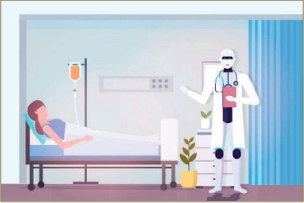
Artificial intelligence in intensive care units
Image: LinkedIn bank.
1 In the future, artificial intelligence will play an important role in medicine. In diagnostics, successful tests have already been performed: for example, the computer can learn to categorize images with great accuracy according to whether they show pathological changes or not. However, it is more difficult to train an artificial intelligence to examine the time-varying conditions of patients and to calculate treatment suggestions -- this is precisely what has now been achieved at TU Wien in cooperation with the Medical University of Vienna.
2 With the help of extensive data from intensive care units of various hospitals, an artificial intelligence was developed that provides suggestions for the treatment of people who require intensive care due to sepsis. Analyses show that artificial intelligence already surpasses the quality of human decisions. However, it is now important also to discuss the legal aspects of such methods.
3 "In an intensive care unit, a lot of different data is collected around the clock. The patients are constantly monitored medically. We wanted to investigate whether these data could be used even better than before," says Prof. Clemens Heitzinger from the Institute for Analysis and Scientific Computing at TU Wien (Vienna).
4 Medical staff make their decisions on the basis of well-founded rules. Most of the time, they know very well which parameters they have to take into account in order to provide the best care. However, the computer can easily take many more parameters than a human into account -- and in some cases this can lead to even better decisions. [...]
5 Analysis shows that AI capabilities are already outperforming humans: "Cure rates are now higher with an AI strategy than with purely human decisions. In one of our studies, the cure rate in terms of 90-day mortality was increased by about 3% to about 88%," says Prof. Heitzinger.
6 Of course, this does not mean that one should leave medical decisions in an intensive care unit to the computer alone. But the artificial intelligence may run along as an additional device at the bedside -- and the medical staff can consult it and compare their own assessment with the artificial intelligence's suggestions.
Disponível em: https://www.sciencedaily.com/releases/2023/05/230511164553.htm. Acesso em: maio/2023. Texto adaptado.
¿Cuál el principal objetivo de este reportaje (Texto) sobre el jugador Vinicius Jr?

Sua aprovação tá logo ali. Só falta um clique
Cadastre-se grátis e libere o acesso a um mundo de estudos com:
- Questões filtradas por matéria, prova e dificuldade
- Comentários explicativos para aprofundar seus estudos
- Conteúdo exclusivo que te dá vantagem na reta final