![[Marketing] Primeira Questao](https://storage.estuda.com.br/banners/0_6e09902a8e108d73cce3c7b9272eb1de_simulado_home_treineiro_desk.png)
Questão 21 - UPF Inverno 2024
Text
Brazil’s floods reveal the growing danger of extreme rain
Helen Li
May 5th, 2024
REUTERS/Amanda Perobelli
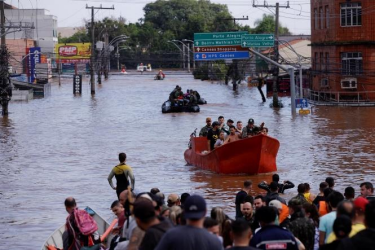
Brazil’s “worst disaster” in the last 80 years has left many people dead, injured and displaced by catastrophic flooding. The
southern state of Rio Grande do Sul received more than 70 percent of all the rain it typically gets in the month of April in the
space of four days.
[5] The torrential rains have destroyed key infrastructure, including knocking out power and water, and blocking roads, leaving
thousands waiting to be rescued from the water.
The floods are the latest consequence of a global spate of extreme rain events that also recently hit Indonesia, Kenya, and
Dubai. Experts point to climate change and this year’s juiced El Niño-La Niña weather pattern as the likely driver — with deadly
consequences.
[10] Brazil’s unrelenting rain is being driven by a climate phenomenon known as El Niño, a periodic event that sees surface ocean
water warm up, spurring storms and rain in the southern hemisphere. Climatologists say the floods are evidence of a “disastrous
cocktail” made up of human-caused global warming and more typical El Niño weather effects. Brazil has recently endured
months of extreme drought and a deadly cyclone. Ane Alencar, science director for the Amazon Environmental Research
Institute, told the Associated Press last year that the oscillating pattern of extreme drought-extreme rain was likely “the new
[15] normal.”
Brazil is not alone in this: extreme flooding has affected countries around the world, and especially in east Africa. An El Niño-
intensified Cyclone Hidaya has caused deadly floods in Kenya and Tanzania, a “stark reminder of the human cost of the climate
crisis,” Greenpeace Africa’s executive director said. Thousands of refugees in Kenya’s Dadaab refugee camps have been
displaced by the rising water levels. “Many people here who are now displaced still don’t have anywhere to go, some don’t
[20] even have food,” Joseph Ndung’u, a resident of Mathare, Nairobi, recently told Semafor Africa.
The changing El Niño and La Niña climate cycle adds “another degree of complexity” for understanding how climate change
will affect future weather patterns, according to research by the United States’ National Oceanic and Atmospheric
Administration. Scientists predict these extremes may “become even stronger than they are today,” and that El Niño-like events
could double in frequency by the end of the century. Ultimately, experts say many countries — and especially developing
[25] nations most vulnerable to climate change — are ill-prepared. Around 40 to 50 million people are currently affected by the
weather pattern in 16 countries, according to the United Nations. The UN Climate Crisis Coordinator for the El Niño/La Niña
Response said “action needs to happen now to support them.”
Retrieved and adapted from: https://www.semafor.com/article/05/05/2024/el-nino-and-climate-change-combine-in-brazils-floods Access on May 6th, 2024.
The purpose of the text is

Sua aprovação tá logo ali. Só falta um clique
Cadastre-se grátis e libere o acesso a um mundo de estudos com:
- Questões filtradas por matéria, prova e dificuldade
- Comentários explicativos para aprofundar seus estudos
- Conteúdo exclusivo que te dá vantagem na reta final