![[Marketing] Primeira Questao](https://storage.estuda.com.br/banners/0_6e09902a8e108d73cce3c7b9272eb1de_simulado_home_treineiro_desk.png)
Questão 32 - UNIUBE Medicina 2021/2
Leia o texto para responder à questão.
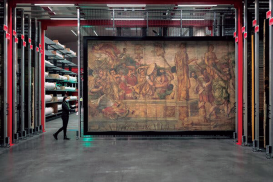
It is the most ambitious move in the history of the Louvre — a five-year project to transfer a quarter of a million artworks to an ultramodern storage site 120 miles away in northern France.
For more than 16 months, a stream of trucks has quietly hauled treasures from the museum’s central Paris basement, and other sites, to the Louvre Conservation Center, a fortress of culture set up in the town of Liévin, near Lens. Already 100,000 works have been moved — including paintings, carpets, tapestries, grand sculptures, small figurines, furniture and decorative pieces — dating from antiquity to the 19th century.
With museums in France closed because of the pandemic, Jean-Luc Martinez, the director of the Louvre, has time on his hands. He took a small group of reporters on a tour of the newly operational site, which is intended to become one of Europe’s largest art research centers and to welcome museum experts, scholars and conservators from around the world.
The Louvre sits on low ground along the banks of the Seine. In 2016, flooding in Paris was so severe that the museum itself was threatened, prompting a round-the-clock, emergency operation to wrap, crate and haul thousands of art objects out of underground storage and onto higher ground. The conservation project in Liévin, costing 60 million euros, or about $73 million, began in late 2017 as a necessary response to the river’s unpredictable, inevitable rise.
“The reality is that our museum is in a flood zone,” Mr. Martinez said on the tour. “You can’t just pick up and move marble sculptures around,” he noted. “There was a danger that the sewers would back up and that dirty, smelly wastewater would damage the art. We had to find a solution. Urgently.”
The Louvre considered, then rejected, the idea of building a site close to Paris: too expensive and impractical. Instead, it chose Liévin, a 10-minute walk from the Louvre’s mini- -museum outpost in the adjacent town of Lens, which opened in 2012.
(Elaine Sciolino. www.nytimes.com, 12.02.2021. Adaptado.)
In the excerpt from the third paragraph “which is intended to become one of Europe’s largest art research centers”, the underlined word refers to the

Sua aprovação tá logo ali. Só falta um clique
Cadastre-se grátis e libere o acesso a um mundo de estudos com:
- Questões filtradas por matéria, prova e dificuldade
- Comentários explicativos para aprofundar seus estudos
- Conteúdo exclusivo que te dá vantagem na reta final