![[Marketing] Primeira Questao](https://storage.estuda.com.br/banners/0_6e09902a8e108d73cce3c7b9272eb1de_simulado_home_treineiro_desk.png)
Questão 16 - UNIG ITAPERUNA 2019
TEXTO
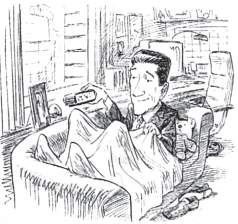
Power napping is good for the I.Q.
Health professionals increasingly recognize the
importance of eight hours’ sleep a night. Scientists
now believe that sleep is the single most important
factor for general health, more important than diet or
[5] exercise. Sleep is the only treatment that can claim to
restore, rejuvenate, and energize both the body and
the brain. The third of our lives that we spend asleep
has a profound effect on the two-thirds that we spend
awake – affecting our mood, memory, alertness, and
[10] performance.
Studies show that people in the developed
world increasingly spend less time asleep and more
time at work or traveling to and from work. Dr. Karine
Spiegel, at the University of Chicago, has found that
[15] the average length of sleep in developed nations has
declined from nine hours in 1910 to seven-and-a-half
hours today. However, we are biologically ill-equipped
to function on little sleep; and losing just one or two
hours’ sleep a night over a long period of time can
[20] have a serious effect on someone’s health.
According to Canadian scientist Dr. Stanley
Coren, every hour of sleep lost in a night also causes
us to drop one I.Q. point the next day. In a week of
five- or six-hour nights, the average person’s I.Q. could
[25] drop 15 points; thus, a normally intelligent person
starts to have a hard time functioning at all.
Most sleep experts agree that humans are
designed to sleep for at least eight hours, but this
should be in two stages: a long sleep at night and a
[30] shorter nap in the afternoon. American companies are
paying attention to this and are reporting increased
levels of alertness in employees who “power nap” at
some point during the afternoon, if only for 20 minutes.
The argument is that those who are not sleep-deprived
[35] are much more efficient at work.
The test used to determine sleep deprivation is
called the Multiple Sleep Latency Test, or MSLT. In
an MSLT, an individual remains in a darkened, quiet
room during the day. According to the theory, the
[40] more sleep-deprived the individual is, the less time it
takes that person to fall asleep. If it takes ten minutes
or longer to fall into a light sleep, the participant is
probably getting enough sleep; anything less shows
moderate sleep deprivation. However, the time of year
[45] seems to affect how much sleep an individual requires.
People tend to sleep as long as 14 hours in the winter
and as little as six hours in summer, without ill effects.
RICHARDS, Jack; ECKSTUT-DIDIER, Samuela. Strategic reading 1: building effective reading skills. Cambridge, 2003. p 122.
According to the text,

Sua aprovação tá logo ali. Só falta um clique
Cadastre-se grátis e libere o acesso a um mundo de estudos com:
- Questões filtradas por matéria, prova e dificuldade
- Comentários explicativos para aprofundar seus estudos
- Conteúdo exclusivo que te dá vantagem na reta final