


![[Marketing] Questao Topo - deslogado](https://storage.estuda.com.br/banners/0_6b7ebee90b03af1c560c73bb8bcce34a_banner_deslogado_70_dias.png)
Questões de Inglês
19.971 Questões
Questão 37 14649461
UPE 2ª Fase - 1º Dia 2021Text 2
Home
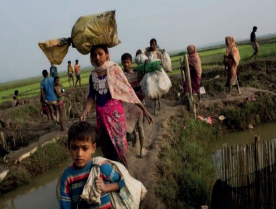
No one leaves home unless
home is the mouth of a shark
you only run for the border
when you see the whole city running as well
Your neighbors running faster than you
breath bloody in their throats
the boy you went to school with
who kissed you dizzy behind the old tin factory
is holding a gun bigger than his body
you only leave home
when home won‘t let you stay.
No one leaves home unless home chases you
fire under feet
hot blood in your belly
it‘s not something you ever thought of doing
until the blade burnt threats into
your neck
and even then you carried the anthem under
your breath
only tearing up your passport in an airport toilet
sobbing as each mouthful of paper
made it clear that you wouldn‘t be going back.
You have to understand,
that no one puts their children in a boat
unless the water is safer than the land
no one burns their palms
under trains
beneath carriages (…)

I want to go home,
but home is the mouth of a shark
home is the barrel of the gun
and no one would leave home
unless home chased you to the shore
unless home told you
to quicken your legs
leave your clothes behind
crawl through the desert
wade through the oceans (…)
No one leaves home until home is a sweaty voice in your ear
saying –
leave,
run away from me now
I dont know what I‘ve become
but I know that anywhere
is safer than here.
By Warsan Shire. Disponível em: https://www.facinghistory.org/educator-resources/current-events/many-faces-global-migration#8 Excertos. Acesso em: set. 2020.
Em determinado momento, a autora revela uma lembrança terna que se mistura aos outros sentimentos evocados no poema.
Assinale-a.
Questão 36 14649460
UPE 2ª Fase - 1º Dia 2021Text 2
Home
No one leaves home unless
home is the mouth of a shark
you only run for the border
when you see the whole city running as well
Your neighbors running faster than you
breath bloody in their throats
the boy you went to school with
who kissed you dizzy behind the old tin factory
is holding a gun bigger than his body
you only leave home
when home won‘t let you stay.
No one leaves home unless home chases you
fire under feet
hot blood in your belly
it‘s not something you ever thought of doing
until the blade burnt threats into
your neck
and even then you carried the anthem under
your breath
only tearing up your passport in an airport toilet
sobbing as each mouthful of paper
made it clear that you wouldn‘t be going back.
You have to understand,
that no one puts their children in a boat
unless the water is safer than the land
no one burns their palms
under trains
beneath carriages (…)
I want to go home,
but home is the mouth of a shark
home is the barrel of the gun
and no one would leave home
unless home chased you to the shore
unless home told you
to quicken your legs
leave your clothes behind
crawl through the desert
wade through the oceans (…)
No one leaves home until home is a sweaty voice in your ear
saying –
leave,
run away from me now
I dont know what I‘ve become
but I know that anywhere
is safer than here.
By Warsan Shire. Disponível em: https://www.facinghistory.org/educator-resources/current-events/many-faces-global-migration#8 Excertos. Acesso em: set. 2020.
O poema Home, da escritora e poeta somali Warsan Shire, traz em seu cerne uma questão relevante nas pautas e discussões mundiais da atualidade. Nele, percebe-se, principalmente, que a autora
Questão 35 14649454
UPE 2ª Fase - 1º Dia 2021Text 1
What is Distance Learning and Why Is It So Important?

1 Distance learning – any form of remote education where the student is not physically present for the lesson – is booming thanks to the power of the Internet. In fact, there are a number of advantages of learning remotely over even traditional teaching models. As the Internet blurs the line between near and far, distance learning is set to disrupt the current paradigm of education.
2 Historically, distance learning described correspondence courses in which students would communicate with their schools or teachers by mail. More recently, distance education has moved online to include a huge range of systems and methods on practically any connected device.
3 Distance education is clearly different from regular education in terms of a student or teacher‘s physical presence. For the most part, it translates into increased freedom for both learners and educators, but it also requires higher degrees of discipline and planning to successfully complete the course of study.
4 The enhanced freedom of remote learning is most clearly seen in the fact that students can choose courses that fit their schedules and resources. (Teachers can do the same.) And in the case of digital learning, students can also choose the location and teaching styles that best suit their needs.
5 Remote education is certainly not a magic bullet and there will always be a place for in-class learning. At the same time, distance learning still has a lot of untapped potential to reach students where they are and connect educators and learners in new ways. From increased flexibility to new learning styles, it seems that the future of learning will be as diverse in time and place as it will be in thought.
Disponível em: https://www.viewsonic.com/library/education/what-is-distance-learning-and-why-is-it-so-important/. Texto adaptado. Acesso em: 20 set. 2020.
In the 4th paragraph, there are two words that can be used as synonyms. They are
Questão 12 14031014
UEA - Geral UEAM - Conhecimento gerais 2021Leia o texto para responder à questão abaixo.
Underwater noise pollution could damage crucial ocean plants
Under the Mediterranean Sea lie meadows of Posidonia oceanica, a native seagrass species. It might not look like it’s doing much — just swaying back and forth with the current — but seagrass absorbs carbon dioxide, emits oxygen, protects coasts from erosion and provides habitat for fish.
But a new threat to seagrass beds has been detected:
underwater noise pollution caused by humans. A team of European scientists reported in the journal Communications Biology that when P. oceanica is exposed to noise, organs in the plant that store energy and detect gravity are destroyed, adding to concern for this already-threatened species.
Anthropogenic underwater noise is “a big concern,” said Nicola Quick, a marine biologist at Duke University, who was not involved in the study. There certainly have been natural subaquatic sounds from earthquakes and heavy rain, as well as from marine organisms, but humans have been adding noise to the soundscape from activities such as shipping, oil and gas extractions, and renewable energy development.
Despite P. oceanica’s seeming accessibility, it took the team six months to obtain the authorization needed to collect the protected species. After successfully acquiring the permits, the team collected 84 seagrass plants. They placed the samples in experimental tanks and played sounds with changing frequency from 50 to 400 Hz — the range that covers the noise generated by human activities. The noise level was around 157 dB underwater, equivalent to roughly 95 dB in the air, somewhere between a bass drum and a subway train.
The team discovered that two hours of noise exposure damaged a plant organ responsible for detecting gravity, meaning noise could affect the plant’s capacity to stay rooted. Moreover, the number of starch grains inside the organ decreased, which could affect the seagrass’s ability to store energy. The starch grains continued to disappear even after the noise stopped.
(Karen Kwon. www.discovermagazine.com, 08.07.2021. Adaptado.)
No trecho do quinto parágrafo “Moreover, the number of starch grains inside the organ decreased”, o termo sublinhado equivale, em português, a
Questão 11 14031013
UEA - Geral UEAM - Conhecimento gerais 2021Leia o texto para responder à questão abaixo.
Underwater noise pollution could damage crucial ocean plants
Under the Mediterranean Sea lie meadows of Posidonia oceanica, a native seagrass species. It might not look like it’s doing much — just swaying back and forth with the current — but seagrass absorbs carbon dioxide, emits oxygen, protects coasts from erosion and provides habitat for fish.
But a new threat to seagrass beds has been detected:
underwater noise pollution caused by humans. A team of European scientists reported in the journal Communications Biology that when P. oceanica is exposed to noise, organs in the plant that store energy and detect gravity are destroyed, adding to concern for this already-threatened species.
Anthropogenic underwater noise is “a big concern,” said Nicola Quick, a marine biologist at Duke University, who was not involved in the study. There certainly have been natural subaquatic sounds from earthquakes and heavy rain, as well as from marine organisms, but humans have been adding noise to the soundscape from activities such as shipping, oil and gas extractions, and renewable energy development.
Despite P. oceanica’s seeming accessibility, it took the team six months to obtain the authorization needed to collect the protected species. After successfully acquiring the permits, the team collected 84 seagrass plants. They placed the samples in experimental tanks and played sounds with changing frequency from 50 to 400 Hz — the range that covers the noise generated by human activities. The noise level was around 157 dB underwater, equivalent to roughly 95 dB in the air, somewhere between a bass drum and a subway train.
The team discovered that two hours of noise exposure damaged a plant organ responsible for detecting gravity, meaning noise could affect the plant’s capacity to stay rooted. Moreover, the number of starch grains inside the organ decreased, which could affect the seagrass’s ability to store energy. The starch grains continued to disappear even after the noise stopped.
(Karen Kwon. www.discovermagazine.com, 08.07.2021. Adaptado.)
No trecho do terceiro parágrafo “as well as from marine organisms”, a expressão sublinhada indica
Questão 10 14031012
UEA - Geral UEAM - Conhecimento gerais 2021Leia o texto para responder à questão abaixo.
Underwater noise pollution could damage crucial ocean plants
Under the Mediterranean Sea lie meadows of Posidonia oceanica, a native seagrass species. It might not look like it’s doing much — just swaying back and forth with the current — but seagrass absorbs carbon dioxide, emits oxygen, protects coasts from erosion and provides habitat for fish.
But a new threat to seagrass beds has been detected:
underwater noise pollution caused by humans. A team of European scientists reported in the journal Communications Biology that when P. oceanica is exposed to noise, organs in the plant that store energy and detect gravity are destroyed, adding to concern for this already-threatened species.
Anthropogenic underwater noise is “a big concern,” said Nicola Quick, a marine biologist at Duke University, who was not involved in the study. There certainly have been natural subaquatic sounds from earthquakes and heavy rain, as well as from marine organisms, but humans have been adding noise to the soundscape from activities such as shipping, oil and gas extractions, and renewable energy development.
Despite P. oceanica’s seeming accessibility, it took the team six months to obtain the authorization needed to collect the protected species. After successfully acquiring the permits, the team collected 84 seagrass plants. They placed the samples in experimental tanks and played sounds with changing frequency from 50 to 400 Hz — the range that covers the noise generated by human activities. The noise level was around 157 dB underwater, equivalent to roughly 95 dB in the air, somewhere between a bass drum and a subway train.
The team discovered that two hours of noise exposure damaged a plant organ responsible for detecting gravity, meaning noise could affect the plant’s capacity to stay rooted. Moreover, the number of starch grains inside the organ decreased, which could affect the seagrass’s ability to store energy. The starch grains continued to disappear even after the noise stopped.
(Karen Kwon. www.discovermagazine.com, 08.07.2021. Adaptado.)
De acordo com o primeiro parágrafo, as ervas marinhas
06