


![[Marketing] Questao Topo - deslogado](https://storage.estuda.com.br/banners/0_6b7ebee90b03af1c560c73bb8bcce34a_banner_deslogado_70_dias.png)
Questões de Inglês
19.971 Questões
Questão 14 6666989
FEMA 2022Leia o texto para responder à questão.
Predicting viral evolution may let vaccines be prepared in advance

Generally, immune systems mount responses only against pathogens that have already infected the bodies they are protecting. Science, though, can shorten the path to immunity by vaccination. This involves presenting the immune system with harmless or lookalike versions of dangerous pathogens so that it may create antibodies and killer cells hostile to the real thing in advance of any actual infection, thereby reducing its danger.
Like immune responses themselves, however, vaccination generally has to wait for the appearance of the pathogen in question before it can do its stuff. There is, therefore, a delay between a pathogen’s arrival on the scene and the deployment of a vaccine against it. That delay costs lives.
But, just as vaccination introduces immune systems to pathogens that are remote from them in space, new techniques which have come to the fore during the current pandemic offer the possibility of introducing them to pathogens that are remote from them in time—pathogens, indeed, that have not yet evolved, but which are likely to do so in the future. Thanks to a combination of high-throughput DNA-sequencing technologies and modern machine-learning it is now possible not merely to observe which variants of a virus are circulating, but also to suggest how they are likely to change. Understanding in this way what a virus might look like in the months and years to come gives those designing vaccines and therapies a leg up, enabling them to prime more immune systems sooner, so that fewer people die.
(www.economist.com, 05.08.2021. Adaptado.)
No trecho do primeiro parágrafo “thereby reducing its danger”, o termo sublinhado indica
Questão 13 6666956
FEMA 2022Leia o texto para responder à questão.
Predicting viral evolution may let vaccines be prepared in advance
Generally, immune systems mount responses only against pathogens that have already infected the bodies they are protecting. Science, though, can shorten the path to immunity by vaccination. This involves presenting the immune system with harmless or lookalike versions of dangerous pathogens so that it may create antibodies and killer cells hostile to the real thing in advance of any actual infection, thereby reducing its danger.
Like immune responses themselves, however, vaccination generally has to wait for the appearance of the pathogen in question before it can do its stuff. There is, therefore, a delay between a pathogen’s arrival on the scene and the deployment of a vaccine against it. That delay costs lives.
But, just as vaccination introduces immune systems to pathogens that are remote from them in space, new techniques which have come to the fore during the current pandemic offer the possibility of introducing them to pathogens that are remote from them in time—pathogens, indeed, that have not yet evolved, but which are likely to do so in the future. Thanks to a combination of high-throughput DNA-sequencing technologies and modern machine-learning it is now possible not merely to observe which variants of a virus are circulating, but also to suggest how they are likely to change. Understanding in this way what a virus might look like in the months and years to come gives those designing vaccines and therapies a leg up, enabling them to prime more immune systems sooner, so that fewer people die.
(www.economist.com, 05.08.2021. Adaptado.)
The aim of the text is to
Questão 12 6666950
FEMA 2022Leia o texto e os gráficos para responder à questão.
Global vaccine coverage
This chart shows the global vaccination coverage of one-year-olds with some of the most important vaccines recommended by the WHO (World Health Organization). For many essential vaccines, coverage is now much higher than 80%. However, the rates of vaccination are still not sufficient.
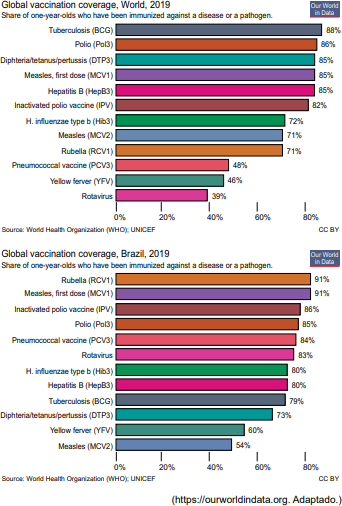
Compare both charts. Based on the data presented, in 2019, Brazil
Questão 11 6666882
FEMA 2022Leia o texto e os gráficos para responder à questão.
Global vaccine coverage
This chart shows the global vaccination coverage of one-year-olds with some of the most important vaccines recommended by the WHO (World Health Organization). For many essential vaccines, coverage is now much higher than 80%. However, the rates of vaccination are still not sufficient.
The aim of text and the chart “Global Vaccination Coverage, Word, 2019” is to show
Questão 15 6655880
Albert Einstein 2022Read the text to answer the question.
In 2008 at least six babies died and 300,000 fell ill after drinking made-in-China infant formula contaminated with toxic chemicals. In response, many Chinese parents embraced foreign baby food brands, catapulting the likes of Danone SA’s Aptamil and Nestlé SA’s Illuma to the top of the market. Yet for the past two years, the leading formula brand in China has been made by China Feihe Ltd., a Beijing company that emphasizes its local roots rather than seeking to obscure them. “More suitable for Chinese babies,” the company’s advertising boasts.
In categories ranging from baby food to sportswear and skin cream, Chinese brands are putting pressure on global rivals that depend on the country for much of their growth. While increasing nationalism has boosted the momentum of domestic products for the past couple of years, the covid-19 pandemic is speeding up the shift. With prices typically lower than foreign brands’, domestic products have increasing appeal in times of constrained household budgets, and the growth of online sales has weakened the multinationals’ advantages in distribution and marketing.
Foreign brands aren’t finished in China, of course. They dominate categories such as expensive handbags and luxury cars. Kentucky Fried Chicken (KFC) — still the biggest fast- -food chain in China — is supplementing its fried chicken with products such as fast-cooking snail noodles to cater to diners stuck at home in the pandemic. “The attitude of big international brands is changing significantly,” says Wu Wenmi, founder of Wenzihui MCN agency. “They are more humble now and willing to hear our opinions of how to play the game.”
One way Chinese companies are playing the game is with marketing that resonates for locals. While foreigners’ ads stress the nutritional value of their infant formula, Feihe nurtures relationships with consumers via loyalty programs and new-parent support groups. And Chinese brands are increasingly tailoring their products to domestic tastes. China Mengniu Dairy Co., for instance, is stepping up sales of innovations such as pineapple-flavored cheese in addition to its lineup of basic milk and fruit yogurts. “Foreign brands were so innovative three decades ago when they first came to China,” Mengniu CEO Lu Minfang says. “But now they’re developing slower than local brands.”

(Bruce Einhorm and Daniela Vrei.
Bloomberg Businessweek. 07.12.2020. Adapted.)
By comparing the first two paragraphs and the graphs it is possible to state that, in China,
Questão 14 6655866
Albert Einstein 2022Read the text to answer the question.
In 2008 at least six babies died and 300,000 fell ill after drinking made-in-China infant formula contaminated with toxic chemicals. In response, many Chinese parents embraced foreign baby food brands, catapulting the likes of Danone SA’s Aptamil and Nestlé SA’s Illuma to the top of the market. Yet for the past two years, the leading formula brand in China has been made by China Feihe Ltd., a Beijing company that emphasizes its local roots rather than seeking to obscure them. “More suitable for Chinese babies,” the company’s advertising boasts.
In categories ranging from baby food to sportswear and skin cream, Chinese brands are putting pressure on global rivals that depend on the country for much of their growth. While increasing nationalism has boosted the momentum of domestic products for the past couple of years, the covid-19 pandemic is speeding up the shift. With prices typically lower than foreign brands’, domestic products have increasing appeal in times of constrained household budgets, and the growth of online sales has weakened the multinationals’ advantages in distribution and marketing.
Foreign brands aren’t finished in China, of course. They dominate categories such as expensive handbags and luxury cars. Kentucky Fried Chicken (KFC) — still the biggest fast- -food chain in China — is supplementing its fried chicken with products such as fast-cooking snail noodles to cater to diners stuck at home in the pandemic. “The attitude of big international brands is changing significantly,” says Wu Wenmi, founder of Wenzihui MCN agency. “They are more humble now and willing to hear our opinions of how to play the game.”
One way Chinese companies are playing the game is with marketing that resonates for locals. While foreigners’ ads stress the nutritional value of their infant formula, Feihe nurtures relationships with consumers via loyalty programs and new-parent support groups. And Chinese brands are increasingly tailoring their products to domestic tastes. China Mengniu Dairy Co., for instance, is stepping up sales of innovations such as pineapple-flavored cheese in addition to its lineup of basic milk and fruit yogurts. “Foreign brands were so innovative three decades ago when they first came to China,” Mengniu CEO Lu Minfang says. “But now they’re developing slower than local brands.”
(Bruce Einhorm and Daniela Vrei.
Bloomberg Businessweek. 07.12.2020. Adapted.)
The last paragraph makes reference to
06