


![[Marketing] Questao Topo - deslogado](https://storage.estuda.com.br/banners/0_6b7ebee90b03af1c560c73bb8bcce34a_banner_deslogado_70_dias.png)
Questões de Inglês
19.971 Questões
Questão 14 6674723
FCSB 2022Read the text to answer question.

While financial institutions around the world have called for a full return to the office in the coming months, Synchrony Financial is moving in the opposite direction. The American firm has told its leadership team that they cannot, in fact, return to the office five days a week. Instead, they’re required to work at least one day from home.
DJ Casto, the company’s chief human resources officer, says one of the main reasons they adopted this rule was to put home-working and office-working staff on a more equal playing field. “From a leadership perspective, we want to make sure we look like we’re supporting both groups,” he explains, noting that 85% of employees in a company-wide survey expressed a desire to work from home full time.
To address concerns that those same workers might feel pressured to come back into the office to get more face time with their bosses (and thus more recognition), Casto says leadership needed to role-model the non-traditional plan. “The executive leadership team has a lot of influence on the behaviours of the workforce,” he explains. “So, if we set the tone at the top of the house to say, ‘it’s OK [to work from home], we’re going to do it, too,’ then it gives people a lot more trust.
Companies moving to a hybrid-work model are grappling with how to best ensure workers physically present in the office don’t gain benefits due to their proximity to bosses and colleagues. Academics call this phenomenon ‘proximity bias’, an unconscious tendency to give preferential treatment to those in our immediate vicinity. Once a matter of location within the office, the lines of what define proximity are now evolving, leaving workers and leaders in search of new ways of tackling the issue to guarantee that those who choose to work from home remain on track for promotions.
Proximity bias existed in the workplace long before the pandemic. “We all can reflect on occasions where the people we sit near are the people we know the best and feel the most kinship to,” says occupational psychologist Ali Shalfrooshan. This bond can create a halo effect, where we build an inflated view of those nearby while overlooking more qualified individuals further away. This halo effect can also cause leadership to excuse the poor performance of those in their proximity, while not properly valuing the skills and expertise of those with whom they have less contact. Leaders must make sure that out of sight doesn’t mean out of mind.
(Mark Johanson. www.bbc.com, 08.08.2021. Adapted.)
In the fragment of the third paragraph “To address concerns that those same workers might feel”, the underlined expression makes reference to employees from Synchrony Financial
Questão 13 6674717
FCSB 2022Read the text to answer question.
While financial institutions around the world have called for a full return to the office in the coming months, Synchrony Financial is moving in the opposite direction. The American firm has told its leadership team that they cannot, in fact, return to the office five days a week. Instead, they’re required to work at least one day from home.
DJ Casto, the company’s chief human resources officer, says one of the main reasons they adopted this rule was to put home-working and office-working staff on a more equal playing field. “From a leadership perspective, we want to make sure we look like we’re supporting both groups,” he explains, noting that 85% of employees in a company-wide survey expressed a desire to work from home full time.
To address concerns that those same workers might feel pressured to come back into the office to get more face time with their bosses (and thus more recognition), Casto says leadership needed to role-model the non-traditional plan. “The executive leadership team has a lot of influence on the behaviours of the workforce,” he explains. “So, if we set the tone at the top of the house to say, ‘it’s OK [to work from home], we’re going to do it, too,’ then it gives people a lot more trust.
Companies moving to a hybrid-work model are grappling with how to best ensure workers physically present in the office don’t gain benefits due to their proximity to bosses and colleagues. Academics call this phenomenon ‘proximity bias’, an unconscious tendency to give preferential treatment to those in our immediate vicinity. Once a matter of location within the office, the lines of what define proximity are now evolving, leaving workers and leaders in search of new ways of tackling the issue to guarantee that those who choose to work from home remain on track for promotions.
Proximity bias existed in the workplace long before the pandemic. “We all can reflect on occasions where the people we sit near are the people we know the best and feel the most kinship to,” says occupational psychologist Ali Shalfrooshan. This bond can create a halo effect, where we build an inflated view of those nearby while overlooking more qualified individuals further away. This halo effect can also cause leadership to excuse the poor performance of those in their proximity, while not properly valuing the skills and expertise of those with whom they have less contact. Leaders must make sure that out of sight doesn’t mean out of mind.
(Mark Johanson. www.bbc.com, 08.08.2021. Adapted.)
In the second paragraph, the concern about putting “home- -working and office-working staff on a more equal playing field” means that, in Synchrony Financial,
Questão 12 6674713
FCSB 2022Read the text to answer question.
While financial institutions around the world have called for a full return to the office in the coming months, Synchrony Financial is moving in the opposite direction. The American firm has told its leadership team that they cannot, in fact, return to the office five days a week. Instead, they’re required to work at least one day from home.
DJ Casto, the company’s chief human resources officer, says one of the main reasons they adopted this rule was to put home-working and office-working staff on a more equal playing field. “From a leadership perspective, we want to make sure we look like we’re supporting both groups,” he explains, noting that 85% of employees in a company-wide survey expressed a desire to work from home full time.
To address concerns that those same workers might feel pressured to come back into the office to get more face time with their bosses (and thus more recognition), Casto says leadership needed to role-model the non-traditional plan. “The executive leadership team has a lot of influence on the behaviours of the workforce,” he explains. “So, if we set the tone at the top of the house to say, ‘it’s OK [to work from home], we’re going to do it, too,’ then it gives people a lot more trust.
Companies moving to a hybrid-work model are grappling with how to best ensure workers physically present in the office don’t gain benefits due to their proximity to bosses and colleagues. Academics call this phenomenon ‘proximity bias’, an unconscious tendency to give preferential treatment to those in our immediate vicinity. Once a matter of location within the office, the lines of what define proximity are now evolving, leaving workers and leaders in search of new ways of tackling the issue to guarantee that those who choose to work from home remain on track for promotions.
Proximity bias existed in the workplace long before the pandemic. “We all can reflect on occasions where the people we sit near are the people we know the best and feel the most kinship to,” says occupational psychologist Ali Shalfrooshan. This bond can create a halo effect, where we build an inflated view of those nearby while overlooking more qualified individuals further away. This halo effect can also cause leadership to excuse the poor performance of those in their proximity, while not properly valuing the skills and expertise of those with whom they have less contact. Leaders must make sure that out of sight doesn’t mean out of mind.
(Mark Johanson. www.bbc.com, 08.08.2021. Adapted.)
Context helps understand that the term “instead”, in the fragment from the first paragraph “Instead, they’re required to work at least one day from home”, carries the idea of
Questão 11 6674702
FCSB 2022Read the text to answer question.
While financial institutions around the world have called for a full return to the office in the coming months, Synchrony Financial is moving in the opposite direction. The American firm has told its leadership team that they cannot, in fact, return to the office five days a week. Instead, they’re required to work at least one day from home.
DJ Casto, the company’s chief human resources officer, says one of the main reasons they adopted this rule was to put home-working and office-working staff on a more equal playing field. “From a leadership perspective, we want to make sure we look like we’re supporting both groups,” he explains, noting that 85% of employees in a company-wide survey expressed a desire to work from home full time.
To address concerns that those same workers might feel pressured to come back into the office to get more face time with their bosses (and thus more recognition), Casto says leadership needed to role-model the non-traditional plan. “The executive leadership team has a lot of influence on the behaviours of the workforce,” he explains. “So, if we set the tone at the top of the house to say, ‘it’s OK [to work from home], we’re going to do it, too,’ then it gives people a lot more trust.
Companies moving to a hybrid-work model are grappling with how to best ensure workers physically present in the office don’t gain benefits due to their proximity to bosses and colleagues. Academics call this phenomenon ‘proximity bias’, an unconscious tendency to give preferential treatment to those in our immediate vicinity. Once a matter of location within the office, the lines of what define proximity are now evolving, leaving workers and leaders in search of new ways of tackling the issue to guarantee that those who choose to work from home remain on track for promotions.
Proximity bias existed in the workplace long before the pandemic. “We all can reflect on occasions where the people we sit near are the people we know the best and feel the most kinship to,” says occupational psychologist Ali Shalfrooshan. This bond can create a halo effect, where we build an inflated view of those nearby while overlooking more qualified individuals further away. This halo effect can also cause leadership to excuse the poor performance of those in their proximity, while not properly valuing the skills and expertise of those with whom they have less contact. Leaders must make sure that out of sight doesn’t mean out of mind.
(Mark Johanson. www.bbc.com, 08.08.2021. Adapted.)
The text is mainly about
Questão 16 6667007
FEMA 2022Leia o texto para responder à questão.
Predicting viral evolution may let vaccines be prepared in advance
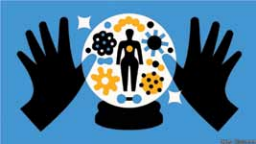
Generally, immune systems mount responses only against pathogens that have already infected the bodies they are protecting. Science, though, can shorten the path to immunity by vaccination. This involves presenting the immune system with harmless or lookalike versions of dangerous pathogens so that it may create antibodies and killer cells hostile to the real thing in advance of any actual infection, thereby reducing its danger.
Like immune responses themselves, however, vaccination generally has to wait for the appearance of the pathogen in question before it can do its stuff. There is, therefore, a delay between a pathogen’s arrival on the scene and the deployment of a vaccine against it. That delay costs lives.
But, just as vaccination introduces immune systems to pathogens that are remote from them in space, new techniques which have come to the fore during the current pandemic offer the possibility of introducing them to pathogens that are remote from them in time—pathogens, indeed, that have not yet evolved, but which are likely to do so in the future. Thanks to a combination of high-throughput DNA-sequencing technologies and modern machine-learning it is now possible not merely to observe which variants of a virus are circulating, but also to suggest how they are likely to change. Understanding in this way what a virus might look like in the months and years to come gives those designing vaccines and therapies a leg up, enabling them to prime more immune systems sooner, so that fewer people die.
(www.economist.com, 05.08.2021. Adaptado.)
In the excerpt from the third paragraph “but which are likely to do so in the future”, the underlined expression means
Questão 15 6666999
FEMA 2022Leia o texto para responder à questão.
Predicting viral evolution may let vaccines be prepared in advance
Generally, immune systems mount responses only against pathogens that have already infected the bodies they are protecting. Science, though, can shorten the path to immunity by vaccination. This involves presenting the immune system with harmless or lookalike versions of dangerous pathogens so that it may create antibodies and killer cells hostile to the real thing in advance of any actual infection, thereby reducing its danger.
Like immune responses themselves, however, vaccination generally has to wait for the appearance of the pathogen in question before it can do its stuff. There is, therefore, a delay between a pathogen’s arrival on the scene and the deployment of a vaccine against it. That delay costs lives.
But, just as vaccination introduces immune systems to pathogens that are remote from them in space, new techniques which have come to the fore during the current pandemic offer the possibility of introducing them to pathogens that are remote from them in time—pathogens, indeed, that have not yet evolved, but which are likely to do so in the future. Thanks to a combination of high-throughput DNA-sequencing technologies and modern machine-learning it is now possible not merely to observe which variants of a virus are circulating, but also to suggest how they are likely to change. Understanding in this way what a virus might look like in the months and years to come gives those designing vaccines and therapies a leg up, enabling them to prime more immune systems sooner, so that fewer people die.
(www.economist.com, 05.08.2021. Adaptado.)
The second paragraph is about
06