


![[Marketing] Questao Topo - deslogado](https://storage.estuda.com.br/banners/0_6b7ebee90b03af1c560c73bb8bcce34a_banner_deslogado_70_dias.png)
Questões de Inglês
19.971 Questões
Questão 31 6694503
USCS Medicina 2022/1Leia o texto para responder à questão.
The Amazon rainforest is now emitting more carbon dioxide than it is able to absorb, scientists have confirmed for the first time. The emissions amount to a billion tonnes of carbon dioxide a year, according to a study. The giant forest had previously been a carbon sink, absorbing the emissions driving the climate crisis, but is now causing its acceleration, researchers said.
Most of the emissions are caused by fires, many deliberately set to clear land for beef and soy production. But even without fires, hotter temperatures and droughts mean the south-eastern Amazon has become a source of CO2, rather than a sink.
Growing trees and plants have taken up about a quarter of all fossil fuel emissions since 1960, with the Amazon playing a major role as the largest tropical forest. Losing the Amazon’s power to capture CO2 is a stark warning that slashing emissions from fossil fuels is more urgent than ever, scientists said.
The research used small planes to measure CO2 levels up to 4,500 m above the forest over the last decade, showing how the whole Amazon is changing. Previous studies indicating the Amazon was becoming a source of CO2 were based on satellite data, which can be hampered by cloud cover, or ground measurements of trees, which can cover only a tiny part of the vast region.
The scientists said the discovery that part of the Amazon was emitting carbon even without fires was particularly worrying. They said it was most likely the result of each year’s deforestation and fires making adjacent forests more susceptible the next year. The trees produce much of the region’s rain, so fewer trees means more severe droughts and heatwaves and more tree deaths and fires.
(Damian Carrington. www.theguardian.com, 14.07.2021. Adaptado.)
The title that best summarizes the main ideia of the text is:
Questão 20 6674769
FCSB 2022Observe picture and text in the cartoon below.
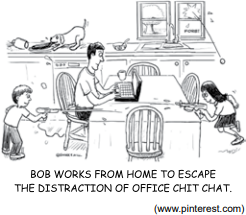
Humor in the cartoon derives from the fact that
Questão 19 6674756
FCSB 2022Read the text to answer question.

While financial institutions around the world have called for a full return to the office in the coming months, Synchrony Financial is moving in the opposite direction. The American firm has told its leadership team that they cannot, in fact, return to the office five days a week. Instead, they’re required to work at least one day from home.
DJ Casto, the company’s chief human resources officer, says one of the main reasons they adopted this rule was to put home-working and office-working staff on a more equal playing field. “From a leadership perspective, we want to make sure we look like we’re supporting both groups,” he explains, noting that 85% of employees in a company-wide survey expressed a desire to work from home full time.
To address concerns that those same workers might feel pressured to come back into the office to get more face time with their bosses (and thus more recognition), Casto says leadership needed to role-model the non-traditional plan. “The executive leadership team has a lot of influence on the behaviours of the workforce,” he explains. “So, if we set the tone at the top of the house to say, ‘it’s OK [to work from home], we’re going to do it, too,’ then it gives people a lot more trust.
Companies moving to a hybrid-work model are grappling with how to best ensure workers physically present in the office don’t gain benefits due to their proximity to bosses and colleagues. Academics call this phenomenon ‘proximity bias’, an unconscious tendency to give preferential treatment to those in our immediate vicinity. Once a matter of location within the office, the lines of what define proximity are now evolving, leaving workers and leaders in search of new ways of tackling the issue to guarantee that those who choose to work from home remain on track for promotions.
Proximity bias existed in the workplace long before the pandemic. “We all can reflect on occasions where the people we sit near are the people we know the best and feel the most kinship to,” says occupational psychologist Ali Shalfrooshan. This bond can create a halo effect, where we build an inflated view of those nearby while overlooking more qualified individuals further away. This halo effect can also cause leadership to excuse the poor performance of those in their proximity, while not properly valuing the skills and expertise of those with whom they have less contact. Leaders must make sure that out of sight doesn’t mean out of mind.
(Mark Johanson. www.bbc.com, 08.08.2021. Adapted.)
Read the graph and the first paragraph of the text to answer the question.
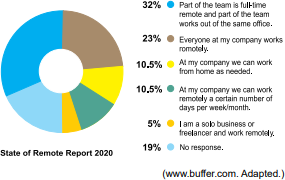
The graph brings the results of a survey with over 3,500 remote workers around the world. The workers were asked about their company’s position regarding remote work.
The result from the survey which corresponds most closely to the position of Synchrony Financial, as described in the first paragraph of the text, is
Questão 18 6674750
FCSB 2022Read the text to answer question.
While financial institutions around the world have called for a full return to the office in the coming months, Synchrony Financial is moving in the opposite direction. The American firm has told its leadership team that they cannot, in fact, return to the office five days a week. Instead, they’re required to work at least one day from home.
DJ Casto, the company’s chief human resources officer, says one of the main reasons they adopted this rule was to put home-working and office-working staff on a more equal playing field. “From a leadership perspective, we want to make sure we look like we’re supporting both groups,” he explains, noting that 85% of employees in a company-wide survey expressed a desire to work from home full time.
To address concerns that those same workers might feel pressured to come back into the office to get more face time with their bosses (and thus more recognition), Casto says leadership needed to role-model the non-traditional plan. “The executive leadership team has a lot of influence on the behaviours of the workforce,” he explains. “So, if we set the tone at the top of the house to say, ‘it’s OK [to work from home], we’re going to do it, too,’ then it gives people a lot more trust.
Companies moving to a hybrid-work model are grappling with how to best ensure workers physically present in the office don’t gain benefits due to their proximity to bosses and colleagues. Academics call this phenomenon ‘proximity bias’, an unconscious tendency to give preferential treatment to those in our immediate vicinity. Once a matter of location within the office, the lines of what define proximity are now evolving, leaving workers and leaders in search of new ways of tackling the issue to guarantee that those who choose to work from home remain on track for promotions.
Proximity bias existed in the workplace long before the pandemic. “We all can reflect on occasions where the people we sit near are the people we know the best and feel the most kinship to,” says occupational psychologist Ali Shalfrooshan. This bond can create a halo effect, where we build an inflated view of those nearby while overlooking more qualified individuals further away. This halo effect can also cause leadership to excuse the poor performance of those in their proximity, while not properly valuing the skills and expertise of those with whom they have less contact. Leaders must make sure that out of sight doesn’t mean out of mind.
(Mark Johanson. www.bbc.com, 08.08.2021. Adapted.)
From the point of view of bosses, one of the possible consequences of the “halo effect”, as mentioned in the last paragraph, is that they may
Questão 17 6674744
FCSB 2022Read the text to answer question.
While financial institutions around the world have called for a full return to the office in the coming months, Synchrony Financial is moving in the opposite direction. The American firm has told its leadership team that they cannot, in fact, return to the office five days a week. Instead, they’re required to work at least one day from home.
DJ Casto, the company’s chief human resources officer, says one of the main reasons they adopted this rule was to put home-working and office-working staff on a more equal playing field. “From a leadership perspective, we want to make sure we look like we’re supporting both groups,” he explains, noting that 85% of employees in a company-wide survey expressed a desire to work from home full time.
To address concerns that those same workers might feel pressured to come back into the office to get more face time with their bosses (and thus more recognition), Casto says leadership needed to role-model the non-traditional plan. “The executive leadership team has a lot of influence on the behaviours of the workforce,” he explains. “So, if we set the tone at the top of the house to say, ‘it’s OK [to work from home], we’re going to do it, too,’ then it gives people a lot more trust.
Companies moving to a hybrid-work model are grappling with how to best ensure workers physically present in the office don’t gain benefits due to their proximity to bosses and colleagues. Academics call this phenomenon ‘proximity bias’, an unconscious tendency to give preferential treatment to those in our immediate vicinity. Once a matter of location within the office, the lines of what define proximity are now evolving, leaving workers and leaders in search of new ways of tackling the issue to guarantee that those who choose to work from home remain on track for promotions.
Proximity bias existed in the workplace long before the pandemic. “We all can reflect on occasions where the people we sit near are the people we know the best and feel the most kinship to,” says occupational psychologist Ali Shalfrooshan. This bond can create a halo effect, where we build an inflated view of those nearby while overlooking more qualified individuals further away. This halo effect can also cause leadership to excuse the poor performance of those in their proximity, while not properly valuing the skills and expertise of those with whom they have less contact. Leaders must make sure that out of sight doesn’t mean out of mind.
(Mark Johanson. www.bbc.com, 08.08.2021. Adapted.)
The expression “Proximity bias” (5th paragraph) can be explained as
Questão 15 6674731
FCSB 2022Read the text to answer question.
While financial institutions around the world have called for a full return to the office in the coming months, Synchrony Financial is moving in the opposite direction. The American firm has told its leadership team that they cannot, in fact, return to the office five days a week. Instead, they’re required to work at least one day from home.
DJ Casto, the company’s chief human resources officer, says one of the main reasons they adopted this rule was to put home-working and office-working staff on a more equal playing field. “From a leadership perspective, we want to make sure we look like we’re supporting both groups,” he explains, noting that 85% of employees in a company-wide survey expressed a desire to work from home full time.
To address concerns that those same workers might feel pressured to come back into the office to get more face time with their bosses (and thus more recognition), Casto says leadership needed to role-model the non-traditional plan. “The executive leadership team has a lot of influence on the behaviours of the workforce,” he explains. “So, if we set the tone at the top of the house to say, ‘it’s OK [to work from home], we’re going to do it, too,’ then it gives people a lot more trust.
Companies moving to a hybrid-work model are grappling with how to best ensure workers physically present in the office don’t gain benefits due to their proximity to bosses and colleagues. Academics call this phenomenon ‘proximity bias’, an unconscious tendency to give preferential treatment to those in our immediate vicinity. Once a matter of location within the office, the lines of what define proximity are now evolving, leaving workers and leaders in search of new ways of tackling the issue to guarantee that those who choose to work from home remain on track for promotions.
Proximity bias existed in the workplace long before the pandemic. “We all can reflect on occasions where the people we sit near are the people we know the best and feel the most kinship to,” says occupational psychologist Ali Shalfrooshan. This bond can create a halo effect, where we build an inflated view of those nearby while overlooking more qualified individuals further away. This halo effect can also cause leadership to excuse the poor performance of those in their proximity, while not properly valuing the skills and expertise of those with whom they have less contact. Leaders must make sure that out of sight doesn’t mean out of mind.
(Mark Johanson. www.bbc.com, 08.08.2021. Adapted.)
In the fragment from the fourth paragraph “new ways of tackling the issue”, the underlined term means
06