


![[Marketing] Questao Topo - deslogado](https://storage.estuda.com.br/banners/0_6b7ebee90b03af1c560c73bb8bcce34a_banner_deslogado_70_dias.png)
Questões de Inglês
19.971 Questões
Questão 34 6707050
UNIFUNEC 2022Leia o texto para responder a questão.
New player in cancer’s spread
When people hear that they might have cancer, perhaps the only thing more frightening than the C word is the M word. Metastatic disease — in which the tumor has traveled beyond its primary place to other spots in the body — is responsible for nine out of every 10 cancer deaths.
Recently an unexpected player in this process has emerged: a common bacterium. Fusobacterium nucleatum, which normally lives harmlessly in the gums, appears to have a role in the spread of some cancers of the colon, esophagus, pancreas and — possibly — breast. Laboratory studies and evidence in patients indicate that the microbe can travel through the blood and infect tumor cells by attaching to a sugar molecule on their surface. There it provokes a range of signals and immune responses known to cause tumor cells to migrate. If further confirmed, the work with F. nucleatum could add to a growing understanding of how the microbiome influences cancer progression and may even point the way to fresh approaches to treatment.
(Claudia Wallis. Scientific American, outubro de 2020. Adaptado.)
In the excerpt from the last paragraph “and may even point the way to fresh approaches to treatment.”, the underlined word can be replaced, with no change in meaning, by
Questão 31 6706975
UNIFUNEC 2022Leia o texto para responder a questão.
New player in cancer’s spread
When people hear that they might have cancer, perhaps the only thing more frightening than the C word is the M word. Metastatic disease — in which the tumor has traveled beyond its primary place to other spots in the body — is responsible for nine out of every 10 cancer deaths.
Recently an unexpected player in this process has emerged: a common bacterium. Fusobacterium nucleatum, which normally lives harmlessly in the gums, appears to have a role in the spread of some cancers of the colon, esophagus, pancreas and — possibly — breast. Laboratory studies and evidence in patients indicate that the microbe can travel through the blood and infect tumor cells by attaching to a sugar molecule on their surface. There it provokes a range of signals and immune responses known to cause tumor cells to migrate. If further confirmed, the work with F. nucleatum could add to a growing understanding of how the microbiome influences cancer progression and may even point the way to fresh approaches to treatment.
(Claudia Wallis. Scientific American, outubro de 2020. Adaptado.)
De acordo com o texto, a ocorrência de metástase de alguns tipos de câncer pode estar associada
Questão 35 6705930
UNIFAE 2022Leia o infográfico para responder a questão.

O trecho do fato número 3 “Andrews is believed to be the inspiration for Indiana Jones” pode ser entendido como:
Questão 32 6705879
UNIFAE 2022Leia o texto para responder a questão.
The asteroid impact that killed off the dinosaurs gave birth to our planet’s tropical rainforests, a study suggests. Researchers used fossil pollen and leaves from Colombia to investigate how the impact changed South American tropical forests. After the 12 km-wide space rock struck Earth 66 million years ago, the type of vegetation that made up these forests changed drastically.
The team has outlined its findings in the prestigious journal Science. Co-author Dr Mónica Carvalho, from the Smithsonian Tropical Research Institution in Panama, said: “Our team examined over 50,000 fossil pollen records and more than 6,000 leaf fossils from before and after the impact.” They found that cone-bearing plants called conifers and ferns were common before the huge asteroid struck what is now the Yucatan Peninsula in Mexico.
But after the devastating impact, plant diversity declined by roughly 45% and extinctions were widespread, particularly among seed-bearing plants. While the forests recovered over the next six million years, angiosperms, or flowering plants, came to dominate them.
(www.bbc.com. Adaptado.)
In the excerpt from the second paragraph “before the huge asteroid struck what is now the Yucatan Peninsula in Mexico”, the underlined word can be replaced, without meaning change, by
Questão 31 6705706
UNIFAE 2022Leia o texto para responder a questão.
The asteroid impact that killed off the dinosaurs gave birth to our planet’s tropical rainforests, a study suggests. Researchers used fossil pollen and leaves from Colombia to investigate how the impact changed South American tropical forests. After the 12 km-wide space rock struck Earth 66 million years ago, the type of vegetation that made up these forests changed drastically.
The team has outlined its findings in the prestigious journal Science. Co-author Dr Mónica Carvalho, from the Smithsonian Tropical Research Institution in Panama, said: “Our team examined over 50,000 fossil pollen records and more than 6,000 leaf fossils from before and after the impact.” They found that cone-bearing plants called conifers and ferns were common before the huge asteroid struck what is now the Yucatan Peninsula in Mexico.
But after the devastating impact, plant diversity declined by roughly 45% and extinctions were widespread, particularly among seed-bearing plants. While the forests recovered over the next six million years, angiosperms, or flowering plants, came to dominate them.
(www.bbc.com. Adaptado.)
According to the text, the asteroid impact led not just to the extiction of dinosaurs, but also to the extinction of
Questão 10 6695182
CUSC Medicina 1° Semestre 2022Leia o texto para responder à questão.
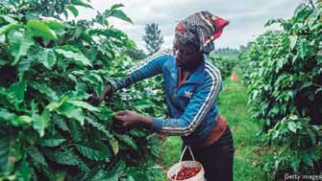
Some of the world’s best arabica coffee beans are grown on the fertile land around Mount Kenya. But like the citizens of many former British colonies, Kenyans are partial to tea. Now an expanding middle class is getting a taste for coffee. Domestic consumption is expected to reach 3,600 tonnes this year, almost a tenth of total production. The pandemic has shown just how important a local market can be, as logjams at ports and a sharp drop in global demand crush exports. “Covid has been an eye-opener,” says Gloria Gummerus, who runs the Sakami estate in western Kenya.
It is a similar story for other coffee-producing countries. Apart from Brazil and Ethiopia (which has an elaborate coffee ritual), many are just beginning to consume their own beans. Over 30% of the world’s coffee is now drunk in producing countries, according to José Sette of the International Coffee Organisation, up from 22% 30 years ago.
(www.economist.com, 08.04.2021. Adaptado.)
According to the text, Kenyans
06