


![[Marketing] Questao Topo - deslogado](https://storage.estuda.com.br/banners/0_6b7ebee90b03af1c560c73bb8bcce34a_banner_deslogado_70_dias.png)
Questões de Inglês
19.971 Questões
Questão 43 6746156
UNIFENAS Tarde 2022/1TEXT
Immunization
Vaccines are the world's safest method to protect children from life-threatening diseases.
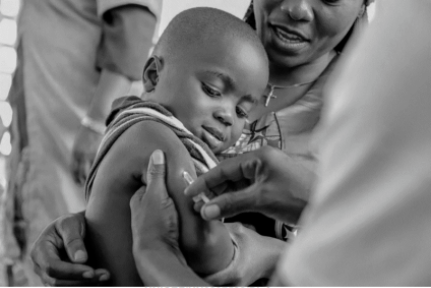
UNICEF/UN0287582/Diefaga
Vaccines are among the greatest advances in global health and development. For over two centuries, vaccines have safely reduced the scourge of diseases like polio, measles and smallpox, helping children grow up healthy and happy. They save more than five lives every minute – preventing up to three million deaths a year, even before the arrival of COVID-19.
Thanks to immunization efforts worldwide, children are able to walk, play, dance and learn. Vaccinated children do better at school, with economic benefits that ripple across their communities. Today, vaccines are estimated to be one of the most cost-effective means of advancing global welfare.
Despite these longstanding benefits, low immunization levels persist. Some 20 million children miss out on life-saving vaccines annually. The most poor and marginalized children – often most in need of vaccines – continue to be the least likely to get them. Many live in countries affected by conflict, in remote areas, or where polio remains endemic.
Low immunization rates also compromise progress in areas of maternal and child health and well-being. In 2019, the World Health Organization (WHO) declared vaccine hesitancy to be one of the top threats to public health. While vaccine hesitancy is as old as vaccination itself, the nature of the challenge continues to shift with the social landscape. Today, vaccine hesitancy and the ‘infodemic’ it fuels are key drivers of under-vaccination across the globe.
Adapted from https://www.unicef.org/immunization#covid-19. Accessed on September 6th, 2021.
“Vaccines are the world's safest method to protect children from life-threatening diseases.” In other words, this sentence means that
Questão 15 6715312
USS (Univassouras) 2022/1PREDICTING TOOTH LOSS
Machine-learning algorithms may help identify those at risk
Tooth loss is often accepted as a natural part of aging, but what if there was a way to better identify
those most susceptible without the need for a dental exam? New research led by investigators at Harvard
School of Dental Medicine suggests that machine learning tools can help identify those at greatest risk for
tooth loss and refer them for further dental assessment in an effort to ensure early interventions to avert
[05] or delay the condition.
The study compared five algorithms using a different combination of variables to screen for risk. The results
showed those that factored medical characteristics and socioeconomic variables, such as race, education,
arthritis, and diabetes, outperformed algorithms that relied on dental clinical indicators alone.
Tooth loss can be physically and psychologically debilitating. It can undoubtedly affect quality of life,
[10] well-being, nutrition, and social interactions. The process can be delayed, even prevented, if the earliest signs of dental disease are identified, and the condition treated promptly. Yet, many people with dental disease may not see a dentist until the process has advanced far beyond the point of saving a tooth. This is precisely where screening tools could help identify those at highest risk and refer them for further assessment, the team said. This approach could also be used globally, in a variety of health care settings,
[15] even by non-dental professional.
“Our findings suggest that the machine-learning algorithm models incorporating socioeconomic
characteristics were better at predicting tooth loss than those relying on routine clinical dental indicators
alone,” Elani said. “This work highlights the importance of social determinants of health. Knowing the
patient’s education level, employment status, and income is just as relevant for predicting tooth loss as
[20] assessing their clinical dental status.
Indeed, it has long been known that low-income and marginalized populations experience a disproportionate
share of the burden of tooth loss, due to lack of regular access to dental care, among other reasons, and
early identification and prompt care are critical in preventing tooth loss. These new findings point to an
important new tool in achieving that and Dr. Elani and her research team shed new light on how they can
[25] most effectively target prevention efforts and improve quality of life for patients.
Adapted from sciencedaily.com. June 24, 2021. Accessed 17 September 2021.
Yet, many people with dental disease may not see a dentist until the process has advanced far beyond the point of saving a tooth. (l. 11-12)
A word with the same semantic value can be found in one of the fragments below:
Questão 14 6715303
USS (Univassouras) 2022/1PREDICTING TOOTH LOSS
Machine-learning algorithms may help identify those at risk
Tooth loss is often accepted as a natural part of aging, but what if there was a way to better identify
those most susceptible without the need for a dental exam? New research led by investigators at Harvard
School of Dental Medicine suggests that machine learning tools can help identify those at greatest risk for
tooth loss and refer them for further dental assessment in an effort to ensure early interventions to avert
[05] or delay the condition.
The study compared five algorithms using a different combination of variables to screen for risk. The results
showed those that factored medical characteristics and socioeconomic variables, such as race, education,
arthritis, and diabetes, outperformed algorithms that relied on dental clinical indicators alone.
Tooth loss can be physically and psychologically debilitating. It can undoubtedly affect quality of life,
[10] well-being, nutrition, and social interactions. The process can be delayed, even prevented, if the earliest signs of dental disease are identified, and the condition treated promptly. Yet, many people with dental disease may not see a dentist until the process has advanced far beyond the point of saving a tooth. This is precisely where screening tools could help identify those at highest risk and refer them for further assessment, the team said. This approach could also be used globally, in a variety of health care settings,
[15] even by non-dental professional.
“Our findings suggest that the machine-learning algorithm models incorporating socioeconomic
characteristics were better at predicting tooth loss than those relying on routine clinical dental indicators
alone,” Elani said. “This work highlights the importance of social determinants of health. Knowing the
patient’s education level, employment status, and income is just as relevant for predicting tooth loss as
[20] assessing their clinical dental status.
Indeed, it has long been known that low-income and marginalized populations experience a disproportionate
share of the burden of tooth loss, due to lack of regular access to dental care, among other reasons, and
early identification and prompt care are critical in preventing tooth loss. These new findings point to an
important new tool in achieving that and Dr. Elani and her research team shed new light on how they can
[25] most effectively target prevention efforts and improve quality of life for patients.
Adapted from sciencedaily.com. June 24, 2021. Accessed 17 September 2021.
Considering dental assessments, machine learning tools should:
Questão 13 6715260
USS (Univassouras) 2022/1PREDICTING TOOTH LOSS
Machine-learning algorithms may help identify those at risk
Tooth loss is often accepted as a natural part of aging, but what if there was a way to better identify
those most susceptible without the need for a dental exam? New research led by investigators at Harvard
School of Dental Medicine suggests that machine learning tools can help identify those at greatest risk for
tooth loss and refer them for further dental assessment in an effort to ensure early interventions to avert
[05] or delay the condition.
The study compared five algorithms using a different combination of variables to screen for risk. The results
showed those that factored medical characteristics and socioeconomic variables, such as race, education,
arthritis, and diabetes, outperformed algorithms that relied on dental clinical indicators alone.
Tooth loss can be physically and psychologically debilitating. It can undoubtedly affect quality of life,
[10] well-being, nutrition, and social interactions. The process can be delayed, even prevented, if the earliest signs of dental disease are identified, and the condition treated promptly. Yet, many people with dental disease may not see a dentist until the process has advanced far beyond the point of saving a tooth. This is precisely where screening tools could help identify those at highest risk and refer them for further assessment, the team said. This approach could also be used globally, in a variety of health care settings,
[15] even by non-dental professional.
“Our findings suggest that the machine-learning algorithm models incorporating socioeconomic
characteristics were better at predicting tooth loss than those relying on routine clinical dental indicators
alone,” Elani said. “This work highlights the importance of social determinants of health. Knowing the
patient’s education level, employment status, and income is just as relevant for predicting tooth loss as
[20] assessing their clinical dental status.
Indeed, it has long been known that low-income and marginalized populations experience a disproportionate
share of the burden of tooth loss, due to lack of regular access to dental care, among other reasons, and
early identification and prompt care are critical in preventing tooth loss. These new findings point to an
important new tool in achieving that and Dr. Elani and her research team shed new light on how they can
[25] most effectively target prevention efforts and improve quality of life for patients.
Adapted from sciencedaily.com. June 24, 2021. Accessed 17 September 2021.
The central idea of the news article is the following:
Questão 33 6711353
UNIFIMES 2022Leia o texto para responder a questão.
Researchers in the US have developed a technological aid: a chest-mounted video camera — linked to a processing unit involving a computer-vision algorithm — and a pair of vibrating wristbands. When the system detects a hazard that the wearer is set to collide with, the wristband on the same side as the hazard vibrates. If the obstacle is straight ahead, both wristbands vibrate. The researchers said the device was not designed to replace canes or guide dogs but rather to provide additional benefits, including helping wearers to avoid hazards above ground level.
Writing in the journal Jama Ophthalmology, the researchers reported that a study of 368 hours of walking video data from 31 blind or partially sighted participants indicates that the approach could be helpful.
After a period of training, each participant used the system for about four weeks, in addition to their cane or guide dog. During this time the system switched unannounced between “active” mode — during which the wristbands vibrated when a hazard was detected — and “silent” mode, where they did not. The researchers then analysed the data to see whether the rate of contacts between the user’s body or cane and the objects identified by the system differed between the two scenarios.
When they looked at a random sample of collision warnings for each participant, they found that such contacts were reduced by 37% when the system was in active mode, taking into account factors including participants’ level of visual acuity.
(Nicola Davis. www.theguardian.com, 22.07.2021. Adaptado.)
In the excerpt from the first paragraph “to provide additional benefits”, the underlined word can be replaced, with no change in meaning, by
Questão 31 6711340
UNIFIMES 2022Examine o cartum Frank and Ernest, de Thaves.

O cartum retrata, sobretudo,
06