


![[Marketing] Questao Topo - deslogado](https://storage.estuda.com.br/banners/0_6b7ebee90b03af1c560c73bb8bcce34a_banner_deslogado_70_dias.png)
Questões de Inglês
19.971 Questões
Questão 29 8872362
Unit-AL Medicina - 1º dia 2022/2Digital devices are increasingly dominating our lives these days. Many, if not most of us are addicted to them. New studies emerge with alarming frequency about the dangers to our physical and mental health of being glued to our small screens. Children are not exercising; people are worrying about their body image because of online pressure from "perfect body" sites; and people are being bullied (or worse) by cyber-criminals. In a study of 1,000 adults in Japan, researchers discovered that nearly 50 per cent of the participants were addicted to their smartphones, but were unaware of their smartphone dependence. The study is one of many clarion calls for "digital detox" to become part of our lives.
The practice of digital detox involves switching off from the Internet to enjoy something called "real life". This involves the bygone custom of conversing with people face to face and "doing everyday stuff". The organization Digital Detox Japan said: "We want detox to be a catalyst for people to rethink their distance from their devices… to set aside time to get ample rest." People need to rely less on devices to avoid the new phenomenon of "nomophobia" – NO MObile PHOBIA. Psychologist Dr Kia-Rai Prewitt warned of the dangers of being too absorbed in smartphones. She wrote: "If you ignore responsibilities at home or work because of the amount of time you spend online, then consider a digital detox."
Disponível em: https://breakingnewsenglish.com. Acesso em: mai. 2022.
The phenomenon of “nomofobia” mentioned in the text refers to the
Questão 28 8872354
Unit-AL Medicina - 1º dia 2022/2Digital devices are increasingly dominating our lives these days. Many, if not most of us are addicted to them. New studies emerge with alarming frequency about the dangers to our physical and mental health of being glued to our small screens. Children are not exercising; people are worrying about their body image because of online pressure from "perfect body" sites; and people are being bullied (or worse) by cyber-criminals. In a study of 1,000 adults in Japan, researchers discovered that nearly 50 per cent of the participants were addicted to their smartphones, but were unaware of their smartphone dependence. The study is one of many clarion calls for "digital detox" to become part of our lives.
The practice of digital detox involves switching off from the Internet to enjoy something called "real life". This involves the bygone custom of conversing with people face to face and "doing everyday stuff". The organization Digital Detox Japan said: "We want detox to be a catalyst for people to rethink their distance from their devices… to set aside time to get ample rest." People need to rely less on devices to avoid the new phenomenon of "nomophobia" – NO MObile PHOBIA. Psychologist Dr Kia-Rai Prewitt warned of the dangers of being too absorbed in smartphones. She wrote: "If you ignore responsibilities at home or work because of the amount of time you spend online, then consider a digital detox."
Disponível em: https://breakingnewsenglish.com. Acesso em: mai. 2022.
The suggestion of “doing everyday stuff”, as a successful means of making a digital detox work, implies in doing things that are
Questão 26 8872242
Unit-AL Medicina - 1º dia 2022/2Digital devices are increasingly dominating our lives these days. Many, if not most of us are addicted to them. New studies emerge with alarming frequency about the dangers to our physical and mental health of being glued to our small screens. Children are not exercising; people are worrying about their body image because of online pressure from "perfect body" sites; and people are being bullied (or worse) by cyber-criminals. In a study of 1,000 adults in Japan, researchers discovered that nearly 50 per cent of the participants were addicted to their smartphones, but were unaware of their smartphone dependence. The study is one of many clarion calls for "digital detox" to become part of our lives.
The practice of digital detox involves switching off from the Internet to enjoy something called "real life". This involves the bygone custom of conversing with people face to face and "doing everyday stuff". The organization Digital Detox Japan said: "We want detox to be a catalyst for people to rethink their distance from their devices… to set aside time to get ample rest." People need to rely less on devices to avoid the new phenomenon of "nomophobia" – NO MObile PHOBIA. Psychologist Dr Kia-Rai Prewitt warned of the dangers of being too absorbed in smartphones. She wrote: "If you ignore responsibilities at home or work because of the amount of time you spend online, then consider a digital detox."
Disponível em: https://breakingnewsenglish.com. Acesso em: mai. 2022.
Among some possible harmful effects of excessive use of digital devices, the only one not mentioned in the text is
Questão 25 8872236
Unit-AL Medicina - 1º dia 2022/2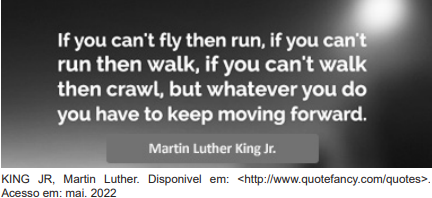
This quote by Martin Luther King Jr. advises people to
Questão 22 8872095
Unit-AL Medicina - 1º dia 2022/2Call it “Zoom face-envy”. Because of the rise of video-conferencing during the pandemic, legions now spend hours staring at their own faces and, inevitably, comparing them with those of others. Actually, poor lighting and the skewed angles of laptop cameras are rarely flattering. Nor is “lockdown face”, brought on by stress, or a lack of sunlight and exercise. For Kim, a 57-year-old actress in New York City, Zoom seemed to add ten pounds and a “crepey” look to her skin. After seeing “way too much” of that, she got a facelift last summer. She is delighted with the result. Similarly, Michèle Le Tournelle, a 62-year-old retiree near Nantes in France, said the “horrible” confinement turned into “a revelation”: it spurred her to undergo a slimming procedure and a facelift with which she has been “very, very, very” pleased.
Many cosmetic surgeons had expected the pandemic to hammer business. Instead the industry is enjoying a Zoom-boom. The American Academy of Facial Plastic and Reconstructive Surgery reckons that the pandemic has led to a 10% increase in cosmetic surgery countrywide. In France, despite limits on elective procedures during the pandemic, cosmetic surgeries are up by nearly 20%, estimates the French Society of Aesthetic Plastic Surgeons. For Ashton Collins, the boss of Save Face, a firm in Cardiff that refers people seeking minimally invasive cosmetic treatments to the 852 (and counting) practitioners it has accredited across Britain, business is “through the roof”. In Italy, Pier Andrea Cicogna of Studio Cicogna, a plastic-surgery clinic in Treviso, says his revenue has risen by nearly a third despite more than three months of closure.
CALL IT… Disponivel em: http://www.economist.com. Acesso em: mai. 2022
According to the text, as people had to work from home during the pandemic, “Zoom face-envy” can be defined as the result of people’s
Questão 21 8872062
Unit-AL Medicina - 1º dia 2022/2Call it “Zoom face-envy”. Because of the rise of video-conferencing during the pandemic, legions now spend hours staring at their own faces and, inevitably, comparing them with those of others. Actually, poor lighting and the skewed angles of laptop cameras are rarely flattering. Nor is “lockdown face”, brought on by stress, or a lack of sunlight and exercise. For Kim, a 57-year-old actress in New York City, Zoom seemed to add ten pounds and a “crepey” look to her skin. After seeing “way too much” of that, she got a facelift last summer. She is delighted with the result. Similarly, Michèle Le Tournelle, a 62-year-old retiree near Nantes in France, said the “horrible” confinement turned into “a revelation”: it spurred her to undergo a slimming procedure and a facelift with which she has been “very, very, very” pleased.
Many cosmetic surgeons had expected the pandemic to hammer business. Instead the industry is enjoying a Zoom-boom. The American Academy of Facial Plastic and Reconstructive Surgery reckons that the pandemic has led to a 10% increase in cosmetic surgery countrywide. In France, despite limits on elective procedures during the pandemic, cosmetic surgeries are up by nearly 20%, estimates the French Society of Aesthetic Plastic Surgeons. For Ashton Collins, the boss of Save Face, a firm in Cardiff that refers people seeking minimally invasive cosmetic treatments to the 852 (and counting) practitioners it has accredited across Britain, business is “through the roof”. In Italy, Pier Andrea Cicogna of Studio Cicogna, a plastic-surgery clinic in Treviso, says his revenue has risen by nearly a third despite more than three months of closure.
CALL IT… Disponivel em: http://www.economist.com. Acesso em: mai. 2022
The central idea of this text is in alternative
06