


![[Marketing] Questao Topo - deslogado](https://storage.estuda.com.br/banners/0_6b7ebee90b03af1c560c73bb8bcce34a_banner_deslogado_70_dias.png)
Questões de Inglês
19.971 Questões
Questão 17 14700923
UNESP 2 Fase - Conhecimentos Específicos 2022Leia o texto para responder à questão.
An invigorating reading
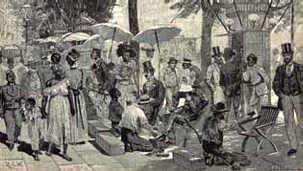
His grandparents were slaves. His father painted houses. His immigrant mother washed laundry. For a poor, mixed-race boy born in Brazil in 1839, their son had done well to become an apprentice typesetter in Rio de Janeiro. But a priest taught him Latin, and a literary agent spotted the gifted lad at the Imprensa Nacional, the government press, and soon he was contributing to newspapers, writing plays and poems and starting a literary circle.
But it was as a novelist that Joaquim Maria Machado de Assis would truly shine. Machado worked as a civil servant and co-founded the Brazilian Academy of Letters; he married happily (although his Portuguese in-laws initially objected to the colour of his skin). Beneath all this outward respectability, his prose was radically ingenious. Ever since “The Posthumous Memoirs of Brás Cubas”, Machado’s fifth novel, appeared in 1881 it has astonished readers with its lordly ironies and scorn for convention. The book’s invigorating style, as much as its backdrop of racial and social injustice, makes it ideal reading for this morbid, insurgent summer.
Brás Cubas, the fictional memoirist, has just died from pneumonia. As a thwarted corpse who failed in almost everything he tried, he wants to set the record straight about his drifting life as an idle, pleasure-seeking dandy in Rio. Beneath his jaunty veneer, Cubas harbours a melancholy pessimism. He sees a freedman lash a slave he has bought — to relieve his own sufferings “by passing them on to someone else”. Yet the novel floats free of the ambient oppression on currents of mischief and urbanity.
Sprinkled with epigrams, dreams, gags and asides, the story teases, dances and delights. Across 160 short chapters (“Long chapters suit long-winded readers”), Machado mocks every rule of the 19th-century novel. A chapter of dialogue is written entirely in punctuation (“!…?…!”). In another, the narrator acknowledges (in a new translation by Margaret Jull Costa and Robin Patterson), “I have just written an utterly pointless chapter”. Dave Eggers, an American author, recently called this “one of the wittiest, most playful, and therefore most alive and ageless books ever written”.
(www.economist.com, 15.08.2020. Adaptado.)
O trecho do quarto parágrafo que exemplifica a frase “Machado mocks every rule of the 19th-century novel” é
Questão 16 14700917
UNESP 2 Fase - Conhecimentos Específicos 2022Leia o texto para responder à questão.
An invigorating reading
His grandparents were slaves. His father painted houses. His immigrant mother washed laundry. For a poor, mixed-race boy born in Brazil in 1839, their son had done well to become an apprentice typesetter in Rio de Janeiro. But a priest taught him Latin, and a literary agent spotted the gifted lad at the Imprensa Nacional, the government press, and soon he was contributing to newspapers, writing plays and poems and starting a literary circle.
But it was as a novelist that Joaquim Maria Machado de Assis would truly shine. Machado worked as a civil servant and co-founded the Brazilian Academy of Letters; he married happily (although his Portuguese in-laws initially objected to the colour of his skin). Beneath all this outward respectability, his prose was radically ingenious. Ever since “The Posthumous Memoirs of Brás Cubas”, Machado’s fifth novel, appeared in 1881 it has astonished readers with its lordly ironies and scorn for convention. The book’s invigorating style, as much as its backdrop of racial and social injustice, makes it ideal reading for this morbid, insurgent summer.
Brás Cubas, the fictional memoirist, has just died from pneumonia. As a thwarted corpse who failed in almost everything he tried, he wants to set the record straight about his drifting life as an idle, pleasure-seeking dandy in Rio. Beneath his jaunty veneer, Cubas harbours a melancholy pessimism. He sees a freedman lash a slave he has bought — to relieve his own sufferings “by passing them on to someone else”. Yet the novel floats free of the ambient oppression on currents of mischief and urbanity.
Sprinkled with epigrams, dreams, gags and asides, the story teases, dances and delights. Across 160 short chapters (“Long chapters suit long-winded readers”), Machado mocks every rule of the 19th-century novel. A chapter of dialogue is written entirely in punctuation (“!…?…!”). In another, the narrator acknowledges (in a new translation by Margaret Jull Costa and Robin Patterson), “I have just written an utterly pointless chapter”. Dave Eggers, an American author, recently called this “one of the wittiest, most playful, and therefore most alive and ageless books ever written”.
(www.economist.com, 15.08.2020. Adaptado.)
No trecho do terceiro parágrafo “Yet the novel floats free of the ambient oppression on currents of mischief and urbanity”, o termo sublinhado expressa
Questão 15 14700914
UNESP 2 Fase - Conhecimentos Específicos 2022Leia o texto para responder à questão.
An invigorating reading
His grandparents were slaves. His father painted houses. His immigrant mother washed laundry. For a poor, mixed-race boy born in Brazil in 1839, their son had done well to become an apprentice typesetter in Rio de Janeiro. But a priest taught him Latin, and a literary agent spotted the gifted lad at the Imprensa Nacional, the government press, and soon he was contributing to newspapers, writing plays and poems and starting a literary circle.
But it was as a novelist that Joaquim Maria Machado de Assis would truly shine. Machado worked as a civil servant and co-founded the Brazilian Academy of Letters; he married happily (although his Portuguese in-laws initially objected to the colour of his skin). Beneath all this outward respectability, his prose was radically ingenious. Ever since “The Posthumous Memoirs of Brás Cubas”, Machado’s fifth novel, appeared in 1881 it has astonished readers with its lordly ironies and scorn for convention. The book’s invigorating style, as much as its backdrop of racial and social injustice, makes it ideal reading for this morbid, insurgent summer.
Brás Cubas, the fictional memoirist, has just died from pneumonia. As a thwarted corpse who failed in almost everything he tried, he wants to set the record straight about his drifting life as an idle, pleasure-seeking dandy in Rio. Beneath his jaunty veneer, Cubas harbours a melancholy pessimism. He sees a freedman lash a slave he has bought — to relieve his own sufferings “by passing them on to someone else”. Yet the novel floats free of the ambient oppression on currents of mischief and urbanity.
Sprinkled with epigrams, dreams, gags and asides, the story teases, dances and delights. Across 160 short chapters (“Long chapters suit long-winded readers”), Machado mocks every rule of the 19th-century novel. A chapter of dialogue is written entirely in punctuation (“!…?…!”). In another, the narrator acknowledges (in a new translation by Margaret Jull Costa and Robin Patterson), “I have just written an utterly pointless chapter”. Dave Eggers, an American author, recently called this “one of the wittiest, most playful, and therefore most alive and ageless books ever written”.
(www.economist.com, 15.08.2020. Adaptado.)
The second paragraph states that “The Posthumous Memoirs of Brás Cubas” is a
Questão 14 14700907
UNESP 2 Fase - Conhecimentos Específicos 2022Leia o texto para responder à questão.
An invigorating reading
His grandparents were slaves. His father painted houses. His immigrant mother washed laundry. For a poor, mixed-race boy born in Brazil in 1839, their son had done well to become an apprentice typesetter in Rio de Janeiro. But a priest taught him Latin, and a literary agent spotted the gifted lad at the Imprensa Nacional, the government press, and soon he was contributing to newspapers, writing plays and poems and starting a literary circle.
But it was as a novelist that Joaquim Maria Machado de Assis would truly shine. Machado worked as a civil servant and co-founded the Brazilian Academy of Letters; he married happily (although his Portuguese in-laws initially objected to the colour of his skin). Beneath all this outward respectability, his prose was radically ingenious. Ever since “The Posthumous Memoirs of Brás Cubas”, Machado’s fifth novel, appeared in 1881 it has astonished readers with its lordly ironies and scorn for convention. The book’s invigorating style, as much as its backdrop of racial and social injustice, makes it ideal reading for this morbid, insurgent summer.
Brás Cubas, the fictional memoirist, has just died from pneumonia. As a thwarted corpse who failed in almost everything he tried, he wants to set the record straight about his drifting life as an idle, pleasure-seeking dandy in Rio. Beneath his jaunty veneer, Cubas harbours a melancholy pessimism. He sees a freedman lash a slave he has bought — to relieve his own sufferings “by passing them on to someone else”. Yet the novel floats free of the ambient oppression on currents of mischief and urbanity.
Sprinkled with epigrams, dreams, gags and asides, the story teases, dances and delights. Across 160 short chapters (“Long chapters suit long-winded readers”), Machado mocks every rule of the 19th-century novel. A chapter of dialogue is written entirely in punctuation (“!…?…!”). In another, the narrator acknowledges (in a new translation by Margaret Jull Costa and Robin Patterson), “I have just written an utterly pointless chapter”. Dave Eggers, an American author, recently called this “one of the wittiest, most playful, and therefore most alive and ageless books ever written”.
(www.economist.com, 15.08.2020. Adaptado.)
According to the first paragraph, Machado de Assis started his literary career
Questão 13 14700880
UNESP 2 Fase - Conhecimentos Específicos 2022Leia o texto para responder à questão.
An invigorating reading
His grandparents were slaves. His father painted houses. His immigrant mother washed laundry. For a poor, mixed-race boy born in Brazil in 1839, their son had done well to become an apprentice typesetter in Rio de Janeiro. But a priest taught him Latin, and a literary agent spotted the gifted lad at the Imprensa Nacional, the government press, and soon he was contributing to newspapers, writing plays and poems and starting a literary circle.
But it was as a novelist that Joaquim Maria Machado de Assis would truly shine. Machado worked as a civil servant and co-founded the Brazilian Academy of Letters; he married happily (although his Portuguese in-laws initially objected to the colour of his skin). Beneath all this outward respectability, his prose was radically ingenious. Ever since “The Posthumous Memoirs of Brás Cubas”, Machado’s fifth novel, appeared in 1881 it has astonished readers with its lordly ironies and scorn for convention. The book’s invigorating style, as much as its backdrop of racial and social injustice, makes it ideal reading for this morbid, insurgent summer.
Brás Cubas, the fictional memoirist, has just died from pneumonia. As a thwarted corpse who failed in almost everything he tried, he wants to set the record straight about his drifting life as an idle, pleasure-seeking dandy in Rio. Beneath his jaunty veneer, Cubas harbours a melancholy pessimism. He sees a freedman lash a slave he has bought — to relieve his own sufferings “by passing them on to someone else”. Yet the novel floats free of the ambient oppression on currents of mischief and urbanity.
Sprinkled with epigrams, dreams, gags and asides, the story teases, dances and delights. Across 160 short chapters (“Long chapters suit long-winded readers”), Machado mocks every rule of the 19th-century novel. A chapter of dialogue is written entirely in punctuation (“!…?…!”). In another, the narrator acknowledges (in a new translation by Margaret Jull Costa and Robin Patterson), “I have just written an utterly pointless chapter”. Dave Eggers, an American author, recently called this “one of the wittiest, most playful, and therefore most alive and ageless books ever written”.
(www.economist.com, 15.08.2020. Adaptado.)
The text is mainly about
Questão 23 14629107
UFT Manhã 2022/2Read the following text in order to answer QUESTIONS.
Hubble telescope finds most distant star ever, giving glimpse into early stages of universe
Astronomers using NASA’s Hubble Space Telescope say they have found the most distant star ever recorded, a giant celestial body that was around when the universe was in the early stages of its existence.
Light from the star, named Earendel, which means "morning star" in Old English, took 12.9 billion years to reach Earth. In 2013, NASA estimated the universe was an estimated 13.8 billion years old, meaning Earendel was born about 900 million years after the big bang. The stars findings were published Wednesday in the journal Nature.
"We almost didn’t believe it at first," Brian Welch, astronomer at Johns Hopkins University and lead author of the study, said in a statement. “Earendel existed so long ago that it may not have had all the same raw materials as the stars around us today."
The previous record for the most distant star ever recorded was the blue star Icarus, which was discovered in 2018. Its light takes about 4 billion years to reach Earth.
Though 12.9 billion years is an almost incomprehensible age, Earendel isn't the oldest star ever spotted. In 2013, Hubble discovered Methuselah, which confused astronomers because it's estimated to be older than the universe at 14.5 billion years old.
The universe was vastly different from 12.9 billion years ago to now.
“When the light that we see from Earendel was emitted, the universe was less than a billion years old; only 6% of its current age. At that time it was 4 billion light-years away from the proto-Milky Way, but during the almost 13 billion years it took the light to reach us, the universe has expanded so that it is now a staggering 28 billion light-years away," Victoria Strait, postdoctoral researcher at the Cosmic Dawn Center in Copenhagen and co-author of the study, said in a statement.
Researchers noted in the study that Earendel is "consistent with a star of mass greater than 50 times the mass of the sun" and is millions of times brighter than our solar system's center.
Available at: https://www.usatoday.com/story/news/world/2022/03/30/nasas-hubble telescope-distant-star/7219036001/
In refference with the text, the discovery of Earendel star was:
06