


![[Marketing] Questao Topo - deslogado](https://storage.estuda.com.br/banners/0_6b7ebee90b03af1c560c73bb8bcce34a_banner_deslogado_70_dias.png)
Questões de Inglês
19.971 Questões
Questão 5 14745315
UFMS PASSE - 3 Etapa 2022-2024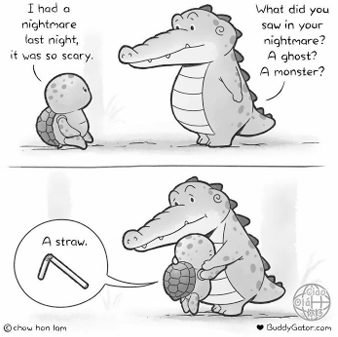
(LAM, Chow Hon. BuddyGator.com. Disponível em: https:// www.boredpanda.com/environmental-comics-inspirin g-to-take-action-rewriting-extinction. Acesso em: 25 oct. 2024)
Qual das alternativas traz a melhor forma em que o discurso indireto é usado para relatar, algum tempo depois, o que a tartaruga disse para o jacaré?
Questão 4 14745313
UFMS PASSE - 3 Etapa 2022-2024Read the text to answer the question.
Nanotechnology refers to the branch of science and engineering devoted to designing, producing, and using structures, devices, and systems by manipulating atoms and molecules at nanoscale, i.e. having one or more dimensions of the order of 100 nanometres (100 millionth of a millimetre) or less.
In the natural world, there are many examples of structures with one or more nanometre dimensions, and many technologies have incidentally involved such nanostructures for many years, but only recently it has been possible to do it intentionally.
Many of the applications of nanotechnology involve new materials that have very different properties and new effects compared to the same materials made at larger sizes. This is due to the very high surface to volume ratio of nanoparticles compared to larger particles, and to effects that appear at that small scale but are not observed at larger scales.
The applications of nanotechnology can be very beneficial and have the potential to make a significant impact on society. Nanotechnology has been embraced by industrial sectors, such as the information and communications sectors, but it is also used in food technology, energy technology, as well as in some medical products and medicines. Nanomaterials may also offer new opportunities for the reduction of environmental pollution.
But, these new materials should also present new health risks. Humans have developed mechanisms of protection against various environmental agents of different sizes. However, until recently, they had never been exposed to synthetic nanoparticles and their specific characteristics. Therefore, the normal human defense mechanisms associated with, for example, immune and inflammatory systems may well not be able to respond adequately to these nanoparticles. In addition, nanoparticles may also disperse and persist in the environment, and therefore have an impact on the environment.
(Scientific Committee on Emerging and Newly Identified Health Risks - SCENIHR. Public Health. Disponível em:https:// ec.europa.eu/health/scientific_committees/opinions_ layman/en/nanotechnologies/l-2/1-introduction.htm Acesso em: 1 nov. 2024. Adaptado)
A frase: “The author said: these new materials should also present new health risks” apresenta discurso direto. Assinale a alternativa que traz essa frase em Discurso Indireto.
Questão 2 14745310
UFMS PASSE - 3 Etapa 2022-2024Read the text to answer the question.
Nanotechnology refers to the branch of science and engineering devoted to designing, producing, and using structures, devices, and systems by manipulating atoms and molecules at nanoscale, i.e. having one or more dimensions of the order of 100 nanometres (100 millionth of a millimetre) or less.
In the natural world, there are many examples of structures with one or more nanometre dimensions, and many technologies have incidentally involved such nanostructures for many years, but only recently it has been possible to do it intentionally.
Many of the applications of nanotechnology involve new materials that have very different properties and new effects compared to the same materials made at larger sizes. This is due to the very high surface to volume ratio of nanoparticles compared to larger particles, and to effects that appear at that small scale but are not observed at larger scales.
The applications of nanotechnology can be very beneficial and have the potential to make a significant impact on society. Nanotechnology has been embraced by industrial sectors, such as the information and communications sectors, but it is also used in food technology, energy technology, as well as in some medical products and medicines. Nanomaterials may also offer new opportunities for the reduction of environmental pollution.
But, these new materials should also present new health risks. Humans have developed mechanisms of protection against various environmental agents of different sizes. However, until recently, they had never been exposed to synthetic nanoparticles and their specific characteristics. Therefore, the normal human defense mechanisms associated with, for example, immune and inflammatory systems may well not be able to respond adequately to these nanoparticles. In addition, nanoparticles may also disperse and persist in the environment, and therefore have an impact on the environment.
(Scientific Committee on Emerging and Newly Identified Health Risks - SCENIHR. Public Health. Disponível em:https:// ec.europa.eu/health/scientific_committees/opinions_ layman/en/nanotechnologies/l-2/1-introduction.htm Acesso em: 1 nov. 2024. Adaptado)
Select the correct alternative that best translates the sentence: “The applications of nanotechnology can be very beneficial and have the potential to make a significant impact on society.”
Questão 12 14723240
PUC-SP Verão A 2022Leia o texto com atenção e escolha a alternativa correta.
Budget 2021: Price rises could hit highest rate in 30 years, says forecaster
In https://www.bbc.com/news/business-59062392, Acesso em: 20 out. 2021.
The cost of living could rise at its fastest rate for 30 years, the government's forecaster has warned.
1- Its latest forecast says inflation, which measures the change in the cost of living over time, is set to jump from 3.1% to an average of 4% in 2022.
However, the Office for Budget Responsibility (OBR) says figures released since its report was compiled suggest inflation could hit almost 5%.
2- The chancellor acknowledged that household budgets are strained.
Rishi Sunak described the overall economic picture as "strong" in the short term, with the OBR now expecting the economy to return to its pre-pandemic level six months earlier than it had forecast previously.
However, he acknowledged the inflation rate was "likely to rise further" from its 3.1% rate in September.
He said it was due to increased demand for energy and supply chain issues as economies and factories reopening following coronavirus lockdowns.
"The pressures caused by supply chains and energy prices will take months to ease," Mr Sunak said.
"It would be irresponsible for anyone to pretend that we can solve this overnight."
3- The UK's exit from the European Union (EU) has exacerbated supply chain problems such as hold ups at ports or with deliveries, the OBR said in its latest report.
4- The OBR also said the fact that the energy price cap has risen was a big factor behind the rising cost of living. The cap sets the maximum price suppliers in England, Wales and Scotland can charge domestic customers on a standard - or default - tariff.
5- The independent forecaster suggested that had its figures been more up-to-date, its inflation forecasts would have painted a bleaker picture for consumers and businesses.
It previously said it had ended any updates to its forecast on 24 September, earlier than usual, and "in response to a request from the chancellor".
6- Richard Hughes, chairman of the OBR, told BBC News that if inflation started feeding into wages, rather than just products in the shops, the problem could persist for longer.
7- Covid recovery
But the OBR lifted its prediction for economic growth in 2021 to 6.5%, up from its previous forecast of 4%. It has also reduced its estimate of the long-term "scarring" effect of Covid-19 on the economy from 3% to 2%.
The effectiveness of Covid vaccines and the adaptability of consumers and businesses had sped up the recovery, the OBR said.
8- But it forecast that economic growth would be lower next year than it previously thought, partly down to a better performance in 2021.
9- In 2022, gross domestic product (GDP), which measures all the activity of companies, governments and people in an economy, will increase by 6%, the OBR said, rather than the 7.3% it predicted in March.
10- Growth is forecast to be 2.1% in 2023, 1.3% in 2024 and 1.6% in 2025.
No parágrafo 2, a sentença The chancellor acknowledged that household budgets are strained, significa que:
Questão 11 14723222
PUC-SP Verão A 2022Leia o texto com atenção e escolha a alternativa correta.
Budget 2021: Price rises could hit highest rate in 30 years, says forecaster
In https://www.bbc.com/news/business-59062392, Acesso em: 20 out. 2021.
The cost of living could rise at its fastest rate for 30 years, the government's forecaster has warned.
1- Its latest forecast says inflation, which measures the change in the cost of living over time, is set to jump from 3.1% to an average of 4% in 2022.
However, the Office for Budget Responsibility (OBR) says figures released since its report was compiled suggest inflation could hit almost 5%.
2- The chancellor acknowledged that household budgets are strained.
Rishi Sunak described the overall economic picture as "strong" in the short term, with the OBR now expecting the economy to return to its pre-pandemic level six months earlier than it had forecast previously.
However, he acknowledged the inflation rate was "likely to rise further" from its 3.1% rate in September.
He said it was due to increased demand for energy and supply chain issues as economies and factories reopening following coronavirus lockdowns.
"The pressures caused by supply chains and energy prices will take months to ease," Mr Sunak said.
"It would be irresponsible for anyone to pretend that we can solve this overnight."
3- The UK's exit from the European Union (EU) has exacerbated supply chain problems such as hold ups at ports or with deliveries, the OBR said in its latest report.
4- The OBR also said the fact that the energy price cap has risen was a big factor behind the rising cost of living. The cap sets the maximum price suppliers in England, Wales and Scotland can charge domestic customers on a standard - or default - tariff.
5- The independent forecaster suggested that had its figures been more up-to-date, its inflation forecasts would have painted a bleaker picture for consumers and businesses.
It previously said it had ended any updates to its forecast on 24 September, earlier than usual, and "in response to a request from the chancellor".
6- Richard Hughes, chairman of the OBR, told BBC News that if inflation started feeding into wages, rather than just products in the shops, the problem could persist for longer.
7- Covid recovery
But the OBR lifted its prediction for economic growth in 2021 to 6.5%, up from its previous forecast of 4%. It has also reduced its estimate of the long-term "scarring" effect of Covid-19 on the economy from 3% to 2%.
The effectiveness of Covid vaccines and the adaptability of consumers and businesses had sped up the recovery, the OBR said.
8- But it forecast that economic growth would be lower next year than it previously thought, partly down to a better performance in 2021.
9- In 2022, gross domestic product (GDP), which measures all the activity of companies, governments and people in an economy, will increase by 6%, the OBR said, rather than the 7.3% it predicted in March.
10- Growth is forecast to be 2.1% in 2023, 1.3% in 2024 and 1.6% in 2025.
De acordo com o texto, em 2022, o produto interno bruto (PIB) será:
Questão 18 14700928
UNESP 2 Fase - Conhecimentos Específicos 2022Leia o texto para responder à questão.
An invigorating reading
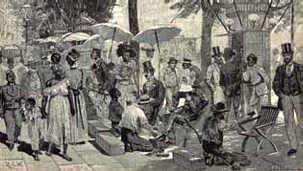
His grandparents were slaves. His father painted houses. His immigrant mother washed laundry. For a poor, mixed-race boy born in Brazil in 1839, their son had done well to become an apprentice typesetter in Rio de Janeiro. But a priest taught him Latin, and a literary agent spotted the gifted lad at the Imprensa Nacional, the government press, and soon he was contributing to newspapers, writing plays and poems and starting a literary circle.
But it was as a novelist that Joaquim Maria Machado de Assis would truly shine. Machado worked as a civil servant and co-founded the Brazilian Academy of Letters; he married happily (although his Portuguese in-laws initially objected to the colour of his skin). Beneath all this outward respectability, his prose was radically ingenious. Ever since “The Posthumous Memoirs of Brás Cubas”, Machado’s fifth novel, appeared in 1881 it has astonished readers with its lordly ironies and scorn for convention. The book’s invigorating style, as much as its backdrop of racial and social injustice, makes it ideal reading for this morbid, insurgent summer.
Brás Cubas, the fictional memoirist, has just died from pneumonia. As a thwarted corpse who failed in almost everything he tried, he wants to set the record straight about his drifting life as an idle, pleasure-seeking dandy in Rio. Beneath his jaunty veneer, Cubas harbours a melancholy pessimism. He sees a freedman lash a slave he has bought — to relieve his own sufferings “by passing them on to someone else”. Yet the novel floats free of the ambient oppression on currents of mischief and urbanity.
Sprinkled with epigrams, dreams, gags and asides, the story teases, dances and delights. Across 160 short chapters (“Long chapters suit long-winded readers”), Machado mocks every rule of the 19th-century novel. A chapter of dialogue is written entirely in punctuation (“!…?…!”). In another, the narrator acknowledges (in a new translation by Margaret Jull Costa and Robin Patterson), “I have just written an utterly pointless chapter”. Dave Eggers, an American author, recently called this “one of the wittiest, most playful, and therefore most alive and ageless books ever written”.
(www.economist.com, 15.08.2020. Adaptado.)
No trecho do quarto parágrafo “In another, the narrator acknowledges”, o termo sublinhado refere-se a
06