


![[Marketing] Questao Topo - deslogado](https://storage.estuda.com.br/banners/0_6b7ebee90b03af1c560c73bb8bcce34a_banner_deslogado_70_dias.png)
Questões de Inglês
19.971 Questões
Questão 1 9141133
FCMSCSP - Santa Casa Medicina 2023Examine a tirinha publicada na conta do Instagram “War and Peas”, em 16.12.2021

A tirinha permite caracterizar a personagem Morte como
Questão 18 9125165
FACISB 2023Read the advertisement.

(www.aaronbraver.com. Adapted.)
The advertisement
Questão 17 9124440
FACISB 2023Read the graph on the attitudes of the British people towards accent varieties in three different points in time.
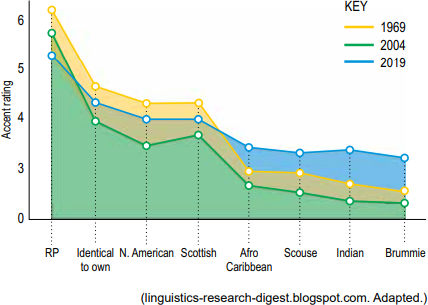
The graph confirms the following information from the text:
Questão 16 9124437
FACISB 2023Read the text to answer question.
“It is impossible for an Englishman to open his mouth
without making some other Englishman despise him,”
playwright George Bernard Shaw wrote in the preface to
Pygmalion in 1913. Recent headlines suggest that accent
prejudice (or “accentism”) is no relic of the past but continues
to blight the university experience of many students.
There is a hierarchy of accents in Britain which has
changed little over the years. The accents of Britain’s highest
classes are seen as neutral, “accentless” and correct,
while others are seen as inferior and are often stigmatised.
As such, those who have “non-standard” accents are
seen as legitimate and admissible targets for comment
and judgement. They are also loaded with an apparent
responsibility to change how they sound.
The higher-class standard accent — “Received
Pronunciation” (RP) — is consistently rated the highest
on scales such as prestige and perceived intelligence.
Such judgments continually reproduce and reaffirm social
inequalities.
The association between the ability to speak in a
certain way and being intelligent is especially relevant in the
university context, where this particular trait is most valued.
Being able to sound intelligent in a classroom translates
directly into gaining recognition and respect amongst peers
and teachers. The repercussions of accentism in the job
market are a further consequence for students.
University is a place and a time where people come
together from all over the country and all over the world. This
can have very interesting effects on students’ accents as
they might naturally start to change the way that they speak
due to their new surroundings. This is a completely normal
process known as accommodation. It is not the same thing
as the enforced undermining of credibility and intelligence
through the stereotyping of someone’s regional accent.
There are many interesting things to learn about how
someone from another part of the country has a different
way of pronouncing a word or uses a different word for
the same thing. For instance, have you ever seen how
many different words there are for a bread roll? We need
to counteract our biases by understanding and celebrating
such diversity, instead of ridiculing those who don’t conform
to an ideological standard rooted in discrimination from
the start.
(Monika Schmid, Amanda Cole and Ella Jeffries.
www.theconversation.com, 26.10.2020. Adapted.)
In the fragment from the last paragraph “instead of ridiculing those who don’t conform”, the underlined expression
Questão 18 9124424
Unichristus 2023Answer the following questions according to text.
Centuries ago, when a man was accused of a crime, he often had to go through a strange test. In one country, the local prince used a pot of hot boiling oil. A metal bar was dropped into the pot. The prisoner then had to put his hand into the oil and take out the metal bar. The prince believed that the hot oil would not burn the hand of an innocent man. He was also convinced that a guilty man would be burnt by the hot oil.
There is no record that any prince anywhere in the world ever plucked up the courage to try the justice of this harsh test on himself.
A. Etherton Mc Graw Hill. Objective English Tests, New York, 2006.
The oil boiling test could be considered as being rather:
Questão 16 9124394
Unichristus 2023Read the text below and answer the questions about it.
Many navigators of the past like Marco Polo and
Christopher Columbus have conquered great fame as a
result of their discoveries. One of these men was
Captain James Cook. In 1778 he discovered the islands of
Hawaii by accident.
Cook, a white English sailor with a log blond hair,
first saw the islands while he was trying to find a new route
for travel by water. The aborigines whom Cook found on
the islands at first believed that he was a pale-faced god.
When the Englishmen were ready to leave the islands,
Captain Cook quarreled with some natives who had stolen
a boat. As the discussion was changing into a riot, one
native stabbed the Captain, even knowing that he might
suffer severe punishment from offending na alledged god.
However, when Captain Cook fell down with a groan, the
natives shouted: “He feels pain. He is not a god.”
Hearing that and remembering the harsh words which the
Captain had yelled at them, a bunch of angry natives
jumped upon him and finished killing him.
Captain Cook later became very famous for his
discovery, but he had an unfortunate fate.
CLARK, Blake. Hawaii: Island Paradise.
According to text two, Captain Cook
06