


![[Marketing] Questao Topo - deslogado](https://storage.estuda.com.br/banners/0_6b7ebee90b03af1c560c73bb8bcce34a_banner_deslogado_70_dias.png)
Questões de Inglês
19.971 Questões
Questão 21 9752082
UFT manhã 2023/2Leia a tirinha de Garfield e Odie para responder a QUESTÃO.

Considerando a tirinha, assinale a alternativa INCORRETA.
Questão 20 9752077
UFT manhã 2023/2Leia os textos I, II e III para responder as QUESTÃO.
TEXTO I
How migration is a gender equality issue
Women migrate for diverse reasons: from leaving behind poverty, conflict and climate-related disasters to escaping deeply entrenched gender inequalities, including sexual and gender-based violence and lack of access to livelihoods and resources.
Many women migrate in pursuit of work or educational opportunities and the possibility of a better life for themselves and their families.
Comprising roughly half of the world’s 272 million migrants, migrant women are agents of change and leaders who contribute to their countries of origin, transit and destination economically and socially in multiple ways. They bring diverse talent and expertise and send financial remittances to their families and communities, allowing economies to thrive.
In what is called “social” remittances, they reshape norms, ideas and behaviours through the social and cultural capital they carry. And as doctors, nurses, scientists, researchers, entrepreneurs, essential workers and more, they are the backbone of the COVID-19 response.
Despite their valuable contributions, migrants face pervasive, intersecting forms of discrimination that impact their well-being and safety at all stages of the journey. Migration is a gendered process and impacts women and men differently: It is entrenched in a globalized sexual division of labour in which there is a demand for women migrant workers in specific service sectors, such as domestic and care work.
Gender stereotypes limit women’s autonomy and decision-making processes, increasing their vulnerability to the systematic violation of their human rights.
Yet, neither a gender-based approach not the specific experiences relating to migrant women are usually captured in migration laws and policies. Collecting and analyzing sexdisaggregated data is a critical step in developing effective gender-responsive polices, programmes and laws that address migration’s unique impacts on women and girls. Doing so is a human rights imperative: When done right, it would ensure safe migration and ultimately prevent labour and humans rights violations, save lives, promote greater gender equality and enhance the well-being of individuals, families and communities.
Disponível em:https://interactive.unwomen.org/multimedia/explainer/migration/en /index.html#:~:text=Migration%20is%20a%20gendered%20process,as%20domes tic%20and%20care%20work
TEXTO II
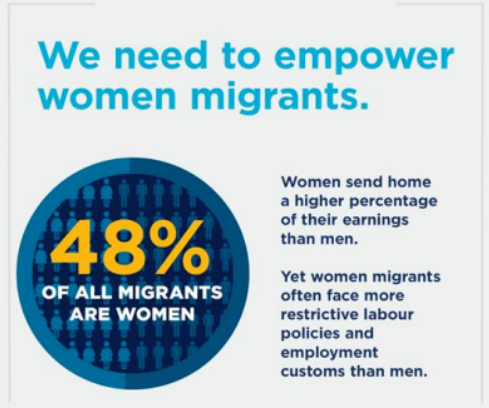
Disponível em: https://rafugeesmigrants un .org/infographics
TEXTO III
During the COVID-19 pandemic, women migrant workers around the world have been on the front lines, working in essential but low-paid and vulnerable jobs – including as health and care workers, nurses, cleaners and agricultural workers – where they face a high risk of exposure to COVID-19.
Travel restrictions and border closures have made cross-border travel more complex and difficult.
Migrant women seeking to return to their countries of origin may decide against travelling for fear of being denied reentry into the countries where they work. The health and economic fallout from the intersecting forms of discrimination, pervasive inequalities, racism and xenophobia further jeopardizing their livelihoods and well-being. Women migrant workers are reported to be losing their jobs in large numbers in some sectors. It is estimated that 75 per cent of migrant women work in the informal economy, often without a contract and with limited coverage by labour laws. Owing to the precarity of informal work, employers can more readily dismiss migrant women in response to the economic decline catalysed by the pandemic.
Disponível em: https://interactive.unwomen.org/multimedia/explainer/migration/e n/index.html
A partir da leitura dos textos, é CORRETO afirmar:
Questão 19 9751991
UFT manhã 2023/2Leia os textos I, II e III para responder as QUESTÃO.
TEXTO I
How migration is a gender equality issue
Women migrate for diverse reasons: from leaving behind poverty, conflict and climate-related disasters to escaping deeply entrenched gender inequalities, including sexual and gender-based violence and lack of access to livelihoods and resources.
Many women migrate in pursuit of work or educational opportunities and the possibility of a better life for themselves and their families.
Comprising roughly half of the world’s 272 million migrants, migrant women are agents of change and leaders who contribute to their countries of origin, transit and destination economically and socially in multiple ways. They bring diverse talent and expertise and send financial remittances to their families and communities, allowing economies to thrive.
In what is called “social” remittances, they reshape norms, ideas and behaviours through the social and cultural capital they carry. And as doctors, nurses, scientists, researchers, entrepreneurs, essential workers and more, they are the backbone of the COVID-19 response.
Despite their valuable contributions, migrants face pervasive, intersecting forms of discrimination that impact their well-being and safety at all stages of the journey. Migration is a gendered process and impacts women and men differently: It is entrenched in a globalized sexual division of labour in which there is a demand for women migrant workers in specific service sectors, such as domestic and care work.
Gender stereotypes limit women’s autonomy and decision-making processes, increasing their vulnerability to the systematic violation of their human rights.
Yet, neither a gender-based approach not the specific experiences relating to migrant women are usually captured in migration laws and policies. Collecting and analyzing sexdisaggregated data is a critical step in developing effective gender-responsive polices, programmes and laws that address migration’s unique impacts on women and girls. Doing so is a human rights imperative: When done right, it would ensure safe migration and ultimately prevent labour and humans rights violations, save lives, promote greater gender equality and enhance the well-being of individuals, families and communities.
Disponível em:https://interactive.unwomen.org/multimedia/explainer/migration/en /index.html#:~:text=Migration%20is%20a%20gendered%20process,as%20domes tic%20and%20care%20work
TEXTO II
Disponível em: https://rafugeesmigrants un .org/infographics
TEXTO III
During the COVID-19 pandemic, women migrant workers around the world have been on the front lines, working in essential but low-paid and vulnerable jobs – including as health and care workers, nurses, cleaners and agricultural workers – where they face a high risk of exposure to COVID-19.
Travel restrictions and border closures have made cross-border travel more complex and difficult.
Migrant women seeking to return to their countries of origin may decide against travelling for fear of being denied reentry into the countries where they work. The health and economic fallout from the intersecting forms of discrimination, pervasive inequalities, racism and xenophobia further jeopardizing their livelihoods and well-being. Women migrant workers are reported to be losing their jobs in large numbers in some sectors. It is estimated that 75 per cent of migrant women work in the informal economy, often without a contract and with limited coverage by labour laws. Owing to the precarity of informal work, employers can more readily dismiss migrant women in response to the economic decline catalysed by the pandemic.
Disponível em: https://interactive.unwomen.org/multimedia/explainer/migration/e n/index.html
Os textos apresentados referem-se a pesquisas desenvolvidas pela ONU Mulheres, uma entidade das Nações Unidas que visa promover o empoderamento da mulher e igualdade de gênero.
Considere as proposições a seguir:
I. Durante a pandemia de COVID-19 houve um aumento significativo em 75% de migração de mulheres.
II. Durante a pandemia de COVID-19 houve um aumento significativo na contratação de mulheres migrantes para a realização de serviços essenciais.
III. Durante a pandemia de COVID-19 houve um aumento significativo em 48% de empoderamento das mulheres migrantes.
IV. Durante a pandemia de COVID-19 houve um aumento significativo na autonomia de decisão das mulheres migrantes.
Com base na análise, julgue as alternativas:
Questão 18 9751987
UFT manhã 2023/2Leia o quadrinho a seguir para responder a QUESTÃO.

Disponivel em: https:/www.gocomics.com/lacucaracha/2023/02/05 (Adaptado)
Em “Chill out, Eddie”, todas as alternativas podem substituir a expressão sublinhada sem prejuízo de sentido, EXCETO:
Questão 17 9751963
UFT manhã 2023/2Leia o quadrinho a seguir para responder a QUESTÃO.
Disponivel em: https:/www.gocomics.com/lacucaracha/2023/02/05 (Adaptado)
Analise as afirmativas a seguir.
I. Na proposta da nova cédula, o governo americano decidiu também homenagear outras figuras ligadas ao contexto histórico americano.
II. Eddie está preocupado porque acha que Cuco está falsificando dinheiro.
III. Cuco foi contratado pelo governo americano para desenhar a nova cédula americana.
IV. Na proposta da nova cédula, Cuco faz uma crítica em relação às figuras homenageadas na cédula atual.
De acordo com as afirmativas, assinale a alternativa CORRETA.
Questão 48 9713913
UFU 1º fase 2023/2For the past two years, Paul Edmonds has been part of an extremely exclusive club with a membership that has reached five people. After navigating HIV for more than 30 years, along with a leukemia diagnosis that came in 2018, a life-saving stem cell transplant became available thanks to a donor who had a rare genetic mutation that makes the body resistant to most strains of HIV. In 2021, Edmonds stopped taking his HIV medication, which he had been dependent on for almost half his life. Today, the 67-year-old who lives in Desert Hot Springs, California, is the fifth person in the world in remission of HIV. Edmonds joins four others who have received similar news, including the late Palm Springs resident Timothy Ray Brown (who was known as the "Berlin Patient"), the first person cured of the virus, who died from a reoccurrence of cancer in 2020. Others include "London Patient" Adam Castillejo, "Düsseldorf Patient" Marc Franke, and the "New York Patient," the first woman to be considered cured who has not come forth publicly. Edmonds is the eldest and had HIV the longest. After two years of being anonymously known as the "City of Hope Patient," Edmonds decided to publicly come forward with his story. By sharing his journey, he wants to advocate for and offer hope to those living and aging with HIV that a cure could be possible one day.
Disponível em: https://www.usatoday.com. Acesso em: 30 abr. 2023.
Considering this text about HIV infection, it is INCORRECT to state tha
06