


![[Marketing] Questao Topo - deslogado](https://storage.estuda.com.br/banners/0_6b7ebee90b03af1c560c73bb8bcce34a_banner_deslogado_70_dias.png)
Questões de Inglês
19.971 Questões
Questão 1 12438019
UFMS PSV 2024Leia a definição de nomofobia e assinale a alternativa que traduza corretamente esses dois últimos exemplos.
“Nomophobia is a rising trend among high school and college students.
Nomophobia may be linked to social anxiety disorder”.
Questão 25 12401570
UNIVESP 2024Leia o texto para responder à questão.
JANUARY 24, 2024
How Long Does It Really Take to Form a Habit?
There’s a myth that it takes 21 days to form a habit. Experts explain why it might take some people longer–or shorter
BY JOCELYN SOLIS-MOREIRA
Waking up at the crack of dawn and going for a run might feel intimidating when you start trying to make it a habit.
Weaving a signifi cant new activity such as this into your regular routine obviously takes determination and time–but
how much time is really needed to make that habit stick?
One popular idea suggests that it takes 21 days to solidify a habit. A three-week time frame might sound easily
reachable to someone making a resolution on New Year’s Day, when people tend to feel extra motivated to start a
new habit or kick an old one, says Colin Camerer, a behavioral economist at the California Institute of Technology
who has conducted research on habit formation. Yet every January 21 very few people can boast that they have
kept their resolutions. One survey showed that only 9 percent of people actually stuck to their goals in 2023.
Everyone has a unique habit-building timeline–and no matter how long it is for any individual, repetition is the key
to making it work, explains Phillippa Lally, a senior lecturer in psychology and the co-director of the Habit Application
and Theory group at the University of Surrey in England. Both Lally and Camerer suggest various individualized ways
to reinforce healthy behaviors and to eventually turn a wholesome task into an unconscious habit.
https://tinyurl.com/e8rjumxe Acesso em: 24.01.2024. Adaptado.
De acordo com o texto, para uma ação se tornar um hábito inconsciente deve-se
Questão 23 12401468
UNIVESP 2024Leia o texto para responder à questão.
JANUARY 24, 2024
How Long Does It Really Take to Form a Habit?
There’s a myth that it takes 21 days to form a habit. Experts explain why it might take some people longer–or shorter
BY JOCELYN SOLIS-MOREIRA
Waking up at the crack of dawn and going for a run might feel intimidating when you start trying to make it a habit.
Weaving a signifi cant new activity such as this into your regular routine obviously takes determination and time–but
how much time is really needed to make that habit stick?
One popular idea suggests that it takes 21 days to solidify a habit. A three-week time frame might sound easily
reachable to someone making a resolution on New Year’s Day, when people tend to feel extra motivated to start a
new habit or kick an old one, says Colin Camerer, a behavioral economist at the California Institute of Technology
who has conducted research on habit formation. Yet every January 21 very few people can boast that they have
kept their resolutions. One survey showed that only 9 percent of people actually stuck to their goals in 2023.
Everyone has a unique habit-building timeline–and no matter how long it is for any individual, repetition is the key
to making it work, explains Phillippa Lally, a senior lecturer in psychology and the co-director of the Habit Application
and Theory group at the University of Surrey in England. Both Lally and Camerer suggest various individualized ways
to reinforce healthy behaviors and to eventually turn a wholesome task into an unconscious habit.
https://tinyurl.com/e8rjumxe Acesso em: 24.01.2024. Adaptado.
O sufixo -able, na palavra reachable, destacada no segundo parágrafo, indica
Questão 30 12297790
UNESP 2024/2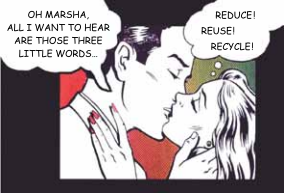
(https://talkintrashwithuhn.com. Adaptado.)
The humour in the cartoon derives from the fact that
Questão 29 12296870
UNESP 2024/2Leia a matéria para responder à questão.
Plastic Waste In The Oceans
In the last few years there has been more and more evidence that plastic pollution in our oceans is becoming a massive problem. Large pieces of plastic which end up in the sea can entangle marine animals or can also suffocate them.
Tiny pieces of plastic — broken down by the action of water and the sun — cause harm by entering the marine food chain. If the animals eat plastic it will make them feel artificially full so that they do not eat and they starve to death. Furthermore, when fish have eaten plastic it becomes part of their body; if we then eat that fish our food contains plastic — we are eating our own plastic waste.
Infographic

(www.reducereuserecycle.co.uk. Adaptado.)
No trecho do segundo parágrafo, “when fish have eaten plastic it becomes part of their body; if we then eat that fish our food contains plastic — we are eating our own plastic waste”, a frase sublinhada, no contexto em que se apresenta, expressa
Questão 27 12296825
UNESP 2024/2Leia a matéria para responder à questão.
Plastic Waste In The Oceans
In the last few years there has been more and more evidence that plastic pollution in our oceans is becoming a massive problem. Large pieces of plastic which end up in the sea can entangle marine animals or can also suffocate them.
Tiny pieces of plastic — broken down by the action of water and the sun — cause harm by entering the marine food chain. If the animals eat plastic it will make them feel artificially full so that they do not eat and they starve to death. Furthermore, when fish have eaten plastic it becomes part of their body; if we then eat that fish our food contains plastic — we are eating our own plastic waste.
Infographic
(www.reducereuserecycle.co.uk. Adaptado.)
O trecho dos dois parágrafos iniciais da matéria que está representado no infográfico é:
06