


![[Marketing] Questao Topo - deslogado](https://storage.estuda.com.br/banners/0_6b7ebee90b03af1c560c73bb8bcce34a_banner_deslogado_70_dias.png)
Questões de Inglês
19.971 Questões
Questão 22 12370482
UECE 2ª Fase 1º Dia 2023/1A Neurologist’s Tips to Protect Your Memory
As we age, our memory declines. This is an
ingrained assumption for many of us; however,
according to neuroscientist Dr. Richard Restak, a
neurologist and clinical professor at George
[5] Washington Hospital University School of Medicine
and Health, decline is not inevitable.
The author of more than 20 books on the mind,
Restak has decades’ worth of experience in guiding
patients with memory problems. “The Complete
[10] Guide to Memory: The Science of Strengthening Your
Mind,” Restak’s latest book, includes tools such as
mental exercises, sleep habits and diet that can help
boost memory.
Yet, Restak ventures beyond this familiar
[15] territory, considering every facet of memory — how
memory is connected to creative thinking,
technology’s impact on memory, how memory
shapes identity. “The point of the book is to
overcome the everyday problems of memory,”
[20] Restak said. Especially working memory, which falls
between immediate recall and long-term memory,
and is tied to intelligence, concentration and
achievement. According to Restak, this is the most
critical type of memory, and exercises to strengthen
[25] it should be practiced daily. But bolstering all
memory skills, he added, is key to warding off later
memory issues. Memory decline is not inevitable
with aging, Restak argues in the book.
Ultimately, “we are what we can remember,”
[30] he said. Here are some of Restak’s tips for developing
and maintaining a healthy memory.
Pay more attention.
Some memory lapses are actually attention
problems, not memory problems. For instance, if
[35] you’ve forgotten the name of someone you met at a
cocktail party, it could be because you were talking
with several people at the time and you didn’t
properly pay attention when you heard it.
“Inattention is the biggest cause for memory
[40] difficulties,” Dr. Restak said. “It means you didn’t
properly encode the memory.” One way to pay
attention when you learn new information, like a
name, is to visualize the word. Having a picture
associated with the word, Restak said, can improve
[45] recall. For instance, he recently had to memorize the
name of a doctor, Dr. King, (an easy example, he
acknowledged). So, he pictured a male doctor “in a
white coat with a crown on his head and a scepter
instead of a stethoscope in his hand.”
[50] Find regular everyday memory challenges.
There are many memory exercises that you can
integrate into everyday life. Dr. Restak suggested
composing a grocery list and memorizing it. When
you get to the store, don’t automatically pull out
[55] your list (or your phone) — instead, pick up
everything according to your memory. “Try to see the
items in your mind,” he said, and only consult the list
at the end, if necessary. If you’re not going to the
store, try memorizing a recipe. He added that
[60] frequent cooking is actually a great way to improve
working memory.
Once in a while, get in the car without turning
on your GPS, and try to navigate through the streets
from memory. A small 2020 study suggested that
[65] people who used a GPS more frequently over time
showed a steeper cognitive decline in spatial memory
three years later.
Play games.
Games like bridge and chess are great for
[70] memory, but so is a simpler game, said Dr. Restak.
For instance, Dr. Restak’s “favorite working memory
game” is Twenty Questions — in which a group (or a
single person) thinks of a person, place or object, and
the other person, the questioner, asks 20 questions
[75] with a yes or no answer. Because to succeed, he said,
the questioner must hold all of the previous answers
in memory in order to guess the correct answer.
Another of Restak’s tried-and-true memory
exercises simply requires a pen and paper or audio
[80] recorder. First, recall all of the US presidents, starting
with Biden and going back to, say, Franklin Roosevelt,
writing or recording them. Then, do the same, from
F.D.R. to Biden. Next, name only the Democratic
presidents, and only the Republican ones. Last, name
[85] them in alphabetical order. If you prefer, try it with
players on your favorite sports team or your favorite
authors. The point is to engage your working
memory, “maintaining information and moving it
around in your mind,” Restak wrote.
[90] Read more novels.
One early indicator of memory issues,
according to Dr. Restak, is giving up on fiction.
“People, when they begin to have memory
difficulties, tend to switch to reading nonfiction,” he
[95] said.
Over his decades of treating patients, Dr.
Restak has noticed that fiction requires active
engagement with the text, starting at the beginning
and working through to the end. “You have to
[100] remember what the character did on page 3, by the
time you get to page 11,” he said.
Beware of technology.
Among Dr. Restak’s new sins of memory, two
are associated with technology.
[105] First is what he calls “technological distortion.”
Storing everything on your phone means that “you
don’t know it,” Dr. Restak said, which can erode our
own mental abilities. “Why bother to focus,
concentrate and apply effort to visualize something
[110] when a cellphone camera can do all the work for
you?” he wrote.
The second way our relationship with
technology is detrimental for memory is because it
often takes our focus away from the task at hand. “In
[115] our day, the greatest impediment of memory is
distraction,” Dr. Restak wrote. Many of these tools
have been designed with the aim of addicting the
person using them. As a result, we are often
distracted by them. People today can check their
[120] email while streaming Netflix, talking with a friend or
walking down the street. All of this impedes our
ability to focus on the present moment, which is
critical for encoding memories.
Determine whether there is cause for concern.
[125] Throughout his career, Dr. Restak has been
asked by dozens of patients how they can improve
their memory. But not all memory lapses are
problematic. For instance — not remembering where
you parked your car in a crowded lot is pretty
[130] normal. Forgetting how you arrived at the parking lot
in the first place, however, indicates potential
memory issues.
There is no simple solution to knowing what
should be of concern, Dr. Restak said — much of it is
[135] context-dependent. For instance, it’s normal to
forget the room number of your hotel, but not the
address of your apartment. If you’re concerned, it’s
best to consult with a medical expert.
Adapted from: https://www.nytimes.com/2022/07/06/
In relation to the improvement of working memory, Dr. Restak suggests a number of challenging exercises and activities that can generate great benefits.
Among these, he includes the frequent practice of
Questão 21 12370362
UECE 2ª Fase 1º Dia 2023/1A Neurologist’s Tips to Protect Your Memory
As we age, our memory declines. This is an
ingrained assumption for many of us; however,
according to neuroscientist Dr. Richard Restak, a
neurologist and clinical professor at George
[5] Washington Hospital University School of Medicine
and Health, decline is not inevitable.
The author of more than 20 books on the mind,
Restak has decades’ worth of experience in guiding
patients with memory problems. “The Complete
[10] Guide to Memory: The Science of Strengthening Your
Mind,” Restak’s latest book, includes tools such as
mental exercises, sleep habits and diet that can help
boost memory.
Yet, Restak ventures beyond this familiar
[15] territory, considering every facet of memory — how
memory is connected to creative thinking,
technology’s impact on memory, how memory
shapes identity. “The point of the book is to
overcome the everyday problems of memory,”
[20] Restak said. Especially working memory, which falls
between immediate recall and long-term memory,
and is tied to intelligence, concentration and
achievement. According to Restak, this is the most
critical type of memory, and exercises to strengthen
[25] it should be practiced daily. But bolstering all
memory skills, he added, is key to warding off later
memory issues. Memory decline is not inevitable
with aging, Restak argues in the book.
Ultimately, “we are what we can remember,”
[30] he said. Here are some of Restak’s tips for developing
and maintaining a healthy memory.
Pay more attention.
Some memory lapses are actually attention
problems, not memory problems. For instance, if
[35] you’ve forgotten the name of someone you met at a
cocktail party, it could be because you were talking
with several people at the time and you didn’t
properly pay attention when you heard it.
“Inattention is the biggest cause for memory
[40] difficulties,” Dr. Restak said. “It means you didn’t
properly encode the memory.” One way to pay
attention when you learn new information, like a
name, is to visualize the word. Having a picture
associated with the word, Restak said, can improve
[45] recall. For instance, he recently had to memorize the
name of a doctor, Dr. King, (an easy example, he
acknowledged). So, he pictured a male doctor “in a
white coat with a crown on his head and a scepter
instead of a stethoscope in his hand.”
[50] Find regular everyday memory challenges.
There are many memory exercises that you can
integrate into everyday life. Dr. Restak suggested
composing a grocery list and memorizing it. When
you get to the store, don’t automatically pull out
[55] your list (or your phone) — instead, pick up
everything according to your memory. “Try to see the
items in your mind,” he said, and only consult the list
at the end, if necessary. If you’re not going to the
store, try memorizing a recipe. He added that
[60] frequent cooking is actually a great way to improve
working memory.
Once in a while, get in the car without turning
on your GPS, and try to navigate through the streets
from memory. A small 2020 study suggested that
[65] people who used a GPS more frequently over time
showed a steeper cognitive decline in spatial memory
three years later.
Play games.
Games like bridge and chess are great for
[70] memory, but so is a simpler game, said Dr. Restak.
For instance, Dr. Restak’s “favorite working memory
game” is Twenty Questions — in which a group (or a
single person) thinks of a person, place or object, and
the other person, the questioner, asks 20 questions
[75] with a yes or no answer. Because to succeed, he said,
the questioner must hold all of the previous answers
in memory in order to guess the correct answer.
Another of Restak’s tried-and-true memory
exercises simply requires a pen and paper or audio
[80] recorder. First, recall all of the US presidents, starting
with Biden and going back to, say, Franklin Roosevelt,
writing or recording them. Then, do the same, from
F.D.R. to Biden. Next, name only the Democratic
presidents, and only the Republican ones. Last, name
[85] them in alphabetical order. If you prefer, try it with
players on your favorite sports team or your favorite
authors. The point is to engage your working
memory, “maintaining information and moving it
around in your mind,” Restak wrote.
[90] Read more novels.
One early indicator of memory issues,
according to Dr. Restak, is giving up on fiction.
“People, when they begin to have memory
difficulties, tend to switch to reading nonfiction,” he
[95] said.
Over his decades of treating patients, Dr.
Restak has noticed that fiction requires active
engagement with the text, starting at the beginning
and working through to the end. “You have to
[100] remember what the character did on page 3, by the
time you get to page 11,” he said.
Beware of technology.
Among Dr. Restak’s new sins of memory, two
are associated with technology.
[105] First is what he calls “technological distortion.”
Storing everything on your phone means that “you
don’t know it,” Dr. Restak said, which can erode our
own mental abilities. “Why bother to focus,
concentrate and apply effort to visualize something
[110] when a cellphone camera can do all the work for
you?” he wrote.
The second way our relationship with
technology is detrimental for memory is because it
often takes our focus away from the task at hand. “In
[115] our day, the greatest impediment of memory is
distraction,” Dr. Restak wrote. Many of these tools
have been designed with the aim of addicting the
person using them. As a result, we are often
distracted by them. People today can check their
[120] email while streaming Netflix, talking with a friend or
walking down the street. All of this impedes our
ability to focus on the present moment, which is
critical for encoding memories.
Determine whether there is cause for concern.
[125] Throughout his career, Dr. Restak has been
asked by dozens of patients how they can improve
their memory. But not all memory lapses are
problematic. For instance — not remembering where
you parked your car in a crowded lot is pretty
[130] normal. Forgetting how you arrived at the parking lot
in the first place, however, indicates potential
memory issues.
There is no simple solution to knowing what
should be of concern, Dr. Restak said — much of it is
[135] context-dependent. For instance, it’s normal to
forget the room number of your hotel, but not the
address of your apartment. If you’re concerned, it’s
best to consult with a medical expert.
Adapted from: https://www.nytimes.com/2022/07/06/
According to Dr. Restak, a good strategy to learn new things, like words, for example, is to establish an association with a/an
Questão 31 12290909
PUC-GO Medicina 2023/2Read the text about the importance of learning a second language:
Besides having more chances of landing a good job or advancing in your career, learning a second language can also give you an insight into other cultures. You will be more prepared and confident to travel the world and explore other people’s ways of living.
Lack of integration is a real problem for most countries. More often than not, this is due to the language barrier. People outside of their home countries end up being isolated, hanging out only with people from similar communities where their language is spoken.
Learning a second language opens up the opportunity for being part of a community with a different culture, and learning more about the world around us.
(Available in: https://www.middlebury.edu/languageschools/blog/why-you-should-learn-second-language-and-gainnew-skills#:~:text=The%20more%20you%20use%20your,use%20 them%20in%20contextual%20situations. Accessed in: March 9th, 2023.)
According to this text, analyse the following sentences:
I - One of the reasons why people outside of their home countries tend to socialize more with people from similar communities is the language barrier.
II - Learning a different language allows people to have more chances of entering the job market and advance in their careers.
III - Most countries are absent of problems like lack of integration because of isolation.
IV - Being a part of a multicultural community is one of the perks of learning another language.
V - Learning a second language prepares you to travel the world and live other people’s lives with more confidence.
Select the alternative with all the correct statements:
Questão 20 12262702
UNIEVA Medicina 2023/2Leia o texto a seguir e responda à questão.
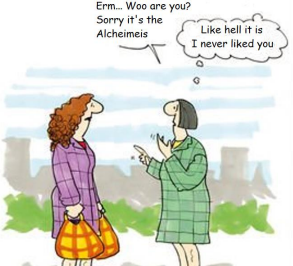
Disponível em: https://www.express.co.uk/life-style/health/1531049/dementiacare-humour-cartoons-evg. Acesso e
In the comic strip, the lady uses the word sorry, in the first speech bubble, to talk about her disease. But in her mind, she confesses that she never really liked her “friend”. Given this context, choose the best answer.
Questão 15 12262616
UNIEVA Medicina 2023/2Leia o texto a seguir e responda à questão.
Regular internet use may be linked to lower dementia risk in older adults, study says
If your parents or grandparents ask you how to post on Instagram or how to send a birthday message to a Facebook friend, a new study suggests you might want to help them – not just to be nice but because getting them online may help their brain health, too.
A study published in the Journal of the American Geriatrics Society suggested that older people who regularly used the internet were less likely to develop dementia. The researchers saw this association after about eight years tracking 18,154 adults between the ages of 50 and 65 who did not have dementia when the study period began.
The adults were a part of the Health and Retirement Study, a multidisciplinary collection of data from a representative sample of people in the US. Each of the participants was asked a simple question: “Do you regularly use the Internet, for sending and receiving e-mail or for any other purpose, such as making purchases, searching for information, or making travel reservations?” People who used the internet at the start of the study had about half the risk of dementia as people who were not regular users.
The researchers also looked at how often these adults were online, from not at all to more than eight hours a day. Those who used the internet for about two hours or less a day had the lowest risk of dementia compared with those that didn’t use the internet, who had a “notably higher estimated risk.”
Scientists still don’t know what causes dementia, so the new research can’t pinpoint the exact connection between internet usage and brain health. Study co-author Dr. Virginia W. Chang has a few ideas. “Online engagement may help to develop and maintain cognitive reserve, which can in turn compensate for brain aging and reduce the risk of dementia.” Texto adaptado do CNN
Disponível em: https://edition.cnn.com/2023/05/03/health/internet-usedementia-risk-wellness/index.html. Acesso em: 03 mai. 2023.
In the last paragraph, the word “pinpoint” can be substituted, without a change in meaning by the following word:
Questão 12 12262586
UNIEVA Medicina 2023/2Leia a charge a seguir e responda à questão.

Disponível em: https://www.ocregister.com/2023/02/20/east-palestine-trainderailment-political-cartoons/. Acesso em: 07 mar. 2023.
The word need found in the cartoon strip can be substituted by one of the following options without a change in meaning and grammatical structure:
06