


![[Marketing] Questao Topo - deslogado](https://storage.estuda.com.br/banners/0_6b7ebee90b03af1c560c73bb8bcce34a_banner_deslogado_70_dias.png)
Questões de Inglês
19.971 Questões
Questão 14 14725128
UNESP 2 Fase - Conhecimentos Específicos 2023Leia o texto para responder à questão.
Black authors shake up Brazil's literary scene

Itamar Vieira Junior, an author, says a major reason Black Brazilian writers are making their mark is because of a shift in how race and racism are being discussed in the country today.
Itamar Vieira Junior, whose day job working for the Brazilian government on land reform took him deep into the impoverished countryside, knew next to nothing about the mainstream publishing industry when he put the final touches on a novel he had been writing on and off for decades. On a whim, in April 2018, he sent the manuscript for Torto Arado, which means crooked plow, to a literary contest in Portugal, wondering what the jury would make of the hardscrabble tale of two sisters in a rural district in northeastern Brazil where the legacy of slavery remains palpable.
To his astonishment, Torto Arado won the 2018 LeYa award, a major Portuguese-language literary prize focused on discovering new voices. The recognition jump-started Mr. Vieira's career, making him a leading voice among the Black authors who have jolted Brazil's literary establishment in recent years with imaginative and searing works that have found commercial success and critical acclaim.
Torto Arado was the best-selling book in Brazil in 2021, with more than 300,000 copies sold to date. The previous year, that distinction went to Djamila Ribeiro's A Little Anti-Racist Handbook (Pequeno Manual Antirracista), a succinct and plainly written dissection of systemic racism in Brazil.
Mr. Vieira, a geographer, and Ms. Ribeiro, who studied philosophy, are part of a generation of Black Brazilians who became the first in their families to get a college degree, taking advantage of Federal Government programs. Mr. Vieira managed to use his day job at Brazil's land reform agency, where he has worked since 2006, to do field research. He studied the politics and power dynamics that shape the lives of rural workers, including some who toil in conditions analogous to modern-day slavery. That experience, he said, made the characters in his novel more layered and their fictional hometown, Água Negra, which means black water, feel authentic.

"I felt a calling to be generous enough to write in the same accessible way that generous authors before me wrote," Djamila Ribeiro said, "because otherwise you only legitimize the power spheres of those who are privileged."
The two authors are among the highest profile figures of a literary boom that includes Black contemporary writers and authors who are experiencing a revival. The clearest example is Carolina Maria de Jesus, who died in 1977 and whose memoir, Child of the Dark (Quarto de Despejo), is now a literary sensation, as it was when it was published in 1960. The book, a compilation of diary entries by Ms. Jesus, a single mother of three, offers a raw account of daily life in a São Paulo slum where dwellers picked through garbage for food and slept in shacks patched together with slabs of cardboard.
(Ernesto Londoño. www.nytimes.com, 12.02.2022. Adaptado.)
According to the text, the novel Torto Arado, by Itamar Vieira Junior,
Questão 14 14712252
PUC-SP Verão A 2023A Summary and Analysis of George Orwell’s Animal Farm
Animal Farm is an allegory for the Russian Revolution and the formation of a Communist regime in Russia (as the Soviet Union). We offer a fuller definition of allegory in a separate post, but the key thing is that, although it was subtitled A Fairy Story, Orwell’s novella is far from being a straightforward tale for children. It’s also political allegory, and even satire.
The cleverness of Orwell’s approach is that he manages to infuse his story with this political meaning while also telling an engaging tale about greed, corruption, and ‘society’ in a more general sense.
One of the commonest techniques used in both Stalinist Russia and in Animal Farm is what’s known as ‘gaslighting’ (meaning to manipulate someone by psychological means so they begin to doubt their own sanity; the term is derived from the film adaptation of Gaslight, a play by Patrick Hamilton).
TEARLE, Oliver. A Summary and Analysis of George Orwell’s Animal Farm. Interesting Literature. Disponível em: https://interestingliterature.com/2020/05/a-summary-and-analysis-of-george-orwells-animal-farm/. Acesso em: 16 out. 2022.
De acordo com o texto acima, a obra de George Orwell, A Revolução dos Bichos,
Questão 12 14712248
PUC-SP Verão A 2023Língua Inglesa
On The Turning Away
On the turning away
From the pale and downtrodden
And the words they say
Which we won’t understand
“Don’t accept that what’s happening
Is just a case of all the suffering
Or you’ll find that you’re joining in
The turning away”
[…]
No more turning away
From the weak and the weary
No more turning away
From the coldness inside
Just a world that we all must share
It's not enough just to stand and stare
Is it only a dream that there'll be
No more turning away?
GILMOUR, David. MOORE, Anthony. On The Turning Away. In: FLOYD, Pink. A Momentary Lapse of Reason. Estados Unidos: Columbia Records, 1987. Disponível em: https://www.letras.mus.br/pink-floyd/67746/. Acesso em: 16 out. 2022.
Na canção, o autor relaciona a expressão “the turning away” ao(à)
Questão 38 14712041
UPE SSA 2ª Fase - 1° Dia 2023Text 02
The Myth of Sustainable Fashion
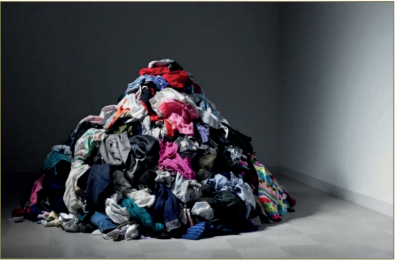
1 Few industries proclaim their sustainability credentials more forcefully than the fashion industry. Products ranging from swimsuits to wedding dresses are marketed as carbon positive, organic, or vegan while yoga mats made from mushrooms and sneakers from sugar cane dot retail shelves. New business models including recycling, resale, rental, reuse, and repair are sold as environmental life savers.
2 The sad truth however is that all this experimentation and supposed “innovation” in the fashion industry over the past 25 years have failed to lessen its planetary impact — a loud wake up call for those who hope that voluntary efforts can successfully address climate change and other major challenges facing society.
3 Take the production of shirts and shoes, which has more than doubled in the past quarter century — three quarters end up burned or buried in landfills. This feels like a personal failure of sorts. For many years, I was the COO of Timberland, a footwear and clothing brand that aspired to lead the industry toward a more sustainable future. The reasons for the industry’s sustainability letdown are complicated. Pressure for implacable growth summed with consumer demand for cheap, fast fashion have been great contributors.
4 The precise negative environmental impact of the fashion industry remains unknown, but it is enormous. The industry’s boundaries spread globally and its multitiered supply chain remains complex and opaque. Thanks to trade liberalization, globalization, and enduring cost pressures, very few brands own the assets of their upstream factories, and most companies outsource final production. “There are still very, very few brands who know where their stuff comes from in the supply chain, and even fewer of them have entered into active relationships with those suppliers to reduce their carbon footprint,” says environmental scientist Linda Greer. Estimates of the industry’s carbon impact range from 4% to 10% of overall global carbon emissions.
5 Like all industries, fashion is nested in a broader system. It is a system premised on growth. While serving as an executive in the industry, never once did a CFO ask me if the business could contract to yield a more durable customer base. This obstinate pursuit of growth, of “more,” drives strategies that are specific to the fashion industry.
6 Despite the improvements in technology and communications, predicting demand across tens of styles that are launched seasonally is much easier than doing the same for thousands of styles released monthly. Therefore, fashion inventories inevitably accumulate, and 40% of fashion goods are sold at a markdown. “The urge to sell more and get consumers to buy more is still in the DNA of the industry,” says Michael Stanley-Jones, co-secretary for the UN Alliance for Sustainable Fashion. “Clothes have a very short life span and end up in the dump.”
7 The speed of this hedonic treadmill continues to ramp up exponentially. Five years ago, McKinsey reported that shorter production lead times enabled by technology and revised business systems enabled brands to “introduce new lines more frequently. Zara offers 24 new clothing collections each year; H&M offers 12 to 16 and refreshes them weekly.” This acceleration and proliferation of “newness” served as a constant draw to bring consumers back to sites and stores. (…)

(PUCKER, Kenneth P. Harvard Business Review. Disponível em: https://hbr.org/2022/01/the-myth-of-sustainable-fashion. Acesso em 20 jun. 2022. Adaptado.)
Considerando o contexto e as regras de gramatica da língua inglesa, assinale a análise linguística CORRETA.
Questão 37 14712038
UPE SSA 2ª Fase - 1° Dia 2023In paragraph 6, Michael Stanley-Jones, co-secretary for the UN Alliance for Sustainable Fashion, says “Clothes have a very short life span and end up in the dump”.
What did he mean?
Questão 36 14712019
UPE SSA 2ª Fase - 1° Dia 2023Text 02
The Myth of Sustainable Fashion
1 Few industries proclaim their sustainability credentials more forcefully than the fashion industry. Products ranging from swimsuits to wedding dresses are marketed as carbon positive, organic, or vegan while yoga mats made from mushrooms and sneakers from sugar cane dot retail shelves. New business models including recycling, resale, rental, reuse, and repair are sold as environmental life savers.
2 The sad truth however is that all this experimentation and supposed “innovation” in the fashion industry over the past 25 years have failed to lessen its planetary impact — a loud wake up call for those who hope that voluntary efforts can successfully address climate change and other major challenges facing society.
3 Take the production of shirts and shoes, which has more than doubled in the past quarter century — three quarters end up burned or buried in landfills. This feels like a personal failure of sorts. For many years, I was the COO of Timberland, a footwear and clothing brand that aspired to lead the industry toward a more sustainable future. The reasons for the industry’s sustainability letdown are complicated. Pressure for implacable growth summed with consumer demand for cheap, fast fashion have been great contributors.
4 The precise negative environmental impact of the fashion industry remains unknown, but it is enormous. The industry’s boundaries spread globally and its multitiered supply chain remains complex and opaque. Thanks to trade liberalization, globalization, and enduring cost pressures, very few brands own the assets of their upstream factories, and most companies outsource final production. “There are still very, very few brands who know where their stuff comes from in the supply chain, and even fewer of them have entered into active relationships with those suppliers to reduce their carbon footprint,” says environmental scientist Linda Greer. Estimates of the industry’s carbon impact range from 4% to 10% of overall global carbon emissions.
5 Like all industries, fashion is nested in a broader system. It is a system premised on growth. While serving as an executive in the industry, never once did a CFO ask me if the business could contract to yield a more durable customer base. This obstinate pursuit of growth, of “more,” drives strategies that are specific to the fashion industry.
6 Despite the improvements in technology and communications, predicting demand across tens of styles that are launched seasonally is much easier than doing the same for thousands of styles released monthly. Therefore, fashion inventories inevitably accumulate, and 40% of fashion goods are sold at a markdown. “The urge to sell more and get consumers to buy more is still in the DNA of the industry,” says Michael Stanley-Jones, co-secretary for the UN Alliance for Sustainable Fashion. “Clothes have a very short life span and end up in the dump.”
7 The speed of this hedonic treadmill continues to ramp up exponentially. Five years ago, McKinsey reported that shorter production lead times enabled by technology and revised business systems enabled brands to “introduce new lines more frequently. Zara offers 24 new clothing collections each year; H&M offers 12 to 16 and refreshes them weekly.” This acceleration and proliferation of “newness” served as a constant draw to bring consumers back to sites and stores. (…)
(PUCKER, Kenneth P. Harvard Business Review. Disponível em: https://hbr.org/2022/01/the-myth-of-sustainable-fashion. Acesso em 20 jun. 2022. Adaptado.)
Entre as afirmações a seguir, assinale a única que está de acordo com o Texto 02.
06