


![[Marketing] Questao Topo - deslogado](https://storage.estuda.com.br/banners/0_6b7ebee90b03af1c560c73bb8bcce34a_banner_deslogado_70_dias.png)
Questões de Inglês
19.971 Questões
Questão 58 13333218
Feevale Medicina 2024/1Texto
UN – United Nations News
May 10th, 2023
1 in 3 children overweight in the European region: WHO report
A new World Health Organization (WHO) report on obesity levels in Europe shows that roughly one in three primary school-aged children is living with obesity or are overweight, and this is only set to rise further. The WHO European Regional Obesity Report 2022 was launched by the spouses of 16 European leaders and Heads of State, in the Croatian capital. Childhood obesity data for WHO’s European Region paints an alarming picture. “Our children are increasingly growing up in environments that make it very difficult for them to eat well and be active. This is a root cause of the obesity epidemic,” said Dr Hans Henri P. Kluge, WHO Regional Director for Europe. “As societies and countries, we have so far failed to reverse the rising rates of childhood obesity, and that’s why WHO/Europe is here in Croatia, at the invitation of Professor Milanović, spouse of the President, to galvanize political support for this truly insidious public health crisis before it becomes even more difficult to address.” Based on current trends and looking exclusively at obesity in the WHO European Region, which covers 53 countries across Europe and Central Asia, the World Obesity Atlas 2023 published by the World Obesity Federation, projects that between 2020 and 2035, there will be:
• a 61% increase in the number of boys living with obesity,
• a 75% increase in the number of girls living with obesity,
• with a total 17 million boys and 11 million girls aged 5-19 living with obesity in the region in 2035.
• Issues involving being overweight and obesity across all age groups are projected to cost
the WHO European Region $800 billion annually, by 2035.
WHO European Region has identified three specific actions to counter current projections and help prevent this silent epidemic from getting worse: prevention is better than cure: efforts to reduce childhood obesity must start early, right from pregnancy and early childhood. Prevention needs to focus on good nutrition at all stages of a child’s life. Prevention efforts are also needed in homes, schools, and the wider community. Regulating the food and beverage industry: the most effective policies to tackle childhood obesity include imposing a tax on sugary drinks, requiring clear front-ofpackage labelling, and restricting marketing of unhealthy foods to children. Promoting physical activity: this includes better urban design and transportation policies, physical activity in the school curriculum and extra-curricular activities, and clear messaging to support active lifestyles throughout the life course.
Adapted from: 1 in 3 children overweight in the European region: WHO report. UN – UNITED NATIONS NEWS. Release date: May 10th, 2023. Available at: https://news.un.org/en/story/2023/05/1136547. Access on May 30th, 2023.
Fill the blanks in the following sentences with Modal Verbs that show speculations and conclusions about the past.
I. The Maya civilization, who lived in Mesoamerica, _________ a very clever people. They had the most accurate written system in the Western Hemisphere.
II. Archaeologists _________ very enthusiastic by the discovery of their astronomical calendar, because it showed a lot of important information about the Maya.
III. The Maya _________ the locations where they lived between the year 700 and 900. This hypothesis is based on their architecture, as well as in the ceramic pots found in those places.
IV. Archaeologists and other researchers once thought the Maya _________ in their town centers. They believed that those sites were used just for ritual purposes. However, nowadays we know this is not true.
Choose the answer that shows the correct uses of Modal Verbs in order of appearance in the sentences.
Questão 56 13333193
Feevale Medicina 2024/1Texto
UN – United Nations News
May 10th, 2023
1 in 3 children overweight in the European region: WHO report
A new World Health Organization (WHO) report on obesity levels in Europe shows that roughly one in three primary school-aged children is living with obesity or are overweight, and this is only set to rise further. The WHO European Regional Obesity Report 2022 was launched by the spouses of 16 European leaders and Heads of State, in the Croatian capital. Childhood obesity data for WHO’s European Region paints an alarming picture. “Our children are increasingly growing up in environments that make it very difficult for them to eat well and be active. This is a root cause of the obesity epidemic,” said Dr Hans Henri P. Kluge, WHO Regional Director for Europe. “As societies and countries, we have so far failed to reverse the rising rates of childhood obesity, and that’s why WHO/Europe is here in Croatia, at the invitation of Professor Milanović, spouse of the President, to galvanize political support for this truly insidious public health crisis before it becomes even more difficult to address.” Based on current trends and looking exclusively at obesity in the WHO European Region, which covers 53 countries across Europe and Central Asia, the World Obesity Atlas 2023 published by the World Obesity Federation, projects that between 2020 and 2035, there will be:
• a 61% increase in the number of boys living with obesity,
• a 75% increase in the number of girls living with obesity,
• with a total 17 million boys and 11 million girls aged 5-19 living with obesity in the region in 2035.
• Issues involving being overweight and obesity across all age groups are projected to cost
the WHO European Region $800 billion annually, by 2035.
WHO European Region has identified three specific actions to counter current projections and help prevent this silent epidemic from getting worse: prevention is better than cure: efforts to reduce childhood obesity must start early, right from pregnancy and early childhood. Prevention needs to focus on good nutrition at all stages of a child’s life. Prevention efforts are also needed in homes, schools, and the wider community. Regulating the food and beverage industry: the most effective policies to tackle childhood obesity include imposing a tax on sugary drinks, requiring clear front-ofpackage labelling, and restricting marketing of unhealthy foods to children. Promoting physical activity: this includes better urban design and transportation policies, physical activity in the school curriculum and extra-curricular activities, and clear messaging to support active lifestyles throughout the life course.
Adapted from: 1 in 3 children overweight in the European region: WHO report. UN – UNITED NATIONS NEWS. Release date: May 10th, 2023. Available at: https://news.un.org/en/story/2023/05/1136547. Access on May 30th, 2023.
According to the text, check True (T) or False (F) about the following statements.
(_) Between 2020 and 2035, there will be more obese boys than obese girls aged 5-19 in the WHO European Region.
(_) Between 2020 and 2035, childhood obesity issues will cost the amount of $800 billion in the WHO European Region.
(_) By 2035, $800 billion will be spent, each year, on issues related to obesity in all age groups in the WHO European Region.
(_) In 2035, there will be 28 million obese children aged 5-19 in the WHO European Region.
Choose the correct answer.
Questão 55 13332696
Feevale Medicina 2024/1Texto
UN – United Nations News
May 10th, 2023
1 in 3 children overweight in the European region: WHO report
A new World Health Organization (WHO) report on obesity levels in Europe shows that roughly one in three primary school-aged children is living with obesity or are overweight, and this is only set to rise further. The WHO European Regional Obesity Report 2022 was launched by the spouses of 16 European leaders and Heads of State, in the Croatian capital. Childhood obesity data for WHO’s European Region paints an alarming picture. “Our children are increasingly growing up in environments that make it very difficult for them to eat well and be active. This is a root cause of the obesity epidemic,” said Dr Hans Henri P. Kluge, WHO Regional Director for Europe. “As societies and countries, we have so far failed to reverse the rising rates of childhood obesity, and that’s why WHO/Europe is here in Croatia, at the invitation of Professor Milanović, spouse of the President, to galvanize political support for this truly insidious public health crisis before it becomes even more difficult to address.” Based on current trends and looking exclusively at obesity in the WHO European Region, which covers 53 countries across Europe and Central Asia, the World Obesity Atlas 2023 published by the World Obesity Federation, projects that between 2020 and 2035, there will be:
• a 61% increase in the number of boys living with obesity,
• a 75% increase in the number of girls living with obesity,
• with a total 17 million boys and 11 million girls aged 5-19 living with obesity in the region in 2035.
• Issues involving being overweight and obesity across all age groups are projected to cost
the WHO European Region $800 billion annually, by 2035.
WHO European Region has identified three specific actions to counter current projections and help prevent this silent epidemic from getting worse: prevention is better than cure: efforts to reduce childhood obesity must start early, right from pregnancy and early childhood. Prevention needs to focus on good nutrition at all stages of a child’s life. Prevention efforts are also needed in homes, schools, and the wider community. Regulating the food and beverage industry: the most effective policies to tackle childhood obesity include imposing a tax on sugary drinks, requiring clear front-ofpackage labelling, and restricting marketing of unhealthy foods to children. Promoting physical activity: this includes better urban design and transportation policies, physical activity in the school curriculum and extra-curricular activities, and clear messaging to support active lifestyles throughout the life course.
Adapted from: 1 in 3 children overweight in the European region: WHO report. UN – UNITED NATIONS NEWS. Release date: May 10th, 2023. Available at: https://news.un.org/en/story/2023/05/1136547. Access on May 30th, 2023.
Consider the following statements about the text.
I. The number of obese children in the WHO European Region is increasing.
II. Childhood obesity in the WHO European Region is alarming, although it is easy for the children to eat well.
III. Childhood obesity is an important issue, but it is not connected to a public health issue.
IV. One of the reasons of childhood obesity is the fact that some children are not active.
Check the correct answer
Questão 50 13276269
FMJ 2024Leia a figura e compare-a ao conteúdo do terceiro parágrafo do texto.
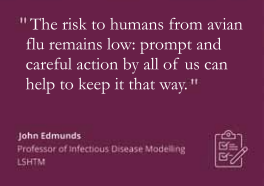
(https://www.lshtm.ac.uk. Adaptado.)
A respeito da gripe aviária, tanto o terceiro parágrafo do texto quanto a figura mencionam
Questão 49 13276247
FMJ 2024Leia o texto para responder à questão.
If you want to know how the world is preparing for the next global pandemic, consider Rolaing, a Cambodian village on the Mekong River. For a few days in February 2023 this isolated spot became the center of public-health activity after an 11-year-old girl died of H5N1, the most virulent species of avian flu. It was Cambodia’s first fatality from the disease since 2014.
A rapid response team of health workers from the region was dispatched to the village. These health workers found a community of almost 2,000 people living side by side with their livestock and chickens. In just 24 hours they set up a temporary testing center, identified a dozen of the girl’s closest contacts, collected saliva and examined the samples for the pathogen.
The speed with which Cambodia, and other countries where novel viruses are known to emerge, can identify and react to future virus threats will determine how effectively the world can contain the next pandemic. There is a global community of experts constantly on high alert, even when threat levels subside. This time around, experts are focused on planning actions in case of any outbreak that puts human health at risk.
(Michelle Cortez and Suzi Ring. Bloomberg Businessweek, 08.05.2023. Adaptado.)
In the excerpt from the third paragraph “even when threat levels subside”, the underlined term can be replaced, without meaning change, by
Questão 48 13276228
FMJ 2024Leia o texto para responder à questão.
If you want to know how the world is preparing for the next global pandemic, consider Rolaing, a Cambodian village on the Mekong River. For a few days in February 2023 this isolated spot became the center of public-health activity after an 11-year-old girl died of H5N1, the most virulent species of avian flu. It was Cambodia’s first fatality from the disease since 2014.
A rapid response team of health workers from the region was dispatched to the village. These health workers found a community of almost 2,000 people living side by side with their livestock and chickens. In just 24 hours they set up a temporary testing center, identified a dozen of the girl’s closest contacts, collected saliva and examined the samples for the pathogen.
The speed with which Cambodia, and other countries where novel viruses are known to emerge, can identify and react to future virus threats will determine how effectively the world can contain the next pandemic. There is a global community of experts constantly on high alert, even when threat levels subside. This time around, experts are focused on planning actions in case of any outbreak that puts human health at risk.
(Michelle Cortez and Suzi Ring. Bloomberg Businessweek, 08.05.2023. Adaptado.)
De acordo com o primeiro e o segundo parágrafos, o vilarejo cambojano de Rolaing
06