


![[Marketing] Questao Topo - deslogado](https://storage.estuda.com.br/banners/0_6b7ebee90b03af1c560c73bb8bcce34a_banner_deslogado_70_dias.png)
Questões de Inglês
19.971 Questões
Questão 43 13477548
UFU 1ª Fase 2024/2Comic strips are art works with texts aiming to produce some effect of humor. Usually humor results from the interaction of text and image and is based on play on words, exaggerations, contradictions, or verbal metaphors.

Drabble by Kevin Fagan for June 10, 2010. Disponível em: https://www.gocomics.com/. Acesso em: 10 Jan. 2024.
Considering this comic strip above, it is correct to state that the effect of humor resulted from
Questão 42 13477502
UFU 1ª Fase 2024/2Large earthquakes are always followed by aftershocks – a series of smaller but still potentially damaging quakes produced as the ground readjusts. But how long does it take for the aftershocks to die out? A new study suggests some areas can experience aftershocks decades or even centuries after the original earthquake. In earthquake-prone areas it is hard to tell the difference between aftershocks and ordinary background seismicity. But recognizing aftershocks is an important part of assessing a region’s disaster risk. To understand how long aftershocks can persist, researchers turned to the stable continental interior of North America, where earthquakes are uncommon. Using statistical analysis, they assessed the timing and clustering of quakes that followed three large magnitude 6.5 to 8 historical earthquakes: one near south-east Quebec in Canada in 1663; a trio of quakes around the Missouri-Kentucky border from 1811 to 1812; and an earthquake in Charleston in South Carolina in 1886. Their results, published in Journal of Geophysical Research: Solid Earth, suggest that the Quebec quake in 1663 has likely shaken itself out, but to their surprise nearly a third of modern quakes in the Missouri-Kentucky area were most likely to be aftershocks from the 1811-12 event, and about 16% of recent quakes in the Charleston region are probably aftershocks from the 1886 quake.
Disponível em: http://www.theguardian.com/. Acesso em: 4 Fev. 2024.
Tome como base o texto acima e analise as asserções abaixo.
I. Terremotos são sempre seguidos de tremores secundários de menor impacto.
II. Cientistas acreditam que até hoje são sentidos efeitos do terremoto de Quebec de 1663.
III. Abalos sísmicos secundários podem ocorrer até mesmo séculos depois do principal.
IV. Em áreas sísmicas, fica difícil distinguir abalos secundários de simples tremores comuns.
V. É pouco provável que terremotos perto de Charleston estejam relacionados com o de 1886.
Assinale a alternativa que apresenta apenas asserções corretas.
Questão 24 13417701
UNITAU Inverno Medicina 2024Read the INFOGRAPHIC below to answer question:
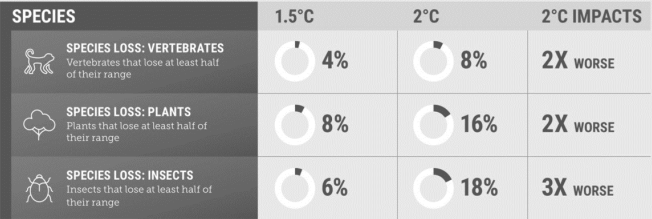
Infographic showing the difference in projected climate impacts on the loss of species between 1.5ºC and 2ºC. (Source: IPCC 2018). Disponível em https://www.climatecouncil.org.au/resources/impacts-degrees-warming/ Acesso 10 jun 2024
Which of the following sentences correctly express the information brought by the infographic?
Questão 23 13417666
UNITAU Inverno Medicina 2024Read the cartoon below to answer the question.

Disponível em : https://www.gocomics.com/calvinandhobbes/2010/08/14. Acesso 09 jun 2024.
What does the sentence “I’ll bet I’d have gotten some cookies if I had filled this with paint” imply about Calvin’s understanding of the consequence of his action?
Questão 22 13417657
UNITAU Inverno Medicina 2024Read the text below to answer question.
Deadly Floods in Brazil Were Worsened by Climate Change, Study finds.
The country’s south received three months’ rain in two weeks. Global warming has made such deluges twice as likely as before, scientists said.
By Raymond Zhong and Manuela Andreoni
June 3, 2024
Human-caused warming has doubled the chances that southern Brazil will experience extreme, multiday downpours like the ones that recently caused disastrous flooding there, a team of scientists said on Monday. The deluges have killed at least 172 people and displaced more than half a million residents from their homes.
Three months’ rain fell in a two-week span of April and May in the southern state of Rio Grande do Sul. After analyzing weather records, the scientists estimated that the region had a 1 percent chance each year of receiving so much rain in so little time. In the cooler climate of the 19th century, before large-scale emissions of greenhouse gases, such colossal downpours were far rarer, the researchers said.
When the latest rains hit, Rio Grande do Sul was still recovering from floods that killed at least 54 people late last year. Three of the four largest floods ever recorded in the state’s capital, Porto Alegre, have now occurred in the past nine months, said Regina Rodrigues, a professor of physical oceanography at the Federal University of Santa Catarina and one of the scientists who worked the new analysis of the climate situation in the south. “While significant floods have occurred in the state of Rio Grande do Sul in the past, they are becoming increasingly strong and widespread,” Dr. Rodrigues said at a news conference. The floods damaged roads, bridges, airports and transmission lines. They ruined soy, rice and wheat crops, which are essential to Brazil’s food supply and economy. Schools closed for weeks, leaving hundreds of thousands of students out of the classroom.
Years of scientific studies have warned that climate change would lead to more intense rainfall and flooding in southern Brazil. But politicians still struggle to accept and act on future climate risks, said Natalie Unterstell, the head of Talanoa, a climate policy research institute in Brazil.“The willingness to listen to scientific information hasn’t translated into decision and investments based on long-term considerations,” she added.
Disponível em https://www.nytimes.com/2024/06/03/climate/brazil-floodsclimate-change.html Acesso 09 jun 2024
Analyze the sentences below and choose the one that, according to the information offered by the text, correctly relates cause and consequence.
Questão 20 13417169
UNITAU Inverno Medicina 2024Read the text below to answer question.
Deadly Floods in Brazil Were Worsened by Climate Change, Study finds.
The country’s south received three months’ rain in two weeks. Global warming has made such deluges twice as likely as before, scientists said.
By Raymond Zhong and Manuela Andreoni
June 3, 2024
Human-caused warming has doubled the chances that southern Brazil will experience extreme, multiday downpours like the ones that recently caused disastrous flooding there, a team of scientists said on Monday. The deluges have killed at least 172 people and displaced more than half a million residents from their homes.
Three months’ rain fell in a two-week span of April and May in the southern state of Rio Grande do Sul. After analyzing weather records, the scientists estimated that the region had a 1 percent chance each year of receiving so much rain in so little time. In the cooler climate of the 19th century, before large-scale emissions of greenhouse gases, such colossal downpours were far rarer, the researchers said.
When the latest rains hit, Rio Grande do Sul was still recovering from floods that killed at least 54 people late last year. Three of the four largest floods ever recorded in the state’s capital, Porto Alegre, have now occurred in the past nine months, said Regina Rodrigues, a professor of physical oceanography at the Federal University of Santa Catarina and one of the scientists who worked the new analysis of the climate situation in the south. “While significant floods have occurred in the state of Rio Grande do Sul in the past, they are becoming increasingly strong and widespread,” Dr. Rodrigues said at a news conference. The floods damaged roads, bridges, airports and transmission lines. They ruined soy, rice and wheat crops, which are essential to Brazil’s food supply and economy. Schools closed for weeks, leaving hundreds of thousands of students out of the classroom.
Years of scientific studies have warned that climate change would lead to more intense rainfall and flooding in southern Brazil. But politicians still struggle to accept and act on future climate risks, said Natalie Unterstell, the head of Talanoa, a climate policy research institute in Brazil.“The willingness to listen to scientific information hasn’t translated into decision and investments based on long-term considerations,” she added.
Disponível em https://www.nytimes.com/2024/06/03/climate/brazil-floodsclimate-change.html Acesso 09 jun 2024
What is the main purpose of the text?
06