


![[Marketing] Questao Topo - deslogado](https://storage.estuda.com.br/banners/0_6b7ebee90b03af1c560c73bb8bcce34a_banner_deslogado_70_dias.png)
Questões de Inglês
19.971 Questões
Questão 38 14625612
FGV-SP Administração - UNIFICADO 2024Texto para a questão.
A TELEVISION DRAMA ABOUT TAIWANESE POLITICS
1 Presidential elections in Taiwan will soon take place. Functionaries in the two main parties frantically smear [mancham a reputação de] the rival candidate and scramble [se esforçam] to shape the image of their own candidate, hiring influencers, inventing catchy [cativantes] slogans, and filming touching [comoventes] moments with voters on the street. But there is one key difference between the universe of “Wave Makers,” a hit political drama that came out on Netflix in April, and Taiwanese reality: in the series, the China question, usually at the center of the island’s politics, does not exist.
2 This concept means that the focus is on domestic issues rather than grand matters of national identity or the threat of invasion. Drawing on deep research and interviews, the show zooms in on the sacrifices women are asked to make for supposedly important causes. It tells a hopeful story of one brave female character standing up for [defendendo] another woman.
3 The fictional election is a vehicle to examine thorny [espinhosas] questions of politics and morality. How much should people be willing to give up for the sake of a wider goal? Where is the line between pragmatic compromise and hypocrisy? All the characters wrestle with clashes [conflitos, embates] between their political mission and personal ideals. The liberal presidential nominee is against the death penalty but fears to say so in public. A young campaigner is castigated as unethical by his friends for missing protests because he was busy making party-propaganda videos. His well worn [bem usada] answer is that power, not protests, brings change.
Adapted from The Economist, June 24, 2023.
The author most likely presents all of the following as typical components of a Taiwanese presidential campaign except
Questão 36 14625607
FGV-SP Administração - UNIFICADO 2024Texto para a questão.
A FORCE FOR PEACE
By
Ngozi Okonjo-Iweala
Diretora Geral of the World Trade Organization (WTO)
1 To abandon the many benefits that come with international trade would be foolish. There are real problems with the current trading system, but the counterfactual scenario is almost certainly worse: it is difficult to believe that international security would be better served if leading powers had no economic interest in one another’s stability and prosperity and no shared institutions in which to engage. Trade between the United States and China benefits people and businesses in both countries enormously and ties the superpowers together, both bilaterally and in international forums, providing an incentive to cooperate where possible and avoid conflict.
2 Strategic competition is a reality of the modern world. But that world will become unlivable unless there is also strategic cooperation. The WTO’s ministerial meeting last summer offered hope that the two can go together. The agreements reached there had the support of all WTO members. They worked across geopolitical and policy fault lines, each perceiving a national interest in reinforcing the world trading system.
3 In the 75 years since the world first embraced multilateral cooperation on trade, the trading system has underpinned [sustentou, apoiou] rising – if still uneven – global prosperity. It has achieved its original goal of helping governments keep markets open in turbulent times. In the face of mighty [poderosos] shocks, from the global financial crisis to the pandemic, the world did not repeat the 1930s spiral of protectionism and depression, instead allowing cross-border demand and supply to be an engine for recovery.
4 Today, the multilateral trading system is part of the solution to major global challenges, from climate change to conflict to pandemic preparedness. And a reformed WTO, fit for the twenty-first century, is needed now more than ever, with rules that underpin the stability, predictability, and openness of the global trading system. In the past 15 years we have learned that unforeseen crises surely lie [ficam, situam-se] ahead and that without the stabilizing force of trade, the world will almost certainly be less able to weather [enfrentar, resistir] them.
Adapted from Foreign Affairs, July/August 2023.
In paragraph 3, the author most likely mentions “the 1930s spiral of protectionism and depression” in order to
Questão 34 14625555
FGV-SP Administração - UNIFICADO 2024Texto para a questão.
A FORCE FOR PEACE
By
Ngozi Okonjo-Iweala
Diretora Geral of the World Trade Organization (WTO)
1 To abandon the many benefits that come with international trade would be foolish. There are real problems with the current trading system, but the counterfactual scenario is almost certainly worse: it is difficult to believe that international security would be better served if leading powers had no economic interest in one another’s stability and prosperity and no shared institutions in which to engage. Trade between the United States and China benefits people and businesses in both countries enormously and ties the superpowers together, both bilaterally and in international forums, providing an incentive to cooperate where possible and avoid conflict.
2 Strategic competition is a reality of the modern world. But that world will become unlivable unless there is also strategic cooperation. The WTO’s ministerial meeting last summer offered hope that the two can go together. The agreements reached there had the support of all WTO members. They worked across geopolitical and policy fault lines, each perceiving a national interest in reinforcing the world trading system.
3 In the 75 years since the world first embraced multilateral cooperation on trade, the trading system has underpinned [sustentou, apoiou] rising – if still uneven – global prosperity. It has achieved its original goal of helping governments keep markets open in turbulent times. In the face of mighty [poderosos] shocks, from the global financial crisis to the pandemic, the world did not repeat the 1930s spiral of protectionism and depression, instead allowing cross-border demand and supply to be an engine for recovery.
4 Today, the multilateral trading system is part of the solution to major global challenges, from climate change to conflict to pandemic preparedness. And a reformed WTO, fit for the twenty-first century, is needed now more than ever, with rules that underpin the stability, predictability, and openness of the global trading system. In the past 15 years we have learned that unforeseen crises surely lie [ficam, situam-se] ahead and that without the stabilizing force of trade, the world will almost certainly be less able to weather [enfrentar, resistir] them.
Adapted from Foreign Affairs, July/August 2023.
With which of the following statements would the author of the article be most likely to agree?
Questão 33 14625553
FGV-SP Administração - UNIFICADO 2024Texto para as questão.
SWEARING ON THE BIBLE
By Angela Stockton
1 On November 22, 1963, the day President John F. Kennedy was assassinated, Vice President Lyndon Johnson (LBJ) did not put his hand on the Bible when he took his oath of office [juramento de posse] as the new President. The book that he and the Secret Service agents thought was the Bible was in fact a missal, i.e., a book of prayers which Catholics used at Masses [Missas].
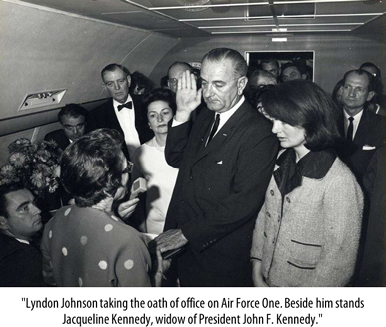
2 That didn’t make LBJ’s oath invalid. Because the Constitution specifically states that no religious test shall be required for public office [cargo público] in the United States, no public official needs to say “So help me, God,” or put his or her left hand on any book. LBJ’s oath would have been equally valid if he had put his left hand on a telephone book or a cookbook.
3 And Barack Obama did put his hand on a Bible for both his public inaugurations and undoubtedly at his third one. His third? Yes, if you recall, Chief Justice [Presidente da Suprema Corte dos EUA] John Roberts messed up the words of the oath when he swore in Obama at his first inauguration. (You had one job, John…) So that no one could say Obama was not validly inaugurated, Roberts went to the White House on the evening of January 20, 2009 and administered the oath again, in private. One hopes that he was reading it off the Constitution that time.
Adapted from Quora Digest, July 29, 2023.
With respect to Barack Obama’s first inauguration, the information in the article most likely supports which of the following?
Questão 32 14625552
FGV-SP Administração - UNIFICADO 2024Texto para as questão.
SWEARING ON THE BIBLE
By Angela Stockton
1 On November 22, 1963, the day President John F. Kennedy was assassinated, Vice President Lyndon Johnson (LBJ) did not put his hand on the Bible when he took his oath of office [juramento de posse] as the new President. The book that he and the Secret Service agents thought was the Bible was in fact a missal, i.e., a book of prayers which Catholics used at Masses [Missas].
2 That didn’t make LBJ’s oath invalid. Because the Constitution specifically states that no religious test shall be required for public office [cargo público] in the United States, no public official needs to say “So help me, God,” or put his or her left hand on any book. LBJ’s oath would have been equally valid if he had put his left hand on a telephone book or a cookbook.
3 And Barack Obama did put his hand on a Bible for both his public inaugurations and undoubtedly at his third one. His third? Yes, if you recall, Chief Justice [Presidente da Suprema Corte dos EUA] John Roberts messed up the words of the oath when he swore in Obama at his first inauguration. (You had one job, John…) So that no one could say Obama was not validly inaugurated, Roberts went to the White House on the evening of January 20, 2009 and administered the oath again, in private. One hopes that he was reading it off the Constitution that time.
Adapted from Quora Digest, July 29, 2023.
At the end of paragraph 2, the author most likely mentions “a telephone book or a cookbook” in order to
Questão 8 14617963
Campo Real Medicina 2024/2The following text refers to question.
“Anatomy of a Fall” defies easy categorization: it is a whodunit, but it is not terribly interested in determining who, in fact, did it. It is a French film, but over 40 percent of the dialogue is in English. In what may be this year’s most fascinating snub, it is not nominated for Best International Feature at the Oscars, but it is a serious contender in five other awards categories, including Best Picture.
The film begins as German writer Sandra Voyter is being interviewed about her work in the first-floor living room of her family’s chalet in the French Alps. She charmingly evades the questions of student journalist Zoé Solidor. We are indirectly introduced to Sandra’s husband Samuel as he blares an instrumental version of 50 Cent’s “P.I.M.P.” from the attic, effectively ending the interview.
Available in: https://www.americamagazine.org/arts-culture/2024/03/06/anatomy-fall-film-oscars-justine-triet-sandra-huller-247434/. Adapted.
Regarding “Anatomy of a Fall”, it is correct to say that this film:
06