


![[Marketing] Questao Topo - deslogado](https://storage.estuda.com.br/banners/0_6b7ebee90b03af1c560c73bb8bcce34a_banner_deslogado_70_dias.png)
Questões de Inglês
19.971 Questões
Questão 5 14404542
UFRGS 2º dia 2025As questão está relacionada ao texto abaixo.
There are as many ways of being blind as there
are of being tall, or sick, or hot. But the popular
view has always conceived …….. blindness as a
totality. The blind bards wandering the
[5] countrysides of ancient Japan, China, or Europe,
the blind housed in asylums in the Middle Ages,
all the pupils in all the schools for the blind from
the Enlightenment onward, blind beggars and
lawyers, war veterans and toddlers - in the eyes
[10] of history, as well as those of most of their
contemporaries, they all saw nothing. Modern
dictionaries still subscribe to this sense:
blindness is the antonym of vision, and connotes
a destitution of sight. What else could it mean?
[15] Despite the poetic impulse to equate blindness
…….. darkness, it's rarely experienced as a black
veil draped over the world. Only around 15
percent of blind people have no light perception
whatsoever. Most see something, even if it isn't
[20] very useful, by sighted standards: a blurry view
of their periphery, with nothing in the middle, or
the inverse - the world seen through a
buttonhole. For some, scenes come through in a
dim haze; for others, light produces a shower of
[25] excruciatingly bright needles. Even those with no
light perception at all have little use for the
popular image of blindness as darkness: the
brain cut off from visual stimulus can still
produce washes of brilliant color and shape. One
[30] blind man, whose optic nerve - the connection
between the eyes and the brain - had been
severed, described seeing a continuously
swirling (and distracting) "visual tinnitus." The
Argentine writer Jorge Luis Borges, decades
[35] …….. his blindness, still saw color, which
sometimes disturbed him: "I, who was
accustomed to sleeping in total darkness," he
said, “was bothered for a long time at having to
sleep in this world of mist, in the greenish or
[40] bluish mist, vaguely luminous, which is the world
of the blind. I wanted to lie down in darkness”.
The arrival or encroachment of blindness gives
rise to a similarly dazzling range of experiences,
an efflorescence of blind varietals. There are
[45] those born blind, with no visual memories,
whose brains – including the visual cortices –
develop using four (or fewer) senses to construct
their view of the world. Those who become blind
in early childhood often retain visual memories
[50] that can contribute to an intuitive understanding
of visual concepts. The late-blinded may have
the most cognitive work to do, forced to relearn
basic skills like orientation and information –
gathering through new senses, long after their
[55] brains' developmental plasticity has hardened.
Some late-blinded adults consciously struggle to
preserve their storehouses of mental images,
like art conservators touching up old and fading
masterpieces.
[60] People are blinded by their spouses or strangers,
by acts of war or sports injuries, by industrial
accidents and bad decisions, malnutrition and
infection, genetic inheritances and spontaneous
mutations. It's disingenuous to argue that
[65] blindness doesn't have a transformative impact
...….. a person's life, but in every case, blindness
is only part of the story. The life of a blind person
is never fully (or even predominantly) defined by
their blindness».
Extraído de: LELAND, A. The Country of the Blind: A memoir at the end of sight. New York: Penguin, 2023.
Associe as palavras da coluna da esquerda às suas respectivas traduções na coluna da direita, de acordo com o sentido que têm no texto.
( ) toddlers (l. 09)
( ) encroachment (l. 42)
( ) disingenuous (l. 64)
1. crianças
2. usurpação
3. invasão
4. genuíno
5. pacifistas
6. hipócrita
A sequência correta de preenchimento dos parênteses, de cima para baixo, é
Questão 1 14404389
UFRGS 2º dia 2025As questão está relacionada ao texto abaixo.
There are as many ways of being blind as there
are of being tall, or sick, or hot. But the popular
view has always conceived …….. blindness as a
totality. The blind bards wandering the
[5] countrysides of ancient Japan, China, or Europe,
the blind housed in asylums in the Middle Ages,
all the pupils in all the schools for the blind from
the Enlightenment onward, blind beggars and
lawyers, war veterans and toddlers - in the eyes
[10] of history, as well as those of most of their
contemporaries, they all saw nothing. Modern
dictionaries still subscribe to this sense:
blindness is the antonym of vision, and connotes
a destitution of sight. What else could it mean?
[15] Despite the poetic impulse to equate blindness
…….. darkness, it's rarely experienced as a black
veil draped over the world. Only around 15
percent of blind people have no light perception
whatsoever. Most see something, even if it isn't
[20] very useful, by sighted standards: a blurry view
of their periphery, with nothing in the middle, or
the inverse - the world seen through a
buttonhole. For some, scenes come through in a
dim haze; for others, light produces a shower of
[25] excruciatingly bright needles. Even those with no
light perception at all have little use for the
popular image of blindness as darkness: the
brain cut off from visual stimulus can still
produce washes of brilliant color and shape. One
[30] blind man, whose optic nerve - the connection
between the eyes and the brain - had been
severed, described seeing a continuously
swirling (and distracting) "visual tinnitus." The
Argentine writer Jorge Luis Borges, decades
[35] …….. his blindness, still saw color, which
sometimes disturbed him: "I, who was
accustomed to sleeping in total darkness," he
said, “was bothered for a long time at having to
sleep in this world of mist, in the greenish or
[40] bluish mist, vaguely luminous, which is the world
of the blind. I wanted to lie down in darkness”.
The arrival or encroachment of blindness gives
rise to a similarly dazzling range of experiences,
an efflorescence of blind varietals. There are
[45] those born blind, with no visual memories,
whose brains – including the visual cortices –
develop using four (or fewer) senses to construct
their view of the world. Those who become blind
in early childhood often retain visual memories
[50] that can contribute to an intuitive understanding
of visual concepts. The late-blinded may have
the most cognitive work to do, forced to relearn
basic skills like orientation and information –
gathering through new senses, long after their
[55] brains' developmental plasticity has hardened.
Some late-blinded adults consciously struggle to
preserve their storehouses of mental images,
like art conservators touching up old and fading
masterpieces.
[60] People are blinded by their spouses or strangers,
by acts of war or sports injuries, by industrial
accidents and bad decisions, malnutrition and
infection, genetic inheritances and spontaneous
mutations. It's disingenuous to argue that
[65] blindness doesn't have a transformative impact
...….. a person's life, but in every case, blindness
is only part of the story. The life of a blind person
is never fully (or even predominantly) defined by
their blindness».
Extraído de: LELAND, A. The Country of the Blind: A memoir at the end of sight. New York: Penguin, 2023.
Assinale a alternativa que preenche adequadamente as lacunas das linhas 03, 16, 35 e 66.
Questão 21 14365975
UNICAMP Conhecimentos Gerais 2025Leia o resumo de uma pesquisa que, em 2021, já alertava para questões climáticas e fatores a elas relacionados.
Politics of attributing extreme events to climate change
Climate change shapes weather events. However, describing it as the cause of disasters can be misleading, since disasters are caused by pre-existing fragilities and inequalities on the ground. Attribution is not neutral. Hence, analytic frames that attribute disaster to climate can divert attention from place-based vulnerabilities and their sociopolitical causes. While politicians may blame climate change, the public may hold the government accountable for inadequate investments in flood or drought prevention. To be strategic and moral, framing choices must therefore be sensitive to context and to how the values implicit within analytic frames about the causes of disaster shape policy responses. Such sensitivity requires multicausal analysis of weather-linked disasters to reduce the damages. Through examples from around the world, especially Brazil, we discuss how and why climate-centric disaster framing can erase from view—and, thus, from policy agendas—the very socioeconomic and political factors that centrally cause vulnerability and suffering in weather extremes.
(Adaptado de https://wires.onlinelibrary.wiley.com/doi/full/10.1002/wcc.750. Acesso em 15/05/2024.)
Qual alternativa expressa corretamente os argumentos dos autores do texto?
Questão 18 14365960
UNICAMP Conhecimentos Gerais 2025Texto 1
The fact that so few African Americans write science fiction is perplexing since they, in a very real sense, inhabit a sci-fi nightmare in which unseen but no less palpable acts of intolerance frustrate their movement; official histories undo what has been done; and technology is too often brought to bear on black bodies. Moreover, the sublegitimate status of science fiction in literature mirrors the subaltern position to which blacks have been relegated throughout American history. The notion of Afrofuturism gives rise to a troubling antinomy: can a community whose past has been deliberately rubbed out, and whose energies have been consumed by the search for legible traces of its history, imagine possible futures?
(Adaptado de DERY, M. Black to the future: interviews with Samuel R. Delany, Greg Tate, and Tricia Rose. In: ___. (Ed.) The Discourse of cyberculture. Durham; London: Duke University Press, p. 179-222, 1994.)
Texto para a questão abaixo.
De acordo com o texto 1, a escassez de autores afro-americanos em obras de ficção científica representa um
Questão 17 14365959
UNICAMP Conhecimentos Gerais 2025Use as informações do texto e da figura a seguir para a escolha da alternativa correta.
Images generated with artificial intelligence (AI. are often not faithful representations of reality. The chart illustrates the level of disparity between a realistic representation of race and gender in various professions and the images generated by AI. The center line in this graph means equal representation. In one case, AI-generated images exclusively represented a certain profession as being held by white males, even though it is actually held by a range of men, women, white, and non-white people. In another case, although more than half of the people holding this position self-identified as white, AI represented it as being held solely by women who were primarily non-white.

(Adaptado de https://www.nature.com/articles/d41586-024-00674-9. Acesso em 02/05/2024.)
Considerando as informações da figura, quais as duas profissões referidas no texto?
Questão 16 14365949
UNICAMP Conhecimentos Gerais 2025A imagem a seguir apresenta a transcrição de um diálogo em um vídeo publicado no Instagram.
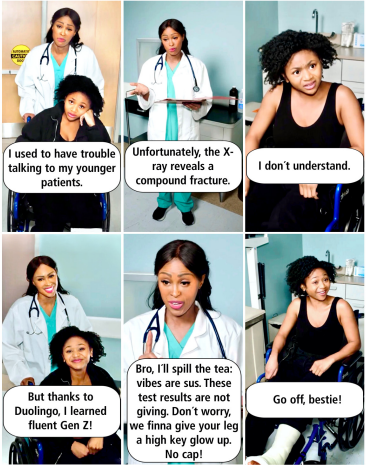
(Adaptado de https://www.instagram.com/dhar.mann. Acesso em 12/04/2024.)
No diálogo, a principal característica da reformulação da fala da médica é a inserção de
06