


![[Marketing] Questao Topo - deslogado](https://storage.estuda.com.br/banners/0_6b7ebee90b03af1c560c73bb8bcce34a_banner_deslogado_70_dias.png)
Questões de Inglês
19.971 Questões
Questão 19 14759036
UNIFESP 1 Dia 2025Leia o texto e examine a imagem para responder à questão.
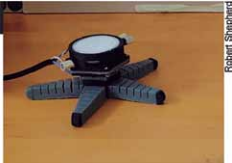
Eat your heart out, Victor Frankenstein1! Researchers have succeeded in creating living machines made from electronic parts and living fungi. In the past, so-called biohybrid robots ― which combine living tissue with robotic materials — have generally employed animal cells, but these are hard to keep alive. Fungi, by contrast, are incredibly resilient. Their branching networks of rootlike filaments, called mycelia, which allow mushrooms to connect and communicate underground, can both sense the environment and fire off electrical signals in response — just like neurons in the human brain.
The team behind the project cultured these filaments from the king oyster mushroom (Pleurotus eryngii) onto electrodes in a 3D-printed platform, then hooked them up to a computer interface — allowing electrical impulses from the fungi to be converted into digital commands.
The end result was the above pictured soft, starfish- -shaped walking robot, as well as another hard robot with wheels. In both cases, the team used ultraviolet light to stimulate the mycelium2, triggering electrical signals that directed the robots to walk and roll at different speeds, the researchers report in Science Robotics. Experts tell National Geographic that the advance lays the groundwork for building robust, sustainable robots. In the future, these hardy, light- -activated cyborgs could be employed in harsh environments on Earth or even on missions outside our planet.
(Phie Jacobs. www.science.org, 28.08.2024. Adaptado.)
1Victor Frankenstein: young scientist and protagonist of a novel and a film, who becomes obsessed with the idea of creating life. Frankenstein constructs the Monster, a living creature with human-like appearance, from parts of deceased bodies.
2mycelium: singular form of mycelia.
A imagem do robô ilustra o seguinte trecho do texto:
Questão 18 14759034
UNIFESP 1 Dia 2025Leia o texto e examine a imagem para responder à questão.
Eat your heart out, Victor Frankenstein1! Researchers have succeeded in creating living machines made from electronic parts and living fungi. In the past, so-called biohybrid robots ― which combine living tissue with robotic materials — have generally employed animal cells, but these are hard to keep alive. Fungi, by contrast, are incredibly resilient. Their branching networks of rootlike filaments, called mycelia, which allow mushrooms to connect and communicate underground, can both sense the environment and fire off electrical signals in response — just like neurons in the human brain.
The team behind the project cultured these filaments from the king oyster mushroom (Pleurotus eryngii) onto electrodes in a 3D-printed platform, then hooked them up to a computer interface — allowing electrical impulses from the fungi to be converted into digital commands.
The end result was the above pictured soft, starfish- -shaped walking robot, as well as another hard robot with wheels. In both cases, the team used ultraviolet light to stimulate the mycelium2, triggering electrical signals that directed the robots to walk and roll at different speeds, the researchers report in Science Robotics. Experts tell National Geographic that the advance lays the groundwork for building robust, sustainable robots. In the future, these hardy, light- -activated cyborgs could be employed in harsh environments on Earth or even on missions outside our planet.
(Phie Jacobs. www.science.org, 28.08.2024. Adaptado.)
1Victor Frankenstein: young scientist and protagonist of a novel and a film, who becomes obsessed with the idea of creating life. Frankenstein constructs the Monster, a living creature with human-like appearance, from parts of deceased bodies.
2mycelium: singular form of mycelia.
De acordo com o texto, os novos robôs bio-híbridos utilizam fungos porque
Questão 16 14759018
UNIFESP 1 Dia 2025Leia o texto e examine a imagem para responder à questão.
Eat your heart out, Victor Frankenstein1! Researchers have succeeded in creating living machines made from electronic parts and living fungi. In the past, so-called biohybrid robots ― which combine living tissue with robotic materials — have generally employed animal cells, but these are hard to keep alive. Fungi, by contrast, are incredibly resilient. Their branching networks of rootlike filaments, called mycelia, which allow mushrooms to connect and communicate underground, can both sense the environment and fire off electrical signals in response — just like neurons in the human brain.
The team behind the project cultured these filaments from the king oyster mushroom (Pleurotus eryngii) onto electrodes in a 3D-printed platform, then hooked them up to a computer interface — allowing electrical impulses from the fungi to be converted into digital commands.
The end result was the above pictured soft, starfish- -shaped walking robot, as well as another hard robot with wheels. In both cases, the team used ultraviolet light to stimulate the mycelium2, triggering electrical signals that directed the robots to walk and roll at different speeds, the researchers report in Science Robotics. Experts tell National Geographic that the advance lays the groundwork for building robust, sustainable robots. In the future, these hardy, light- -activated cyborgs could be employed in harsh environments on Earth or even on missions outside our planet.
(Phie Jacobs. www.science.org, 28.08.2024. Adaptado.)
1Victor Frankenstein: young scientist and protagonist of a novel and a film, who becomes obsessed with the idea of creating life. Frankenstein constructs the Monster, a living creature with human-like appearance, from parts of deceased bodies.
2mycelium: singular form of mycelia.
The main purpose of the text is to
Questão 35 14723187
UDESC Manhã 2025/2TEXT
Artificial Intelligence is transforming the world
Artificial Intelligence (AI) is a branch of computer science that focuses on creating machines capable of performing tasks that require human-like intelligence. This includes learning from experience, understanding natural language, recognizing patterns, and making decisions. AI technology has made significant advancements in recent years and is now an integral part of our daily lives. ______, virtual assistants like Siri and Google Assistant use AI to respond to voice commands and provide information. In the business world, AI can analyze large datasets quickly, helping companies make informed decisions and improve efficiency. In healthcare, AI plays a vital role in diagnosing diseases and developing personalized treatment plans based on patient data. ______, AI is at the forefront of innovations such as self-driving cars, which can navigate and make decisions in real-time. ______, the rise of AI also presents ethical concerns, including privacy issues and the potential for job displacement. ______ AI continues to evolve, it is essential for society to address these challenges while harnessing its benefits for a brighter future. Understanding AI will be crucial for adapting to the changes it brings to various aspects of our lives.
Available at: www.betterenglishstudy.com. Acessed on: April 16 th, 2025.
Answer the questions below according to text.
The text:
Questão 34 14723180
UDESC Manhã 2025/2TEXT

Available at: https://rrenatto.wordpress.com/. Acessed on: April 16 th , 2025.
Answer the question below according to text.
The text says that:
Questão 33 14723174
UDESC Manhã 2025/2TEXT

Available at: https://rrenatto.wordpress.com/. Acessed on: April 16th , 2025.
Answer the question below according to text.
The comic strip says that:
06