


![[Marketing] Questao Topo - deslogado](https://storage.estuda.com.br/banners/0_6b7ebee90b03af1c560c73bb8bcce34a_banner_deslogado_70_dias.png)
Questões de Inglês
19.971 Questões
Questão 41 14771244
UECE Específicas 2 Fase 1 Dia 2025/1Alice Munro
[1] Alice Munro (born July 10, 1931,
Wingham, Ontario, Canada—died May 13,
2024, Port Hope, Ontario) was a Canadian
short-story writer who gained international
[5] recognition with her exquisitely drawn
narratives. The Swedish Academy dubbed her a
“master of the contemporary short story”
when it awarded her the Nobel Prize for
Literature in 2013. Munro’s work is noted for
[10] its precise imagery and narrative style, which is
at once lyrical, compelling, economical, and
intense, revealing the depth and complexities
in the emotional lives of everyday people.
Munro was raised on what she called
[15] “this collapsing enterprise of
a fox and mink farm, just beyond the most
disreputable part of town.” Her mother, a
teacher, played a significant role in her life, as
did her great-aunt and her grandmother. She
[20] attended the University of Western Ontario but
left after two years of studying English and
journalism. At age 20, in 1951, she married her
first husband, James Munro, and moved
to Vancouver. She moved again in 1963,
[25] to Victoria, where the couple started a
bookstore and together raised three daughters.
After her first marriage ended in 1972, she
returned to Ontario and settled in Clinton, near
her childhood home, where she lived with her
[30] second husband (married 1976).
Munro had begun writing stories as a
teenager, and she persevered in her attempt to
establish herself as a writer despite years of
rejection from publishers and the limitations
[35] imposed on her career by the responsibilities
of marriage and motherhood. Her first
collection of stories was published as Dance of
the Happy Shades (1968). It is one of three of
her collections—the other two being Who Do
[40] You Think You Are? (1978; also published
as The Beggar Maid: Stories of Flo and Rose)
and The Progress of Love (1986)—awarded the
annual Governor General’s Literary Award for
fiction. Lives of Girls and Women (1971) was
[45] conceived as a novel but developed into a
series of interrelated coming-of-age stories.
Like much of her fiction, the tales capture the
social and cultural milieu of her native
southwestern Ontario. Munro embraced the
[50] mystery, intimacy, and tension of the ordinary
lives of both men and women, rooted in the
uncharted and ambivalent landscape of what
affectionately came to be known as “Munro
country.”
[55] Her later volumes include Something
I’ve Been Meaning to Tell You (1974), The
Moons of Jupiter (1982), Friend of My
Youth (1990), A Wilderness Station (1994),
and The Love of a Good Woman (1998). The
[60] latter volume received
both Canada’s esteemed Giller Prize (later the
Scotiabank Giller Prize) and the National Book
Critics Circle Award in the U.S. Her book Open
Secrets (1994) contains stories that range in
[65] setting from the semicivilized hills of southern
Ontario to the mountains of Albania.
In Runaway (2004) Munro explores the depths
of ordinary lives through the use of temporal
shifts and realistically rendered reminiscences;
[70] it also was awarded the Giller Prize. The View
from Castle Rock (2007) combines history,
family memoir, and fiction into narratives of
questionable inquiries and obscure replies. In
2009 Munro won the Man Booker International
[75] Prize; that same year she published the short
story collection Too Much Happiness.
Like much of her oeuvre, the stories
in Dear Life (2012) were unified by
examinations of sex, love, and death. Four of
[80] the stories in the collection were explicitly
framed as fictionalized autobiography meant
to encapsulate the aging Munro’s feelings
about her life. She told an interviewer
that Dear Life, her 14th collection, would be
[85] her last. She issued several compilations of
previously published material,
including Selected Stories (1996) and Family
Furnishings: Selected Stories, 1995-
2014 (2014).
[90] Munro’s short story about the
domestic erosions of Alzheimer disease, “The
Bear Came over the Mountain,” originally
published in Hateship, Friendship, Courtship,
Loveship, Marriage (2001), was made into the
[95] critically acclaimed film Away from Her (2006),
directed by Sarah Polley and starring Julie
Christie and Gordon Pinsent with Michael
Murphy and Olympia Dukakis. Other
film adaptations of Munro’s work
[100] include Hateship Loveship (2013), which was
based on the title story of her 2001 collection,
and Almodóvar’s Julieta (2016), a mystery-
drama inspired by several stories in Runaway.
With the exception of Canadian-born
[105] American author Saul Bellow (who won the
prize in 1976), Munro was the first Canadian—
as well as the 13th woman—to be named the
Nobel literature laureate.
Adapted from: https://www.britannica.com
The Canadian writer Alice Munro became famous due to her
Questão 48 14771117
UNIFENAS Tarde 2025/1TEXT 1
Read the following excerpt from the book The Emperor of All Maladies and answer the questions which follow.
On the morning of May 19, 2004, Carla Reed, a thirty-year-old kindergarten teacher from Ipswich, Massachusetts, a mother of three young children, woke up in bed with a headache. “Not just any headache,” she would recall later, “but a sort of numbness in my head. The kind of numbness that instantly tells you that something is terribly wrong.”
Something had been terribly wrong for nearly a month. Late in April, Carla had discovered a few bruises on her back. They had suddenly appeared one morning, like strange stigmata, then grown and vanished over the next month, leaving large map-shaped marks on her back. Almost indiscernibly, her gums had begun to turn white. By early May, Carla, a vivacious, energetic woman accustomed to spending hours in the classroom chasing down five- and six-year-olds, could barely walk up a flight of stairs. Some mornings, exhausted and unable to stand up, she crawled down the hallways of her house on all fours to get from one room to another. She slept fitfully for twelve or fourteen hours a day, then woke up feeling so overwhelmingly tired that she needed to haul herself back to the couch again to sleep.
Carla and her husband saw a general physician and a nurse twice during those four weeks, but she returned each time with no tests and without a diagnosis. Ghostly pains appeared and disappeared in her bones. The doctor fumbled about for some explanation. Perhaps it was a migraine, she suggested, and asked Carla to try some aspirin. The aspirin simply worsened the bleeding in Carla’s white gums.
Outgoing, gregarious, and ebullient, Carla was more puzzled than worried about her waxing and waning illness. She had never been seriously ill in her life. The hospital was an abstract place for her; she had never met or consulted a medical specialist, let alone an oncologist. She imagined and concocted various causes to explain her symptoms—overwork, depression, dyspepsia, neuroses, insomnia. But in the end, something visceral arose inside her—a seventh sense—that told Carla something acute and catastrophic was brewing within her body.
On the afternoon of May 19, Carla dropped her three children with a neighbor and drove herself back to the clinic, demanding to have some blood tests. Her doctor ordered a routine test to check her blood counts. As the technician drew a tube of blood from her vein, he looked closely at the blood’s color, obviously intrigued. Watery, pale, and dilute, the liquid that welled out of Carla’s veins hardly resembled blood.
Carla waited the rest of the day without any news. At a fish market the next morning, she received a call.
“We need to draw some blood again,” the nurse from the clinic said.
“When should I come?” Carla asked, planning her hectic day. She remembers looking up at the clock on the wall. A half-pound steak of salmon was warming in her shopping basket, threatening to spoil if she left it out too long.
In the end, commonplace particulars make up Carla’s memories of illness: the clock, the car pool, the children, a tube of pale blood, a missed shower, the fish in the sun, the tightening tone of a voice on the phone. Carla cannot recall much of what the nurse said, only a general sense of urgency. “Come now,” she thinks the nurse said. “Come now.”
Excerpted from: Siddhartha Mukherjee, M.D. The Emperor of All Maladies, Scribner 2010
The nurse’s answer at the end of this extract, “Come now,” shows that the situation is
Questão 47 14771115
UNIFENAS Tarde 2025/1TEXT 1
Read the following excerpt from the book The Emperor of All Maladies and answer the questions which follow.
On the morning of May 19, 2004, Carla Reed, a thirty-year-old kindergarten teacher from Ipswich, Massachusetts, a mother of three young children, woke up in bed with a headache. “Not just any headache,” she would recall later, “but a sort of numbness in my head. The kind of numbness that instantly tells you that something is terribly wrong.”
Something had been terribly wrong for nearly a month. Late in April, Carla had discovered a few bruises on her back. They had suddenly appeared one morning, like strange stigmata, then grown and vanished over the next month, leaving large map-shaped marks on her back. Almost indiscernibly, her gums had begun to turn white. By early May, Carla, a vivacious, energetic woman accustomed to spending hours in the classroom chasing down five- and six-year-olds, could barely walk up a flight of stairs. Some mornings, exhausted and unable to stand up, she crawled down the hallways of her house on all fours to get from one room to another. She slept fitfully for twelve or fourteen hours a day, then woke up feeling so overwhelmingly tired that she needed to haul herself back to the couch again to sleep.
Carla and her husband saw a general physician and a nurse twice during those four weeks, but she returned each time with no tests and without a diagnosis. Ghostly pains appeared and disappeared in her bones. The doctor fumbled about for some explanation. Perhaps it was a migraine, she suggested, and asked Carla to try some aspirin. The aspirin simply worsened the bleeding in Carla’s white gums.
Outgoing, gregarious, and ebullient, Carla was more puzzled than worried about her waxing and waning illness. She had never been seriously ill in her life. The hospital was an abstract place for her; she had never met or consulted a medical specialist, let alone an oncologist. She imagined and concocted various causes to explain her symptoms—overwork, depression, dyspepsia, neuroses, insomnia. But in the end, something visceral arose inside her—a seventh sense—that told Carla something acute and catastrophic was brewing within her body.
On the afternoon of May 19, Carla dropped her three children with a neighbor and drove herself back to the clinic, demanding to have some blood tests. Her doctor ordered a routine test to check her blood counts. As the technician drew a tube of blood from her vein, he looked closely at the blood’s color, obviously intrigued. Watery, pale, and dilute, the liquid that welled out of Carla’s veins hardly resembled blood.
Carla waited the rest of the day without any news. At a fish market the next morning, she received a call.
“We need to draw some blood again,” the nurse from the clinic said.
“When should I come?” Carla asked, planning her hectic day. She remembers looking up at the clock on the wall. A half-pound steak of salmon was warming in her shopping basket, threatening to spoil if she left it out too long.
In the end, commonplace particulars make up Carla’s memories of illness: the clock, the car pool, the children, a tube of pale blood, a missed shower, the fish in the sun, the tightening tone of a voice on the phone. Carla cannot recall much of what the nurse said, only a general sense of urgency. “Come now,” she thinks the nurse said. “Come now.”
Excerpted from: Siddhartha Mukherjee, M.D. The Emperor of All Maladies, Scribner 2010
According to this section of the text, "Outgoing, gregarious, and ebullient, Carla was more puzzled than worried about her waxing and waning illness.”, we can affirm that Carla
Questão 44 14771106
UNIFENAS Tarde 2025/1TEXT 1
Read the following excerpt from the book The Emperor of All Maladies and answer the questions which follow.
On the morning of May 19, 2004, Carla Reed, a thirty-year-old kindergarten teacher from Ipswich, Massachusetts, a mother of three young children, woke up in bed with a headache. “Not just any headache,” she would recall later, “but a sort of numbness in my head. The kind of numbness that instantly tells you that something is terribly wrong.”
Something had been terribly wrong for nearly a month. Late in April, Carla had discovered a few bruises on her back. They had suddenly appeared one morning, like strange stigmata, then grown and vanished over the next month, leaving large map-shaped marks on her back. Almost indiscernibly, her gums had begun to turn white. By early May, Carla, a vivacious, energetic woman accustomed to spending hours in the classroom chasing down five- and six-year-olds, could barely walk up a flight of stairs. Some mornings, exhausted and unable to stand up, she crawled down the hallways of her house on all fours to get from one room to another. She slept fitfully for twelve or fourteen hours a day, then woke up feeling so overwhelmingly tired that she needed to haul herself back to the couch again to sleep.
Carla and her husband saw a general physician and a nurse twice during those four weeks, but she returned each time with no tests and without a diagnosis. Ghostly pains appeared and disappeared in her bones. The doctor fumbled about for some explanation. Perhaps it was a migraine, she suggested, and asked Carla to try some aspirin. The aspirin simply worsened the bleeding in Carla’s white gums.
Outgoing, gregarious, and ebullient, Carla was more puzzled than worried about her waxing and waning illness. She had never been seriously ill in her life. The hospital was an abstract place for her; she had never met or consulted a medical specialist, let alone an oncologist. She imagined and concocted various causes to explain her symptoms—overwork, depression, dyspepsia, neuroses, insomnia. But in the end, something visceral arose inside her—a seventh sense—that told Carla something acute and catastrophic was brewing within her body.
On the afternoon of May 19, Carla dropped her three children with a neighbor and drove herself back to the clinic, demanding to have some blood tests. Her doctor ordered a routine test to check her blood counts. As the technician drew a tube of blood from her vein, he looked closely at the blood’s color, obviously intrigued. Watery, pale, and dilute, the liquid that welled out of Carla’s veins hardly resembled blood.
Carla waited the rest of the day without any news. At a fish market the next morning, she received a call.
“We need to draw some blood again,” the nurse from the clinic said.
“When should I come?” Carla asked, planning her hectic day. She remembers looking up at the clock on the wall. A half-pound steak of salmon was warming in her shopping basket, threatening to spoil if she left it out too long.
In the end, commonplace particulars make up Carla’s memories of illness: the clock, the car pool, the children, a tube of pale blood, a missed shower, the fish in the sun, the tightening tone of a voice on the phone. Carla cannot recall much of what the nurse said, only a general sense of urgency. “Come now,” she thinks the nurse said. “Come now.”
Excerpted from: Siddhartha Mukherjee, M.D. The Emperor of All Maladies, Scribner 2010
Concerning her first trips to the doctor, the first doctor treating her
Questão 24 14759078
UNIFESP 1 Dia 2025Leia o texto e examine o infográfico para responder à questão.
Year after year, illegal fires consume thousands of hectares of Brazilian biomes, threatening biodiversity and all life on the planet. Data from the end of August 2024 shows a dramatic and alarming increase in fire outbreaks compared to the same period in 2023 in the Amazon, Cerrado, and Pantanal. In this distressing scenario, impunity acts as fuel for this destruction, and the Brazilian authorities must respond quickly: investigate and hold those responsible for illegal fires accountable, while also strengthening prevention measures and adopting strategies to deal with the reality of extreme events.
The consequences of fires know no borders. In addition to causing harm to people living nearby, the smoke from fires in the Amazon and Pantanal travelled to distant regions. The state of São Paulo experienced its worst August since INPE’s (Instituto Nacional de Pesquisas Espaciais) measurements began in 1998, with 3,612 heat spots recorded — something never seen before. The reasons are still being investigated, as on a single day (August 23), the number of fire outbreaks in the state surpassed those recorded across the entire Amazon biome, where illegal fires are common at this time of year.
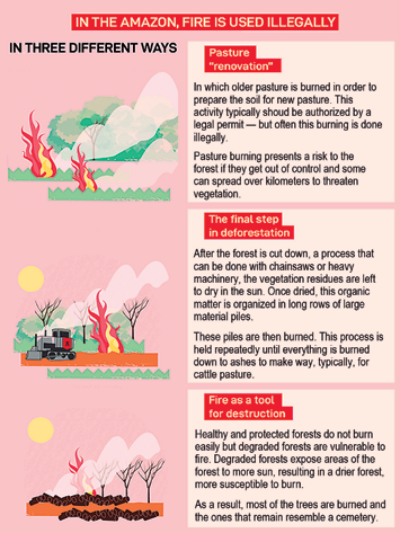
(www.greenpeace.org, 05.09.2024. Adaptado.)
No trecho do item “Pasture ‘renovation’”, do infográfico, “older pasture is burned in order to prepare the soil for new pasture”, o trecho sublinhado pode ser substituído, sem alteração de sentido, por:
Questão 22 14759048
UNIFESP 1 Dia 2025Leia o texto e examine o infográfico para responder à questão.
Year after year, illegal fires consume thousands of hectares of Brazilian biomes, threatening biodiversity and all life on the planet. Data from the end of August 2024 shows a dramatic and alarming increase in fire outbreaks compared to the same period in 2023 in the Amazon, Cerrado, and Pantanal. In this distressing scenario, impunity acts as fuel for this destruction, and the Brazilian authorities must respond quickly: investigate and hold those responsible for illegal fires accountable, while also strengthening prevention measures and adopting strategies to deal with the reality of extreme events.
The consequences of fires know no borders. In addition to causing harm to people living nearby, the smoke from fires in the Amazon and Pantanal travelled to distant regions. The state of São Paulo experienced its worst August since INPE’s (Instituto Nacional de Pesquisas Espaciais) measurements began in 1998, with 3,612 heat spots recorded — something never seen before. The reasons are still being investigated, as on a single day (August 23), the number of fire outbreaks in the state surpassed those recorded across the entire Amazon biome, where illegal fires are common at this time of year.
(www.greenpeace.org, 05.09.2024. Adaptado.)
According to the text, in August 2024, there was an unusual fire irruption event
06