


![[Marketing] Questao Topo - deslogado](https://storage.estuda.com.br/banners/0_6b7ebee90b03af1c560c73bb8bcce34a_banner_deslogado_70_dias.png)
Questões de Inglês
19.971 Questões
Questão 35 15012224
UNEMAT 2025/1The first bicycle
With covid and the coming climate crisis, bicycles are getting more and more popular. But where did the bicycle come from? Who invented this "velocipede"?
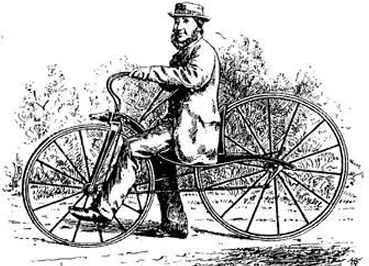
You may be surprised to learn that the humble bicycle was invented several years later than the railway locomotive! But the two-wheeler has come a long way since the day it was invented by a Scottish blacksmith, Kirkpatrick MacMillan, back (it is said) in 1839.
MacMillan developed his bike from an older wheeled vehicle, called a "hobby horse". This was a wooden horse with two wheels. The rider sat on the horse, and pushed the vehicle along with his feet. It was not a very fast or safe vehicle, since it had no steering and no brakes.
MacMillan, nicknamed Mad Pate, modified the hobby horse, by adding a system of articulated bars. The rider could push the bars back and forwards with his feet, and make the back wheel go round. He could also steer the bike, as the front wheel could be turned.
To demonstrate his invention, he cycled 60 miles to Glasgow! It must have been a terrible journey, on the roads of the day! Pate's bike did not have rubber tyres or springs.
Mad Pate was not recognised in his time, but other people became interested in bicycles. Twenty-five years later, a Frenchman called Pierre Lallemant designed and patented the first bicycle with rotary pedals; and in 1876, H.J.Lawson added another basic feature, "chain-drive".
Other features, such as rubber tyres and gears, have appeared since then; but the basic bicycle has not changed.
Since then the bicycle has had a magnificent fortune. Today, it is probably the most common form of transport in the world, especially in developing countries; and non-polluting and easy to ride, it has a big future as the town vehicle of tomorrow. Thanks Pate!
Disponível em: https://linguapress.com/intermediate/bike story.htm. Acesso em: 02 out. 2024
De acordo com o texto,
Questão 24 14981169
CESMAC Dia 1 2025/2WHO launches first-ever guidelines on meningitis diagnosis, treatment and care
The World Health Organization (WHO) has today published its first-ever global guidelines for meningitis diagnosis, treatment and care, aiming to speed up detection, ensure timely treatment, and improve long-term care for those affected. By bringing together the latest evidence-based recommendations, the guidelines provide a critical tool for reducing deaths and disability caused by the disease.
Despite effective treatments and vaccines against some forms of meningitis, the disease remains a significant global health threat. Bacterial meningitis is the most dangerous form and can become fatal within 24 hours. Many pathogens can cause meningitis with an estimated 2.5 million cases reported globally in 2019. This includes 1.6 million cases of bacterial meningitis which resulted in approximately 240 000 deaths.
Around 20% of people who contract bacterial meningitis develop long-term complications, including disabilities that impact quality of life. The disease also carries heavy financial and social costs for individuals, families, and communities.
“Bacterial meningitis kills one in six of the people it strikes, and leaves many others with lasting health challenges," said Dr Tedros Adhanom Ghebreyesus, WHO Director-General. “Implementing these new guidelines will help save lives, improve long-term care for those affected by meningitis, and strengthen health systems”.
Disponível em: https://www.who.int/news/item/10-04-2025-who-launches-first-ever-guidelines-on meningitis-diagnosis--treatment-and-care. Acesso em: 21 abr. 2025. Adaptado.
Why is bacterial meningitis considered especially severe, according to the text?
Questão 23 14981155
CESMAC Dia 1 2025/2Malaria Ends with Us: Reinvest, Reimagine, Reignite
It’s time to recommit to ending malaria. We have the knowledge, life-saving tools and targeted prevention, testing and treatment methods to defeat this disease. We must reinvest in proven interventions, reimagine our strategies to overcome current obstacles, and reignite our collective efforts together with countries and communities to accelerate progress ________ ending malaria.
Disponível em: https://www.who.int/campaigns/world-malaria-day/2025. Acesso em: 21 abr. 2025. Adaptado.
Which word best fills the gap in the passage considering the context?
Questão 22 14981146
CESMAC Dia 1 2025/2Why Employees Stay Silent When They See Warning Signs of a Problem
To address challenges posed by ambiguous threats, employees need to speak up at the earliest signs of trouble. Yet research shows that the more ambiguous a threat, the more likely employees are to remain silent. Why does it happen? The likely explanation is cognitive overload. Employees juggle multiple responsibilities, and ambiguous threats require significant mental effort to assess. As a result, they may shift their focus to more manageable tasks. Additionally, traditional workplace structures reinforce the assumption that decision-making is a leadership responsibility, while employees are expected to execute rather than question. Thus, by relying on leaders to make sense of the threat, employees offload the burden of grappling with ambiguity themselves. This reliance is problematic because even the most capable leaders may overlook ambiguous threats or misjudge weaknesses in their team’s products and processes. Meanwhile, employees — who interact with these products and processes daily — may have critical insights that could help navigate uncertainty. The authors recommend targeted actions at three levels. At the organizational level, companies should foster a mindset of proactively analyzing even the smallest errors. At the leadership level, managers should prepare employees for uncertain situations and provide them with the skills needed to recognize and respond to threats. Finally, employees themselves should be enabled to challenge leadership when necessary.
Disponível em: https://hbr.org/2025/04/why-employees-stay-silent-when-they-see-warning-signs-of-a problem. Acesso em: 20 abr. 2025. Adaptado.
Why do the authors recommend targeted actions in the text?
Questão 20 14981125
CESMAC Dia 1 2025/2Countries are already experiencing significant health system disruptions – WHO
The World Health Organization (WHO) issues warning on health service disruptions reported in 70% of its surveyed country offices as a result of sudden suspensions and reductions in official development assistance (ODA) for health.
The findings, based on rapid WHO assessment of the fast evolving situation, raise concern for potentially deeper and prolonged effects on health systems and services across the world, especially in vulnerable and fragile settings. This requires urgent action and international response.
The new rapid stock take conducted in March–April 2025 with 108 WHO country offices, primarily in low- and lower-middle income countries, shows that many countries are working to increase or reallocate funding from domestic and alternative external sources to address gaps. However, up to 24% of WHO Country Office responses suggest budget cuts are already translating into increased out-of-pocket payments. The poor and vulnerable likely risk bearing the additional brunt of these impacts.
Disponível em: https://www.who.int/news/item/10-04-2025-countries-are-already-experiencing significant-health-system-disruptions---who. Acesso em: 21 abr. 2025. Adaptado.
What does the text recommend to deal with the health service disruptions?
Questão 18 14981093
CESMAC Dia 1 2025/2Leading Global Teams Effectively
Avoid the Western assumptions that often derail cross-cultural work. by David Livermore
Western managers leading global teams face a challenge: Their expertise and training usually are rooted in individualistic contexts and emphasize values such as autonomy, empowerment, egalitarianism, and authenticity. Yet more than 70% of the world’s workforce comes from collectivist and hierarchical cultures. To be successful, managers need to develop “cultural intelligence” — a fluency in adapting to culturally complex situations. A good starting point is to understand four common mistakes that derail Western leaders: Too much autonomy. Autonomy is not equally motivating for everyone. Some individuals thrive when given clear processes and struggle to be productive in the absence of directive leadership. Too much psychological safety. People from collectivist cultures are often uncomfortable with an emphasis on open debate and frank speaking. Too much emphasis on differences. When people become overconfident in their understanding of differences, it can lead to rigid thinking in which behavior is reduced to stereotypes. Too much transparency. For people from face-saving cultures, it can be disorienting to hear a leader speak candidly about a mistake. Cultural intelligence is the key to navigating these complexities on cross-cultural teams.
Disponível em: https://hbr.org/2025/05/leading-global-teams-effectively. Acesso em: 21 abr. 2025. Adaptado
According to the text, what is the general advice for Western managers leading global teams?
06