


![[Marketing] Questao Topo - deslogado](https://storage.estuda.com.br/banners/0_6b7ebee90b03af1c560c73bb8bcce34a_banner_deslogado_70_dias.png)
Questões de Inglês
19.971 Questões
Questão 5 15188574
UEG Medicina 2025/2Leia o texto a seguir para responder à questão.
Why do doctors have bad handwriting?
Ever get a note from a doctor and not been able to read it? It’s an old joke that doctors, despite their incredible education and a job that requires critical attention to detail, just can’t seem to make their handwriting readable to the rest of us. But is the stereotype true?
Is it true that all doctors have bad handwriting?
This myth is so widespread that researchers actually looked into this claim. When comparing a group of health care professionals, including hospital executives, clinicians and managers, researchers didn’t find that doctors’ writing was any better or worse than others in the group. (The participants were given 10 seconds to write the sentence “Quality improvement is the best thing since sliced bread.”) A second, larger study also concluded that doctors’ handwriting is no worse (or better) than that of professionals in other fields.
What could make health care workers’ handwriting difficult to read?]
Health care settings are incredibly fast-paced, technical environments with few desks or writing stations. Doctors, nurses and other health care professionals are often writing detailed notes, as quickly as they can, using technical jargon, on whatever surface is available to them to write on. Patients also may be unfamiliar with the medical jargon or shorthand health care professionals use to communicate. All of these factors together can make their writing challenging to read.
Should I be worried if I can’t read my doctor’s handwriting?
Whether written on a piece of paper or emailed, it is important that patients understand what their health status is and the pros and cons of available treatment options. The solution? Talk about it with your doctor! Always best to ask about something you’re unsure about.
If you’re worried, it’s also perfectly acceptable to take your own handwritten notes during an appointment.
Let’s talk solutions
Clear and accurate communication is the bedrock of effective health care. Thankfully, the growing use of electronic health records — where notes, forms, prescriptions and treatment plans are typed out and stored electronically — are replacing the handwritten note. These systems also ensure everyone on a patient’s care team is using clear, widely accepted medical terms. And if something still isn’t clear, responses are just a phone call or email away.
Fonte: https://www.cma.ca/healthcare-for-real/why-do-doctors-have-bad-handwriting. Acesso em: 7 fev. 2025.
According to the text above, doctors
Questão 4 15188559
UEG Medicina 2025/2Leia o texto a seguir para responder à questão.
Why do doctors have bad handwriting?
Ever get a note from a doctor and not been able to read it? It’s an old joke that doctors, despite their incredible education and a job that requires critical attention to detail, just can’t seem to make their handwriting readable to the rest of us. But is the stereotype true?
Is it true that all doctors have bad handwriting?
This myth is so widespread that researchers actually looked into this claim. When comparing a group of health care professionals, including hospital executives, clinicians and managers, researchers didn’t find that doctors’ writing was any better or worse than others in the group. (The participants were given 10 seconds to write the sentence “Quality improvement is the best thing since sliced bread.”) A second, larger study also concluded that doctors’ handwriting is no worse (or better) than that of professionals in other fields.
What could make health care workers’ handwriting difficult to read?]
Health care settings are incredibly fast-paced, technical environments with few desks or writing stations. Doctors, nurses and other health care professionals are often writing detailed notes, as quickly as they can, using technical jargon, on whatever surface is available to them to write on. Patients also may be unfamiliar with the medical jargon or shorthand health care professionals use to communicate. All of these factors together can make their writing challenging to read.
Should I be worried if I can’t read my doctor’s handwriting?
Whether written on a piece of paper or emailed, it is important that patients understand what their health status is and the pros and cons of available treatment options. The solution? Talk about it with your doctor! Always best to ask about something you’re unsure about.
If you’re worried, it’s also perfectly acceptable to take your own handwritten notes during an appointment.
Let’s talk solutions
Clear and accurate communication is the bedrock of effective health care. Thankfully, the growing use of electronic health records — where notes, forms, prescriptions and treatment plans are typed out and stored electronically — are replacing the handwritten note. These systems also ensure everyone on a patient’s care team is using clear, widely accepted medical terms. And if something still isn’t clear, responses are just a phone call or email away.
Fonte: https://www.cma.ca/healthcare-for-real/why-do-doctors-have-bad-handwriting. Acesso em: 7 fev. 2025.
The text reveals that
Questão 3 15188555
UEG Medicina 2025/2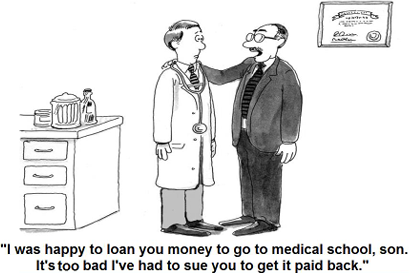
Disponível em: https://www.rd.com/list/medical-cartoons. Acesso em: 5 fev. 2025
The conversation between the characters shows that
Questão 1 15187523
UEG Medicina 2025/2Leia o texto a seguir para responder à questão.
Language Teaching New Worlds/New Words
Like desire, language disrupts, refuses to be contained within boundaries. It speaks itself against our will, in words and thoughts that intrude, even violate the most private spaces of mind and body. It was in my first year of college that I read Adrienne Rich’s poem, “The Burning of Paper Instead of Children.” That poem, speaking against domination, against racism and class oppression, attempts to illustrate graphically that stopping the political persecution and torture of living beings is a more vital issue than censorship, than burning books. One line of this poem that moved and disturbed something within me: “This is the oppressor’s language yet I need it to talk to you.” I’ve never forgotten it. Perhaps I could not have forgotten it even if I tried to erase it from memory. Words impose themselves, take root in our memory against our will. The words of this poem begat a life in my memory that I could not abort or change.
When I find myself thinking about language now, these words are there, as if they were always waiting to challenge and assist me. I find myself silently speaking them over and over again with the intensity of a chant. They startle me, shaking me into an awareness of the link between languages and domination. Initially, I resist the idea of the “oppressor’s language,” certain that this construct has the potential to disempower those of us who are just learning to speak, who are just learning to claim language as a place where we make ourselves subject. “This is the oppressor’s languages yet I need it to talk to you.” Adrienne Rich’s words. Then, when I first read these words, and now, they make me think of standard English, of learning to speak against black vernacular, against the ruptured and broken speech of a dispossessed and displaced people. Standard English is not the speech of exile. It is the language of conquest and domination; in the United States, it is the mask which hides the loss of so many tongues, all those sounds of diverse, native communities we will never hear, the speech of the Gullah, Yiddish, and so many other unremembered tongues.
Reflecting on Adrienne Rich’s words, I know that it is not the English language that hurts me, but what the oppressors do with it, how they shape it to become a territory that limits and defines, how they make it a weapon that can shame, humiliate, colonize.
[…]
To recognize that we touch one another in language seems particularly difficult in a society that would have us believe that there is no dignity in the experience of passion, that to feel deeply is to be inferior, for within the dualism of Western metaphysical thought, ideas are always more important than language. To heal the splitting of mind and body, we marginalized and oppressed people attempt to recover ourselves and our experiences in language. We seek to make a place for intimacy. Unable to find such a place in standard English, we create the ruptured, broken, unruly speech of the vernacular. When I need to say words that do more than simply mirror or address the dominant reality, I speak black vernacular. There, in that location, we make English do what we want it to do. We take the oppressor’s language and turn it against itself. We make our words a counter-hegemonic speech, liberating ourselves in language.
HOOKS, bell. Teaching to Transgress: Education as the Practice of Freedom. New York: Routledge. 1994, p.167-175. (Adaptado).
Considering the linguistic aspects in the text, it can be verified that
Questão 4 15183908
UEG 2025/1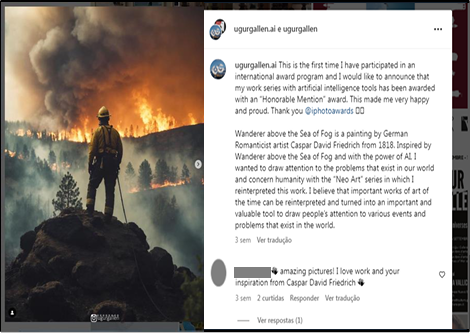
Disponível em: https://www.instagram.com/ugurgallen/. Acesso em: 14 out. 2024.
Considering this Instagram post by Turkish artist Ugur Gallenkus, known as Ugur Gallen, it can be verified that
Questão 3 15183899
UEG 2025/1Formation, by Beyoncé
(...)
My daddy Alabama, momma Louisiana
You mix that negro with that creole, make a Texas bama
I like my baby hair with baby hair and afros
I like my negro nose with Jackson Five nostrils
Earned all this money but they never take the country out me
(…)
Disponível em: https://www.vagalume.com.br/beyonce/formation.html. Acesso em: 14 out. 2024.
This part of the song “Formation” shows
06