


![[Marketing] Questao Topo - deslogado](https://storage.estuda.com.br/banners/0_6b7ebee90b03af1c560c73bb8bcce34a_banner_deslogado_70_dias.png)
Questões de Inglês
19.971 Questões
Questão 33 15419374
UENP 2025Texto para a questão.
The ugly side of beauty: Chemicals in cosmetics threaten college-age women’s reproductive health
Walk through the personal care aisles of your local store and you’ll see dozens of products that promise to soften your skin, make you smell better, extend your lashes, decrease wrinkling, tame your curly hair, or even semi-permanently change the color of your lips, hair or skin.
Many of product promises like these are based on chemicals that can also be hazardous to your health, including endocrine-disrupting chemicals that can interfere with fertility and reproduction, fetal growth and infant development.
That’s a big concern, because these products are heavily marketed to young women in the years before they might consider starting a family.
Recent studies have demonstrated that college-age women use cosmetic products at higher rates than other groups. Additionally, many of these young women are unaware of the health risks from frequent use of popular products containing contaminants of emerging concern. And finding cleaner alternatives often means paying more.
For example, in a 2021 review of studies detecting endocrine-disrupting chemicals in daily-use cosmetic products, phthalates were present in perfumes, shower gels, shampoo and nail polish. Parabens were detected in lotions, creams, shampoos, body wash, face cleansers and lipstick. Triclosan was detected in toothpastes, soaps and other cleansers. And UV filters were present in sunscreens, lotions, toothpaste, and lipstick.
Many of these chemicals can co-occur in products, putting consumers at risk of exposure to multiple chemicals at once, and sometimes without warning, as labels do not always list endocrine-disrupting chemicals among the ingredients.
As you rub cosmetic products onto your skin, breathe in their scent or use them to brush your teeth, the chemicals found within can travel throughout your body, targeting your endocrine, nervous and cardiovascular systems.
When these chemicals are endocrine disruptors, such as phthalates, parabens, triclosan and PFAS, they can mimic naturally produced hormones or block hormone receptors. Their presence can result in abnormal hormone production, secretion or transport throughout the body.
These hormonal changes can lead to reproductive problems, including poor sperm quality, miscarriage and endometriosis. They can also lead to thyroid disruption and abnormal growth and development.
Source: https://theconversation.com/the-ugly-side-of-beauty-chemicals-in-cosmetics-threaten-college-age-womensreproductive-health-206572 (Adapted)
Mark the INCORRECT option, considering the following passage from the text:
“Walk through the personal care aisles of your local store and you’ll see dozens of products that promise to soften your skin, make you smell better, extend your lashes, decrease wrinkling, tame your curly hair, or even semi-permanently change the color of your lips, hair or skin”.
Questão 32 15419373
UENP 2025Texto para a questão.
The ugly side of beauty: Chemicals in cosmetics threaten college-age women’s reproductive health
Walk through the personal care aisles of your local store and you’ll see dozens of products that promise to soften your skin, make you smell better, extend your lashes, decrease wrinkling, tame your curly hair, or even semi-permanently change the color of your lips, hair or skin.
Many of product promises like these are based on chemicals that can also be hazardous to your health, including endocrine-disrupting chemicals that can interfere with fertility and reproduction, fetal growth and infant development.
That’s a big concern, because these products are heavily marketed to young women in the years before they might consider starting a family.
Recent studies have demonstrated that college-age women use cosmetic products at higher rates than other groups. Additionally, many of these young women are unaware of the health risks from frequent use of popular products containing contaminants of emerging concern. And finding cleaner alternatives often means paying more.
For example, in a 2021 review of studies detecting endocrine-disrupting chemicals in daily-use cosmetic products, phthalates were present in perfumes, shower gels, shampoo and nail polish. Parabens were detected in lotions, creams, shampoos, body wash, face cleansers and lipstick. Triclosan was detected in toothpastes, soaps and other cleansers. And UV filters were present in sunscreens, lotions, toothpaste, and lipstick.
Many of these chemicals can co-occur in products, putting consumers at risk of exposure to multiple chemicals at once, and sometimes without warning, as labels do not always list endocrine-disrupting chemicals among the ingredients.
As you rub cosmetic products onto your skin, breathe in their scent or use them to brush your teeth, the chemicals found within can travel throughout your body, targeting your endocrine, nervous and cardiovascular systems.
When these chemicals are endocrine disruptors, such as phthalates, parabens, triclosan and PFAS, they can mimic naturally produced hormones or block hormone receptors. Their presence can result in abnormal hormone production, secretion or transport throughout the body.
These hormonal changes can lead to reproductive problems, including poor sperm quality, miscarriage and endometriosis. They can also lead to thyroid disruption and abnormal growth and development.
Source: https://theconversation.com/the-ugly-side-of-beauty-chemicals-in-cosmetics-threaten-college-age-womensreproductive-health-206572 (Adapted)
Mark the INCORRECT option, according to the text.
Questão 31 15419369
UENP 2025Texto para a questão.
The ugly side of beauty: Chemicals in cosmetics threaten college-age women’s reproductive health
Walk through the personal care aisles of your local store and you’ll see dozens of products that promise to soften your skin, make you smell better, extend your lashes, decrease wrinkling, tame your curly hair, or even semi-permanently change the color of your lips, hair or skin.
Many of product promises like these are based on chemicals that can also be hazardous to your health, including endocrine-disrupting chemicals that can interfere with fertility and reproduction, fetal growth and infant development.
That’s a big concern, because these products are heavily marketed to young women in the years before they might consider starting a family.
Recent studies have demonstrated that college-age women use cosmetic products at higher rates than other groups. Additionally, many of these young women are unaware of the health risks from frequent use of popular products containing contaminants of emerging concern. And finding cleaner alternatives often means paying more.
For example, in a 2021 review of studies detecting endocrine-disrupting chemicals in daily-use cosmetic products, phthalates were present in perfumes, shower gels, shampoo and nail polish. Parabens were detected in lotions, creams, shampoos, body wash, face cleansers and lipstick. Triclosan was detected in toothpastes, soaps and other cleansers. And UV filters were present in sunscreens, lotions, toothpaste, and lipstick.
Many of these chemicals can co-occur in products, putting consumers at risk of exposure to multiple chemicals at once, and sometimes without warning, as labels do not always list endocrine-disrupting chemicals among the ingredients.
As you rub cosmetic products onto your skin, breathe in their scent or use them to brush your teeth, the chemicals found within can travel throughout your body, targeting your endocrine, nervous and cardiovascular systems.
When these chemicals are endocrine disruptors, such as phthalates, parabens, triclosan and PFAS, they can mimic naturally produced hormones or block hormone receptors. Their presence can result in abnormal hormone production, secretion or transport throughout the body.
These hormonal changes can lead to reproductive problems, including poor sperm quality, miscarriage and endometriosis. They can also lead to thyroid disruption and abnormal growth and development.
Source: https://theconversation.com/the-ugly-side-of-beauty-chemicals-in-cosmetics-threaten-college-age-womensreproductive-health-206572 (Adapted)
Assinale a alternativa CORRETA em relação à ideia central do texto.
Questão 5 15410906
ENEM PPL 1° Dia (Verde) 2025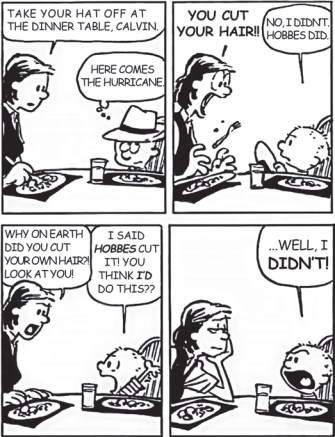
WATTERSON, B. Disponível em: www.gocomics.com. Acesso em: 14 maio 2024 (adaptado).
Nesses quadrinhos, Calvin menciona o fenômeno da natureza “hurricane” para se referir ao comportamento da mãe em reação a seu(sua)
Questão 4 15410822
ENEM PPL 1° Dia (Verde) 2025How is Dune so prescient about climate change?
The planet, or what’s left of it, is barely recognizable. Once verdant, it’s now a parched wasteland. The rich shelter in air-conditioned bubbles, leaving everyone else to face the storms and sand.
This vision of climate apocalypse is all too familiar today, but in 1963, when Frank Herbert started serializing his science-fiction epic Dune, it was deeply strange. Mr. Herbert’s tale of climate change no longer seems odd. It is in many ways the story of our time.
How did Mr. Herbert foresee our predicament? The environmentalism of Dune had a source close to home. Native communities had suffered some of the worst environmental harms in the midcentury United States, and Mr. Herbert had close contacts among the Quileute and Hoh peoples of the Olympic Peninsula in Washington State. Indigenous environmentalists alerted him to how much damage industrialism had wrought. They warned him that it could become planetary in scope, a warning that he passed on in his influential novel.
Disponível em: www.nytimes.com. Acesso em: 25 out. 2021 (adaptado).
Esse texto destaca que o romance Duna, do escritor Frank Herbert, foi
Questão 3 15410820
ENEM PPL 1° Dia (Verde) 2025Say What? / Could you please, Pleeeeeeeeeeease repeat
Did you say: Molleta? / Prieta? / Morena? Ohh African!
Hmmm Soy Puertorriquena / Yes, Puertorican
[…]
My English is covered with spices
spices from the Caribbean
Spices that you might find Strange
BARDEGUEZ-BROWN, C. Disponível em: https://poets.org. Acesso em: 21 jan. 2025 (adaptado).
Nesse poema sobre a temática da identidade, o eu lírico aborda o(a)
06