


![[Marketing] Questao Topo - deslogado](https://storage.estuda.com.br/banners/0_6b7ebee90b03af1c560c73bb8bcce34a_banner_deslogado_70_dias.png)
Questões de Inglês
19.971 Questões
Questão 18 15440669
UNIFESP 1 Dia 2026Leia o texto para responder à questão.
A new kind of Brazilian music is poised for a global boom
The world is watching Brazil after the country won its first Oscar for “I’m Still Here”, a film set in Rio de Janeiro during the dictatorship in the 1970s. The film’s smooth soundtrack feeds into foreigners’ imagination of Brazil as a country where samba and bossa nova bands croon jazzy songs on sandy boardwalks. But this image is out of date. Modern Brazilians prefer sertanejo, a bouncing country genre, and funk, a style that emerged from Rio’s favelas.
Sertanejo has been the most listened-to genre on Brazilian radio and streaming platforms for a decade. Its ascent reflects changes in Brazil’s economy, which used to be based on manufacturing but is now driven by agriculture. “Most music producers in Brazil used to be based in Rio,” says Leo Morel of Midia Research, a market-research firm. But as agriculture became more important, “rural states started winning a voice”. Sertanejo singers’ themes are cattle, beer and American pickup trucks. In 2003 the genre accounted for 15 of the 100 most-played songs on Brazilian radio; in 2022 that figure was 76. But, despite this dominance, sertanejo has little export potential. Few artists care about going global, says Mr Morel. That leaves funk (which Brazilians pronounce as “funky”) as the genre that could go global and alter Brazil’s brand.
Brazilian funk emerged in the late 1980s, inspired by Miami bass and electro-funk, two sub-genres of American hip-hop that incorporate electronic drums. Brazilians made funk their own by speeding up the underlying rhythms. Where hip-hop or reggaeton, the genre popularised in Puerto Rico, run at around 90 beats per minute, funk races along at 130 or more. Brazilians have developed a sub-culture around the genre, including weekly baile funk (dance parties) in favelas, with moves like the acrobatic passinho for men, which involves elaborate footwork, and the rebolada for women, a paced variant of twerking.
(www.economist.com, 06.03.2025. Adaptado.)
The first paragraph mentions the film “I’m Still Here” because
Questão 17 15440667
UNIFESP 1 Dia 2026Leia o texto para responder à questão.
A new kind of Brazilian music is poised for a global boom
The world is watching Brazil after the country won its first Oscar for “I’m Still Here”, a film set in Rio de Janeiro during the dictatorship in the 1970s. The film’s smooth soundtrack feeds into foreigners’ imagination of Brazil as a country where samba and bossa nova bands croon jazzy songs on sandy boardwalks. But this image is out of date. Modern Brazilians prefer sertanejo, a bouncing country genre, and funk, a style that emerged from Rio’s favelas.
Sertanejo has been the most listened-to genre on Brazilian radio and streaming platforms for a decade. Its ascent reflects changes in Brazil’s economy, which used to be based on manufacturing but is now driven by agriculture. “Most music producers in Brazil used to be based in Rio,” says Leo Morel of Midia Research, a market-research firm. But as agriculture became more important, “rural states started winning a voice”. Sertanejo singers’ themes are cattle, beer and American pickup trucks. In 2003 the genre accounted for 15 of the 100 most-played songs on Brazilian radio; in 2022 that figure was 76. But, despite this dominance, sertanejo has little export potential. Few artists care about going global, says Mr Morel. That leaves funk (which Brazilians pronounce as “funky”) as the genre that could go global and alter Brazil’s brand.
Brazilian funk emerged in the late 1980s, inspired by Miami bass and electro-funk, two sub-genres of American hip-hop that incorporate electronic drums. Brazilians made funk their own by speeding up the underlying rhythms. Where hip-hop or reggaeton, the genre popularised in Puerto Rico, run at around 90 beats per minute, funk races along at 130 or more. Brazilians have developed a sub-culture around the genre, including weekly baile funk (dance parties) in favelas, with moves like the acrobatic passinho for men, which involves elaborate footwork, and the rebolada for women, a paced variant of twerking.
(www.economist.com, 06.03.2025. Adaptado.)
In the title of the text “A new kind of Brazilian music is poised for a global boom”, the underlined phrase refers to
Questão 16 15440659
UNIFESP 1 Dia 2026Leia o texto para responder à questão.
A new kind of Brazilian music is poised for a global boom
The world is watching Brazil after the country won its first Oscar for “I’m Still Here”, a film set in Rio de Janeiro during the dictatorship in the 1970s. The film’s smooth soundtrack feeds into foreigners’ imagination of Brazil as a country where samba and bossa nova bands croon jazzy songs on sandy boardwalks. But this image is out of date. Modern Brazilians prefer sertanejo, a bouncing country genre, and funk, a style that emerged from Rio’s favelas.
Sertanejo has been the most listened-to genre on Brazilian radio and streaming platforms for a decade. Its ascent reflects changes in Brazil’s economy, which used to be based on manufacturing but is now driven by agriculture. “Most music producers in Brazil used to be based in Rio,” says Leo Morel of Midia Research, a market-research firm. But as agriculture became more important, “rural states started winning a voice”. Sertanejo singers’ themes are cattle, beer and American pickup trucks. In 2003 the genre accounted for 15 of the 100 most-played songs on Brazilian radio; in 2022 that figure was 76. But, despite this dominance, sertanejo has little export potential. Few artists care about going global, says Mr Morel. That leaves funk (which Brazilians pronounce as “funky”) as the genre that could go global and alter Brazil’s brand.
Brazilian funk emerged in the late 1980s, inspired by Miami bass and electro-funk, two sub-genres of American hip-hop that incorporate electronic drums. Brazilians made funk their own by speeding up the underlying rhythms. Where hip-hop or reggaeton, the genre popularised in Puerto Rico, run at around 90 beats per minute, funk races along at 130 or more. Brazilians have developed a sub-culture around the genre, including weekly baile funk (dance parties) in favelas, with moves like the acrobatic passinho for men, which involves elaborate footwork, and the rebolada for women, a paced variant of twerking.
(www.economist.com, 06.03.2025. Adaptado.)
The main purpose of the text is to
Questão 15 15440656
UNIFESP 1 Dia 2026Examine o meme, publicado pelo perfil @classicalcringe no Instagram, em 30.01.2025.
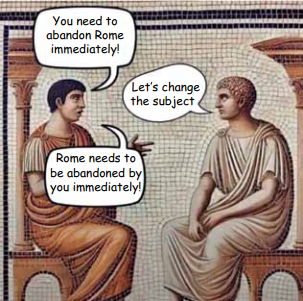
A compreensão do humor do meme demanda o conhecimento do seguinte tópico gramatical:
Questão 6 15440642
UNIFESP 1 Dia 2026This artistic and intellectual movement was not only of epoch-making importance, it was also aware of its importance. It represented one of the most decisive turning points in the history of the European mind, and it was perfectly conscious of its historical rôle. Since the Gothic, the development of sensibility had received no stronger impulse and the artist’s right to follow the call of his feelings and individual disposition had probably never been emphasized with such absoluteness. The rationalism that had been steadily progressing since the Renaissance, and was given a position of dominating importance in the whole civilized world by the enlightenment, suffered the most painful setback in its history. Never since the dissolution of the supernaturalism and traditionalism of the Middle Ages had reason, alertness and sobriety of mind, the will to and the capacity for self-control, been spoken of with such contempt.
(Arnold Hauser. The social history of art, 1999. Adaptado.)
O movimento artístico e intelectual a que o texto se refere é denominado
Questão 21 15435481
ACAFE Medicina - Verão 2026/1Consider the proverb: “Early to bed and early to rise makes a man healthy, wealthy, and wise.” Now analyze the statements that follow.
I. The word rise functions as the main verb of the sentence, agreeing in number with the compound subject.
II. The proverb has a compound subject formed by two parallel phrases.
III. The word rise is used as a verb in the infinitive form as part of a compound subject.
IV. The phrase a man healthy, wealthy, and wise is a direct object with complements that describe the result of the action.
Select the alternative that CORRECTLY describes the grammatical structure of the proverb.
06