


![[Marketing] Questao Topo - deslogado](https://storage.estuda.com.br/banners/0_6b7ebee90b03af1c560c73bb8bcce34a_banner_deslogado_70_dias.png)
Questões de Inglês
19.971 Questões
Questão 41 16198349
USP FUVEST - Simulado Oficial - 1ª Fase (1ª edição) 2026No quadro a seguir, são reproduzidos três trocadilhos, frases que possuem a função de serem engraçadas.
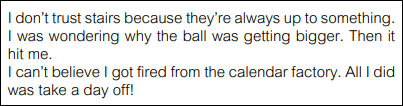
Disponível em https://parade.com/1024249/marynliles/.
O efeito de humor dos trocadilhos decorre da compreensão da
Questão 32 16198234
USP FUVEST - Simulado Oficial - 1ª Fase (1ª edição) 2026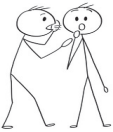
Gossip may not be good for you, per se, but it’s deeply connected to human nature.
The historian Yuval Noah Harari wrote that gossip helped early Homo sapiens form larger and more stable bands. He borrowed the idea from the anthropologist Robin Dunbar, who theorized that language — and by extension, gossip — replaced grooming, a social bonding practice still seen among our primate cousins.
Humans needed something that would help them keep upto-date with friends and family as they spread out across distances, and networks of Homo sapiens were becoming too large for everyone to effectively groom everyone else.
Or, to put it another way, humans evolved to gossip. The language of social bonding is thought to play a pivotal part in ensuring our survival and later flourishing.
Gossip’s ability to drive “vicarious learning” and facilitate “social connection” was the subject of a recent study by scientists at Dartmouth’s Computational Social Affective Neuroscience Laboratory.
Luke Chang, a professor of psychological and brain sciences, explained that he and his co-researcher, Eshin Jolly, dug into the topic because gossip is ubiquitous but not well-studied.
They created a game where individuals received small amounts of money and were divided into groups of six. Each round, an individual could choose to keep the money or put it into a pot, benefiting everyone. To replicate the societal pressures of gossip, they gave the players the option to exchange private communications, which inevitably turned into a way for people to size up who was hoarding or who was contributing.
“Our work suggests that there’s a lot more richness there than we’re willing to think about,” Mr. Jolly said. “When I’m talking with you about somebody, even if it’s negative or positive, it’s this idea that we’ve decided to temperature check how we feel about the social world at large.”
The New York Times,¬28 May, 2021. Adaptado.
De acordo com o texto, no estudo conduzido por cientistas de Dartmouth College, um aspecto associado à fofoca refere-se
Questão 31 16198195
USP FUVEST - Simulado Oficial - 1ª Fase (1ª edição) 2026
Gossip may not be good for you, per se, but it’s deeply connected to human nature.
The historian Yuval Noah Harari wrote that gossip helped early Homo sapiens form larger and more stable bands. He borrowed the idea from the anthropologist Robin Dunbar, who theorized that language — and by extension, gossip — replaced grooming, a social bonding practice still seen among our primate cousins.
Humans needed something that would help them keep upto-date with friends and family as they spread out across distances, and networks of Homo sapiens were becoming too large for everyone to effectively groom everyone else.
Or, to put it another way, humans evolved to gossip. The language of social bonding is thought to play a pivotal part in ensuring our survival and later flourishing.
Gossip’s ability to drive “vicarious learning” and facilitate “social connection” was the subject of a recent study by scientists at Dartmouth’s Computational Social Affective Neuroscience Laboratory.
Luke Chang, a professor of psychological and brain sciences, explained that he and his co-researcher, Eshin Jolly, dug into the topic because gossip is ubiquitous but not well-studied.
They created a game where individuals received small amounts of money and were divided into groups of six. Each round, an individual could choose to keep the money or put it into a pot, benefiting everyone. To replicate the societal pressures of gossip, they gave the players the option to exchange private communications, which inevitably turned into a way for people to size up who was hoarding or who was contributing.
“Our work suggests that there’s a lot more richness there than we’re willing to think about,” Mr. Jolly said. “When I’m talking with you about somebody, even if it’s negative or positive, it’s this idea that we’ve decided to temperature check how we feel about the social world at large.”
The New York Times,¬28 May, 2021. Adaptado.
Segundo o texto, para os primeiros Homo Sapiens, a fofoca
Questão 24 16197755
USP FUVEST - Simulado Oficial - 1ª Fase (1ª edição) 2026Perhaps you’ve noticed that more and more people are “creative” these days: creative directors, creative consultants, content creators. In recent essays, researchers reflect upon how a word once applied to artists was co-opted by the corporate and tech worlds. In the postwar consumer economy, businesses began to prize “creative” thinkers who could figure out how to brand and sell products. The vogue for creativity led to such intense and wacky ideas as Synectics, a kind of group therapy designed to solve problems by accessing the subconscious. Creativity has become a life style, with “coders dressed like bohemians,” and also the paragon of human flourishing: “Uncreative people are rigid and repressed; creative people are authentically themselves, and therefore fully human.” That sounds nice, but reading more about the topic could help to understand how in such cases creativity has always been more about economics than about aesthetics.
Disponível em https://www.newyorker.com/magazine/. Adaptado.
De acordo com o texto, o emprego da “criatividade” pelo mundo corporativo tem como objetivo
Questão 10 16190458
IDOMED Medicina - online 23/11 2026/1Effects of vanity on mental health and personal relationships
06 July 2024
(1st §) Vanity is a human trait that has been explored and criticized throughout history. It manifests itself in excessive concern about appearance, the constant search for recognition and valuing oneself based on the judgment of others. It is not a new phenomenon. In ancient Greece, for example, philosophers such as Socrates and Plato criticized vanity as a character flaw.
(2nd §) From a psychological perspective, vanity can be seen as a manifestation of insecurity and a need for external validation. Vain people often seek the approval of others to feel valuable and selfconfident. Moreover, this need for recognition may be a result of negative things that happened in someone´s life, such as lack of approval or rejection in childhood. Actually, vain people often seek attention and praise from others, whether through their achievements, appearance, or social status.
(3rd §) In the digital age, social media has also amplified vanity. Many people use social media platforms to present an idealized image of themselves, seeking likes, comments, and followers as a form of validation. The pressure to maintain a perfect and attractive image on social media can lead to vain behavior and excessive concern about self-image.
(4th §) Although vanity may seem like an expression of self-confidence, it is often a sign of insecurity and low self-esteem. Vain people rely on external approval to feel good about themselves, which can lead to fragile and fluctuating self-esteem. The constant search for recognition can create a feeling of emptiness and a dependence on external validation. And excessive concern about appearance and recognition can lead to stress and anxiety. Vain people may feel constant pressure to meet standards of beauty and success, which can result in anxiety and stress. This pressure can negatively impact their mental health and overall well-being.
(5th §) One way to counteract vanity is to truly love who you are and be authentic. Learning to value yourself, rather than seeking external validation, can lead to greater self-esteem and wellbeing. Authenticity in relationships and self-expression can foster more genuine and meaningful connections with others.
Available at: https://xn--soar-hqa.co/en/effects-of-vanity-on-mental-health-and-personal-relationships. Accessed in: August 30th, 2025.(Adapted).
According to the conclusion, to overcome vanity, the following is necessary:
Questão 9 16190446
IDOMED Medicina - online 23/11 2026/1Effects of vanity on mental health and personal relationships
06 July 2024
(1st §) Vanity is a human trait that has been explored and criticized throughout history. It manifests itself in excessive concern about appearance, the constant search for recognition and valuing oneself based on the judgment of others. It is not a new phenomenon. In ancient Greece, for example, philosophers such as Socrates and Plato criticized vanity as a character flaw.
(2nd §) From a psychological perspective, vanity can be seen as a manifestation of insecurity and a need for external validation. Vain people often seek the approval of others to feel valuable and selfconfident. Moreover, this need for recognition may be a result of negative things that happened in someone´s life, such as lack of approval or rejection in childhood. Actually, vain people often seek attention and praise from others, whether through their achievements, appearance, or social status.
(3rd §) In the digital age, social media has also amplified vanity. Many people use social media platforms to present an idealized image of themselves, seeking likes, comments, and followers as a form of validation. The pressure to maintain a perfect and attractive image on social media can lead to vain behavior and excessive concern about self-image.
(4th §) Although vanity may seem like an expression of self-confidence, it is often a sign of insecurity and low self-esteem. Vain people rely on external approval to feel good about themselves, which can lead to fragile and fluctuating self-esteem. The constant search for recognition can create a feeling of emptiness and a dependence on external validation. And excessive concern about appearance and recognition can lead to stress and anxiety. Vain people may feel constant pressure to meet standards of beauty and success, which can result in anxiety and stress. This pressure can negatively impact their mental health and overall well-being.
(5th §) One way to counteract vanity is to truly love who you are and be authentic. Learning to value yourself, rather than seeking external validation, can lead to greater self-esteem and wellbeing. Authenticity in relationships and self-expression can foster more genuine and meaningful connections with others.
Available at: https://xn--soar-hqa.co/en/effects-of-vanity-on-mental-health-and-personal-relationships. Accessed in: August 30th, 2025.(Adapted).
Moreover, this need for recognition may be a result of negative things that happened in someone´s life, such as lack of approval or rejection in childhood. Actually, vain people often seek attention and praise from others, whether through their achievements, appearance, or social status. (2nd §)
The underlined words can be replaced, without significant change in meaning, by the following expressions:
06