


![[Marketing] Questao Topo - deslogado](https://storage.estuda.com.br/banners/0_6b7ebee90b03af1c560c73bb8bcce34a_banner_deslogado_70_dias.png)
Questões de Inglês
19.971 Questões
Questão 56 16406658
CEFSA Conhecimentos Gerais 2026/1Leia o texto para responder à questão.
Misinformation is found in every element of our online lives. It ranges from fake products available to buy, fake lifestyle posts on social media accounts and fake news about health and politics. It has an impact not only on our beliefs but also our behavior. And since anyone can create and share online content, without the kind of verification processes or fact checking typical of more traditional media, misinformation has proliferated. This is particularly important as young people increasingly turn to social media for all kinds of information, using it as a source of news and as a search engine. But despite their frequent use of social media, teenagers struggle to evaluate the accuracy of the content they consume.
A research conducted in Scotland has explored what teenagers understand about misinformation online. It was found that the young people in the study tended to — wrongly — believe that misinformation was only about world events and scams. Because of this, they believed that they personally did not see a lot of misinformation. This may make them vulnerable to misinformation as they are only alert for it in these domains. Interestingly, the teens in this study saw older adults, particularly grandparents, as especially vulnerable to believing false information. On the other hand, they viewed their parents as more skilled at spotting misinformation than they themselves were.
The researchers discussed whose role it was to challenge misinformation online. The teens were reluctant to challenge it themselves. They thought it would not make a difference if they did, or they feared being victimized online or even offline. Instead, they believed that governments should stop the spread of misinformation “as they know about what wars are happening”. They also felt that platforms should take responsibility to stop the spread of misinformation to protect their reputation, so that people don’t panic about fake news.
(Yvonne Skipper. www.theconversation.com, 21.07.2025. Adaptado.)
De acordo com o segundo parágrafo, a pesquisa conduzida na Escócia demonstrou que os adolescentes
Questão 54 16406613
CEFSA Conhecimentos Gerais 2026/1Leia o texto para responder à questão.
Misinformation is found in every element of our online lives. It ranges from fake products available to buy, fake lifestyle posts on social media accounts and fake news about health and politics. It has an impact not only on our beliefs but also our behavior. And since anyone can create and share online content, without the kind of verification processes or fact checking typical of more traditional media, misinformation has proliferated. This is particularly important as young people increasingly turn to social media for all kinds of information, using it as a source of news and as a search engine. But despite their frequent use of social media, teenagers struggle to evaluate the accuracy of the content they consume.
A research conducted in Scotland has explored what teenagers understand about misinformation online. It was found that the young people in the study tended to — wrongly — believe that misinformation was only about world events and scams. Because of this, they believed that they personally did not see a lot of misinformation. This may make them vulnerable to misinformation as they are only alert for it in these domains. Interestingly, the teens in this study saw older adults, particularly grandparents, as especially vulnerable to believing false information. On the other hand, they viewed their parents as more skilled at spotting misinformation than they themselves were.
The researchers discussed whose role it was to challenge misinformation online. The teens were reluctant to challenge it themselves. They thought it would not make a difference if they did, or they feared being victimized online or even offline. Instead, they believed that governments should stop the spread of misinformation “as they know about what wars are happening”. They also felt that platforms should take responsibility to stop the spread of misinformation to protect their reputation, so that people don’t panic about fake news.
(Yvonne Skipper. www.theconversation.com, 21.07.2025. Adaptado.)
According to the text, misinformation is
Questão 53 16406607
CEFSA Conhecimentos Gerais 2026/1Leia o texto para responder à questão.
Misinformation is found in every element of our online lives. It ranges from fake products available to buy, fake lifestyle posts on social media accounts and fake news about health and politics. It has an impact not only on our beliefs but also our behavior. And since anyone can create and share online content, without the kind of verification processes or fact checking typical of more traditional media, misinformation has proliferated. This is particularly important as young people increasingly turn to social media for all kinds of information, using it as a source of news and as a search engine. But despite their frequent use of social media, teenagers struggle to evaluate the accuracy of the content they consume.
A research conducted in Scotland has explored what teenagers understand about misinformation online. It was found that the young people in the study tended to — wrongly — believe that misinformation was only about world events and scams. Because of this, they believed that they personally did not see a lot of misinformation. This may make them vulnerable to misinformation as they are only alert for it in these domains. Interestingly, the teens in this study saw older adults, particularly grandparents, as especially vulnerable to believing false information. On the other hand, they viewed their parents as more skilled at spotting misinformation than they themselves were.
The researchers discussed whose role it was to challenge misinformation online. The teens were reluctant to challenge it themselves. They thought it would not make a difference if they did, or they feared being victimized online or even offline. Instead, they believed that governments should stop the spread of misinformation “as they know about what wars are happening”. They also felt that platforms should take responsibility to stop the spread of misinformation to protect their reputation, so that people don’t panic about fake news.
(Yvonne Skipper. www.theconversation.com, 21.07.2025. Adaptado.)
The aim of the article is to
Questão 20 16394420
ACAFE Medicina Inverno 2026/2Text 2
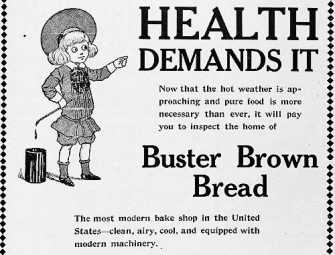
https://commons.wikimedia.org/wiki/File:Buster_Brown_Bread_(1907)_(ADVERT_448).jpeg. Access: 03 May 2026.
Transcript of the text:
HEALTH DEMANDS IT
Now that the hot weather is approaching and pure food is more necessary than ever, it will pay you to inspect the home of
Buster Brown Bread
The most modern bake shop in the United States - clean, airy, cool and equipped with modern machinery.
Source: University of Washington, Public domain, via Wikimedia Commons. Available at:
The advertisement in text 2 indirectly reveals some consumer attitudes about food production in the early 20th century.
Based on the advertisement's language and strategies, we can appropriately infer that:
Questão 19 16394412
ACAFE Medicina Inverno 2026/2Text 2
https://commons.wikimedia.org/wiki/File:Buster_Brown_Bread_(1907)_(ADVERT_448).jpeg. Access: 03 May 2026.
Transcript of the text:
HEALTH DEMANDS IT
Now that the hot weather is approaching and pure food is more necessary than ever, it will pay you to inspect the home of
Buster Brown Bread
The most modern bake shop in the United States - clean, airy, cool and equipped with modern machinery.
Source: University of Washington, Public domain, via Wikimedia Commons. Available at:
Text 2 is a fragment of a newspaper advertisement for Buster Brown Bread published in 1907.
The primary goal of the Buster Brown Bread advertisement is:
Questão 17 16394402
ACAFE Medicina Inverno 2026/2Text 1
WHO validates Brazil for eliminating mother-to-child transmission of HIV
1 The World Health Organization (WHO) has validated Brazil for the elimination of mother-to-child
2 transmission (EMTCT) of HIV, making it the most populous country in the Americas to achieve this historic
3 milestone. This accomplishment reflects Brazil’s long-standing commitment to universal and free access to
4 health services through its Unified Health System (SUS), anchored in a strong primary health-care system and
5 respect for human rights.
6 Brazil met all the criteria for EMTCT validation, including reducing vertical transmission of HIV to below 2%
7 and achieving over 95% coverage for prenatal care, routine HIV testing, and timely treatment for pregnant
8 women living with HIV. In addition to meeting the targets of the validation, Brazil demonstrated the delivery of
9 quality services for mothers and their infants, robust data and laboratory systems, and a strong commitment
10 to human rights, gender equality and community engagement.
11 The evaluation, supported by PAHO, was conducted by independent experts who reviewed data,
12 documentation, and health facility operations. Findings were then assessed by WHO’s Global Validation
13 Advisory Committee, which formally recommended Brazil’s validation for elimination.
14 “This achievement shows that eliminating vertical transmission of HIV is possible when pregnant women
15 know their HIV status, receive timely treatment, and have access to maternal health services and safe delivery,”
16 said Dr Jarbas Barbosa, Director of PAHO. “It is also the result of the tireless dedication of thousands of health
17 professionals, community health workers, and civil society organizations. Every day, they sustain the continuity
18 of care, identify obstacles, and work to overcome them, ensuring that even the most vulnerable populations can
19 access essential health services."
Wolld Health Organization. 18 Dec. 2025. Available at: https://www.who.int/news/item/18-12-2025-who-validatesbrazil-for-eliminating-mother-to-child-transmission-of-hiv (Adapted). Access: 6 Apr. 2026.
According to the Merriam-Webster dictionary, the word “delivery” can be defined as:
I. the act of taking something to a person or place.
II. the act or process of giving birth.
III. the way something is said officially or publicly.
IV. something delivered.
Mark the option that fully contains the meaning of the word “delivery” used in text 1.
06