


![[Marketing] Questao Topo - deslogado](https://storage.estuda.com.br/banners/0_6b7ebee90b03af1c560c73bb8bcce34a_banner_deslogado_70_dias.png)
Questões de Inglês
19.971 Questões
Questão 3493304
A lenda da galinha-d?angola
As pessoas mais antigas que habitavam o sul da África contam que essa história aconteceu durante a pior seca vivida na região. O sol, sem dó nem piedade, castigava todos os seres vivos.
Onde antes havia água, só se via poeira. O solo ficou seco e rachado.
Sem ter o que fazer, os habitantes da região foram embora para as montanhas e faziam preces para que a chuva voltasse, porém em vão.
Um dia, nuvens negras e pesadas começaram a se formar no céu.
A chuva estava se aproximando do vilarejo. Contudo, um elefante desgovernado espantou as nuvens. A galinha-d?angola, que até então tinha somente uma crista vermelha e as penas pretas, ao ver aquela situação entrou em desespero e correu atrás das nuvens, suplicando que voltassem.
Ela correu muito, por um longo tempo.
Ao verem o esforço da galinha tentando salvar todas as criaturas da seca, as nuvens resolveram retornar e molhar todo o território. E por causa do seu esforço, as nuvens decidiram dar um presente para a galinha.
Assim que a chuva começou a cair, molhando tudo e enchendo os rios e lagos, as gotas de água que caíam sobre as penas negras da galinha viravam pintas brancas que refletiam o brilho da chuva. Assim, a galinha-d?angola tornou-se uma das aves mais bonitas da Terra.
E, por causa do esforço e do cansaço da galinha-d"angola, todas as aves de sua espécie cacarejam até hoje: "Tô fraca, tô fraca, tô fraca, tô fraca!?.
Lenda popular recontada por Valeria Guimarães.
A lenda da galinha-d?angola
As pessoas mais antigas que habitavam o sul da África contam que essa história aconteceu durante a pior seca vivida na região. O sol, sem dó nem piedade, castigava todos os seres vivos.
Onde antes havia água, só se via poeira. O solo ficou seco e rachado.
Sem ter o que fazer, os habitantes da região foram embora para as montanhas e faziam preces para que a chuva voltasse, porém em vão.
Um dia, nuvens negras e pesadas começaram a se formar no céu.
A chuva estava se aproximando do vilarejo. Contudo, um elefante desgovernado espantou as nuvens. A galinha-d?angola, que até então tinha somente uma crista vermelha e as penas pretas, ao ver aquela situação entrou em desespero e correu atrás das nuvens, suplicando que voltassem.
Ela correu muito, por um longo tempo.
Ao verem o esforço da galinha tentando salvar todas as criaturas da seca, as nuvens resolveram retornar e molhar todo o território. E por causa do seu esforço, as nuvens decidiram dar um presente para a galinha.
Assim que a chuva começou a cair, molhando tudo e enchendo os rios e lagos, as gotas de água que caíam sobre as penas negras da galinha viravam pintas brancas que refletiam o brilho da chuva. Assim, a galinha-d?angola tornou-se uma das aves mais bonitas da Terra.
E, por causa do esforço e do cansaço da galinha-d"angola, todas as aves de sua espécie cacarejam até hoje: "Tô fraca, tô fraca, tô fraca, tô fraca!?.
O texto apresentado tem como objetivo
Questão 3493254
The three presents of D?Artagnan The Elder
In those times panics were common, and few days passed without some city or other registering in its archives an event of this kind. There were nobles, who made war against each other; there was the king, who made war against the cardinal; there was Spain, which made war against the king. Then, in addition to these concealed or public, secret or open wars, there were robbers, mendicants, Huguenots, wolves, and scoundrels, who made war upon everybody.
Alexandre Dumas.
The three presents of D?Artagnan The Elder
In those times panics were common, and few days passed without some city or other registering in its archives an event of this kind. There were nobles, who made war against each other; there was the king, who made war against the cardinal; there was Spain, which made war against the king. Then, in addition to these concealed or public, secret or open wars, there were robbers, mendicants, Huguenots, wolves, and scoundrels, who made war upon everybody.
Alexandre Dumas.
O trecho retirado do romance de Alexandre Dumas, The Three Musketeers, descreve uma época que se caracteriza, primordialmente, por ter sido
Questão 3493252
LOOMINGS
Call me Ishmael. Some years ago " never mind how long precisely " having little or no money in my purse, and nothing particular to interest me on shore, I thought I would sail about a little and see the watery part of the world. It is a way I have of driving off the spleen and regulating the circulation. [?]
Again, I always go to sea as a sailor, because they make a point of paying me for my trouble, whereas they never pay passengers a single penny that I ever heard of. On the contrary, passengers themselves must pay. And there is all the difference in the world between paying and being paid. The act of paying is perhaps the most uncomfortable infliction that the two orchard thieves entailed upon us. But being paid, " what will compare with it" [?]
MELVILLE, Herman. Moby dick. Nova Iorque: Quarto Knows, 2016. p. 1?3.
Call me Ishmael. Some years ago " never mind how long precisely " having little or no money in my purse, and nothing particular to interest me on shore, I thought I would sail about a little and see the watery part of the world. It is a way I have of driving off the spleen and regulating the circulation. [?]
Again, I always go to sea as a sailor, because they make a point of paying me for my trouble, whereas they never pay passengers a single penny that I ever heard of. On the contrary, passengers themselves must pay. And there is all the difference in the world between paying and being paid. The act of paying is perhaps the most uncomfortable infliction that the two orchard thieves entailed upon us. But being paid, " what will compare with it" [?]
MELVILLE, Herman. Moby dick. Nova Iorque: Quarto Knows, 2016. p. 1?3.
O romance Moby Dick, ou The Whale (título sob o qual o fascículo foi primeiramente publicado), foi escrito pelo estadunidense Herman Melville e publicado em Londres em 1851. A fantástica história narra o infortúnio encontro entre um navio baleeiro e uma baleia cachalote. O trecho acima, retirado do primeiro capítulo do romance, narra
Questão 3493236
"When I was alive and had a human heart," answered the statue, "I did not know what tears were, for I lived in the Palace of Sans-Souci, where sorrow is not allowed to enter. In the daytime I played with my companions in the garden, and in the evening I led the dance in the Great Hall. Round the garden ran a very lofty wall, but I never cared to ask what lay beyond it, everything about me was so beautiful. My courtiers called me the Happy Prince, and happy indeed I was, if pleasure be happiness. So I lived, and so I died. And now that I am dead they have set me up here so high that I can see all the ugliness and all the misery of my city, and though my heart is made of lead yet I cannot choose but weep."
WILDE, Oscar. The Happy Prince. 1888.
"When I was alive and had a human heart," answered the statue, "I did not know what tears were, for I lived in the Palace of Sans-Souci, where sorrow is not allowed to enter. In the daytime I played with my companions in the garden, and in the evening I led the dance in the Great Hall. Round the garden ran a very lofty wall, but I never cared to ask what lay beyond it, everything about me was so beautiful. My courtiers called me the Happy Prince, and happy indeed I was, if pleasure be happiness. So I lived, and so I died. And now that I am dead they have set me up here so high that I can see all the ugliness and all the misery of my city, and though my heart is made of lead yet I cannot choose but weep."
WILDE, Oscar. The Happy Prince. 1888.
"The Happy Prince" é o título de um conto escrito em 1888 por Oscar Wilde. O conto é iniciado com uma apresentação do príncipe, personagem descrito, no momento da narrativa, como um
Questão 3493188
GO WEST
(Together) We will go our way
(Together) We will leave some day
[...]
There, where the air is free
We"ll be (we"ll be) what we want to be
Now, if we make a stand
We"ll find (we"ll find) our promised land!
(I know that) there are many ways
(To live there) in the sun or shade
(Together) we will find the place
(To settle) where there?s so much space
[?]
(Together) We will go our way
(Together) We will leave some day
[...]
There, where the air is free
We"ll be (we"ll be) what we want to be
Now, if we make a stand
We"ll find (we"ll find) our promised land!
(I know that) there are many ways
(To live there) in the sun or shade
(Together) we will find the place
(To settle) where there?s so much space
[?]
Pet Shop Boys. Go West. Very. 1993.
O título da música faz referência a "Go West, young man", frase popularizada em um jornal no século XIX referente à colonização americana do Oeste do país. Esse expansionismo foi conduzido pela ideia de que Deus deu o direito aos europeus de dominarem todo o território conhecido hoje como Estados Unidos. Com relação ao trecho da letra de música acima, é possível concluir que
Questão 64 16165101
USP FUVEST - Simulado Oficial - 1ª Fase (2ª edição) 2027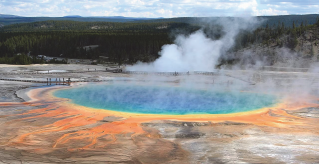
Molecules in hot springs such as Yellowstone's Grand Prismatic
Spring could have been a source of early life.¬(Frank Kovalchek).
When a bone grows, our bodies’ proteins help provide the structure. When a muscle tears, proteins help rebuild it. When we fight an infection, transport oxygen in our blood or send messages to a cell, proteins often step up to the plate. But how did these skilled molecules first form on Earth and help give rise to life?
The mystery, which has evaded scientists for more than five decades, can be explained with rather simple chemistry, according to a study published in Nature.
In lab experiments, scientists have successfully shown how two basic ingredients of life — ribonucleic acid (RNA) and amino acids — can combine to start protein synthesis.
The basic ingredients and conditions — in water — are thought to have been around on Earth about 4 billion years ago, providing clues to how early life may have been kickstarted or could arise on other planets.
“It seems pretty probable” that this reaction would have been occurring on early Earth, said Matthew Powner, a chemist at University College London and an author of the new study.
Powner’s lab investigates the chemical processes that lead to life, exploring key mechanisms seen in all living organisms. One of the most fundamental processes is how cells make proteins, the complex molecules responsible for our growth and survival from bone formation to immune support.
Proteins are made of amino acids, which are thought to have been around long before life emerged. Proteins can’t replicate themselves and are built from blueprints, provided by nucleic acids like DNA and RNA, that instruct the amino acids to assemble.
The Washington Post.27 August 2025. Adaptado.
De acordo com o texto, a explicação de que proteínas são construídas a partir de instruções fornecidas por ácidos nucleicos está associada à ideia de que
06