


![[Marketing] Questao Topo - deslogado](https://storage.estuda.com.br/banners/0_6b7ebee90b03af1c560c73bb8bcce34a_banner_deslogado_70_dias.png)
Questões de Inglês
19.971 Questões
Questão 43 44374
UNEMAT 1° Dia 2011/2Texto 1
OBAMA’S VISIT TO BRRELATIONS
By Juan Forero and Perry Bacon Jr.

[1] Shortly after taking office, President Obama
declared Brazil's charismatic president Luiz Inacio
Lula da Silva "the most popular politician on Earth."
And Lula said he was "a fan" of Obama.
[5] The relationship held the promise of a closer
alliance between Washington and Brasilia. But it
soon soured, with Lula saying at the end of his term
that the United States behaved as an "empire" and
that "nothing had changed" under Obama.
[10] Now, Obama and Brazil's new president, Dilma
Rousseff, will try to repair at times strained
relations between the two countries as the
American president arrives for a two-day state visit
before flying to Chile, a close U.S. ally, and El
[15] Salvador, where drug-related violence is rising.
There's positive interest on both sides in starting
over," said ]ulia Sweig, a scholar at the Council on
Foreign Relations who recently met with officials in
the new government in Brazil. "Now they have to
[20] translate that optimism and goodwill to figure out
what they can do together that's in both of their
interests, and how to mitigate the tensions that will
naturally arise."
The trip will be Obama's first to South America as
[25] president. Even as the crisis in ]apan and unrest in
the Middle East dominate Obama's national
security briefings, administration officials decided
not to cancel the president's trip but instead cast it
as a way to renew relations with a region that is an
[30] emerging market for U.S.-made goods.
The trip is in part a kind of box-checking exercise,
as the Obama administration wanted to make a
major trip to this region of the world in Obama's
first term. White House officials said they would
[35] use Obama's visit to the three countries, but
particularly Brazil, to emphasize economic issues,
in a nod to an American electorate concerned about
high unemployment.
This trip fundamentally is about the U.S. recovery,
[40] U.S. exports and the critical relationship that Latin
America plays in our economic future and jobs here
in the United States," said Michael Froman, deputy
national security adviser for international
economic affairs.
[45] Brazil is the most influential country in this region,
and American officials, while playing down any
tensions with Lula, have expressed optimism about
establishing close ties With Rousseff.
Fonte: WASHINGTON POST NEWS SERVICE
O termo unrest (ℓ 25) significa:
Questão 88 43995
UFG 2011/2
Read the cartoon.

According to the doctor, his patient should
Questão 82 43989
UFG 2011/2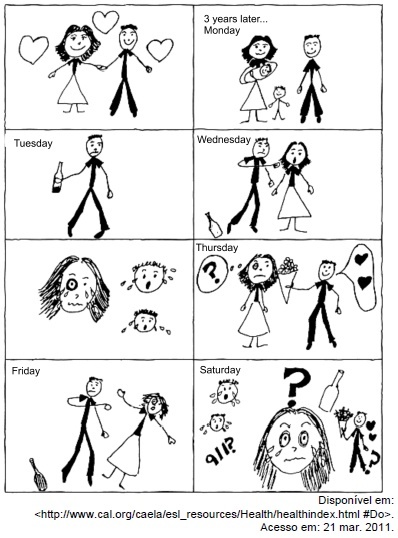
The aim of this picture story is to
Questão 76 41815
UFPR 2011Lucy’s Big Brother Reveals New Facets of her Species
First came Lucy. Then came Lucy’s baby, an infant of her species. Now comes Lucy’s “big brother”: the partial skeleton of a large male of Australopithecus afarensis, unveiled this week in the Proceedings of the National Academy of Sciences. The roughly 40% complete skeleton has been nicknamed Kadanuumuu, which means “big man” in the Afar language of the Afar Depression of Ethiopia, where it was found. “It was huge – a big man, with long legs”, says lead author Yohannes Haile-Selassie, a palaeoanthropologist at the Cleveland Museum of Natural History in Ohio.
Dated to 3.6 million years ago, the new skeleton is almost half a million years older than Lucy and the second oldest skeleton found of a possible human ancestor. It had long legs and a torso and a pelvis more like those of a modern human than an African ape, showing that fully upright walking was in place at this early date, Haile-Selassie says. Although headless, the skeleton also preserves parts not found before in Lucy’s species. “It is important because it provides the ribs and scapula”, says palaeoanthropologist Carol Ward of the University of Missouri, Columbia.
In 2005, a sharp-eyed member of Haile-Selassie’s team, Alemayehu Asfaw, spotted a fragment of lower arm bone on the ground at Woranso-Mille, about 48 kilometers north of Lucy’s grave at Hadar. Over the next 4 years, the team unearthed the shoulder blade, collarbone, ribs, and neck vertebra, the first time those bones were found together in an A. afarensis adult. The team also found a pelvis, an arm, and leg bones. Although they never found the skull or teeth, which are typically used to assign species, the skeleton’s age and similarity to Lucy suggest that it belongs to her species, says co-author Owen Lovejoy of Kent State University in Ohio.
The robust male stood between 1.5 and 1.7 meters tall, about 30% larger than Lucy. Isolated bones of other individuals suggest that some males were even larger, so the new skeleton doesn’t settle a long-standing debate over just how much sexual dimorphism there was in A. afarensis, Lovejoy says. The shoulder blade looks more like that of a gorilla and a modern human than that of a chimpanzee. The curvature of the second rib suggests a wide rib cage at the top and a barrel shape overall, similar to that of modern humans and distinct from the more funnel-shaped rib cage of a chimpanzee, the authors say.
(Science Magazine, 25 June 2010.)
Why do palaeoanthropologists believe the skeleton may be a human ancestor?
Questão 73 41812
UFPR 2011Lucy’s Big Brother Reveals New Facets of her Species
First came Lucy. Then came Lucy’s baby, an infant of her species. Now comes Lucy’s “big brother”: the partial skeleton of a large male of Australopithecus afarensis, unveiled this week in the Proceedings of the National Academy of Sciences. The roughly 40% complete skeleton has been nicknamed Kadanuumuu, which means “big man” in the Afar language of the Afar Depression of Ethiopia, where it was found. “It was huge – a big man, with long legs”, says lead author Yohannes Haile-Selassie, a palaeoanthropologist at the Cleveland Museum of Natural History in Ohio.
Dated to 3.6 million years ago, the new skeleton is almost half a million years older than Lucy and the second oldest skeleton found of a possible human ancestor. It had long legs and a torso and a pelvis more like those of a modern human than an African ape, showing that fully upright walking was in place at this early date, Haile-Selassie says. Although headless, the skeleton also preserves parts not found before in Lucy’s species. “It is important because it provides the ribs and scapula”, says palaeoanthropologist Carol Ward of the University of Missouri, Columbia.
In 2005, a sharp-eyed member of Haile-Selassie’s team, Alemayehu Asfaw, spotted a fragment of lower arm bone on the ground at Woranso-Mille, about 48 kilometers north of Lucy’s grave at Hadar. Over the next 4 years, the team unearthed the shoulder blade, collarbone, ribs, and neck vertebra, the first time those bones were found together in an A. afarensis adult. The team also found a pelvis, an arm, and leg bones. Although they never found the skull or teeth, which are typically used to assign species, the skeleton’s age and similarity to Lucy suggest that it belongs to her species, says co-author Owen Lovejoy of Kent State University in Ohio.
The robust male stood between 1.5 and 1.7 meters tall, about 30% larger than Lucy. Isolated bones of other individuals suggest that some males were even larger, so the new skeleton doesn’t settle a long-standing debate over just how much sexual dimorphism there was in A. afarensis, Lovejoy says. The shoulder blade looks more like that of a gorilla and a modern human than that of a chimpanzee. The curvature of the second rib suggests a wide rib cage at the top and a barrel shape overall, similar to that of modern humans and distinct from the more funnel-shaped rib cage of a chimpanzee, the authors say.
(Science Magazine, 25 June 2010.)
Are the statements true (T) or false (F), according to the text?
( ) The new skeleton was really Lucy’s brother.
( ) The new skeleton is almost 100% complete.
( ) The new skeleton is larger than that of Lucy.
( ) The new skeleton is similar to a chimpanzee.
( ) The team spent four years excavating for bones.
Mark the alternative which presents the correct sequence, from top to bottom.
Questão 43 41327
UNEMAT 1° Dia 2011/1Texto 1
CAN A VIRUS MAKE YOU FAT?
Although the idea sounds more like the premise of a B movie than scientific theory two scientists at the University of Wisconsin in Madison believe they've found a virus that causes some people to get fat. Nikhil Dhurandhar and Richard Atkinson reported recently that when they injected a virus known as AD36 into mice and chickens, the animals' body fat increased. Because humans were unlikely to volinteer for such exiperimentation, the scientists decided to test for the presence of antibodies to the virus. Of 154
people tested, about 15 percent of those who were obese had the antibodies. None of the lean people did.
However, the findings don't necessarily prove that the virus caused obesity in the test group. As several virologists have pointed out, obese people may simply be more susceptible to such a virus.

Biologists have
found a virus
that causes
obesity in
animals such as
chickens. Now
the researchers
are testing
people for it.
A palavra unlikely significa:
06