


![[Marketing] Questao Topo - deslogado](https://storage.estuda.com.br/banners/0_6b7ebee90b03af1c560c73bb8bcce34a_banner_deslogado_70_dias.png)
Questões de Inglês
19.971 Questões
Questão 57 43833
FUVEST (USP) 2012
Although robots have made great strides in manufacturing, where tasks are repetitive, they are still no match for humans, who can grasp things and move about effortlessly in the physical world. Designing a robot to mimic the basic capabilities of motion and perception would be revolutionary, researchers say, with applications stretching from care for the elderly to returning overseas manufacturing operations to the United States (albeit with fewer workers).
Yet the challenges remain immense, far higher than artificial intelligence obstacles like speaking and hearing. “All these problems where you want to duplicate something biology does, such as perception, touch, planning or grasping, turn out to be hard in fundamental ways,” said Gary Bradski, a vision specialist at Willow Garage, a robot development company based in Silicon Valley. “It’s always surprising, because humans can do so much effortlessly.”
http://www.nytimes.com, July 11, 2011. Adaptado.
De acordo com o texto, o especialista Gary Bradski afirma que
Questão 56 43831
FUVEST (USP) 2012
Although robots have made great strides in manufacturing, where tasks are repetitive, they are still no match for humans, who can grasp things and move about effortlessly in the physical world. Designing a robot to mimic the basic capabilities of motion and perception would be revolutionary, researchers say, with applications stretching from care for the elderly to returning overseas manufacturing operations to the United States (albeit with fewer workers).
Yet the challenges remain immense, far higher than artificial intelligence obstacles like speaking and hearing. “All these problems where you want to duplicate something biology does, such as perception, touch, planning or grasping, turn out to be hard in fundamental ways,” said Gary Bradski, a vision specialist at Willow Garage, a robot development company based in Silicon Valley. “It’s always surprising, because humans can do so much effortlessly.”
http://www.nytimes.com, July 11, 2011. Adaptado.
Segundo o texto, um grande desafio da robótica é
Questão 55 43830
FUVEST (USP) 2012JUST 10 YEARS INTO A NEW CENTURY, MORE THAN TWO-thirds of the country sees the past decade as a period of decline for the U.S., according to a new TIME/Aspen Ideas Festival poll that probed Americans on the decade since the tragic events of Sept. 11, 2001. Osama bin Laden is dead and al-Qaeda seriously weakened, but the impact of the 9/11 attacks and the decisions that followed have, in the view of most Americans, put the U.S. in a tailspin that the country has been unable to shake during two administrations and almost 10 years of trying.
ACCORDING TO THE POLL, ONLY 6% OF MORE THAN 2,000 Americans believe the country has completely recovered from the events of 9/11. Some of this pessimism can be tied to fears of more terrorist attacks. Despite the death of bin Laden, most Americans think another terrorist attack in the U.S. is likely.
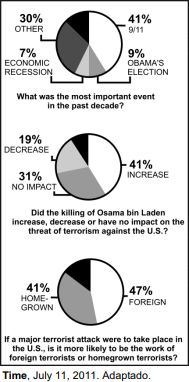
Com base nos gráficos que acompanham o texto, é correto afirmar que, para os norte-americanos,
Questão 54 43828
FUVEST (USP) 2012JUST 10 YEARS INTO A NEW CENTURY, MORE THAN TWO-thirds of the country sees the past decade as a period of decline for the U.S., according to a new TIME/Aspen Ideas Festival poll that probed Americans on the decade since the tragic events of Sept. 11, 2001. Osama bin Laden is dead and al-Qaeda seriously weakened, but the impact of the 9/11 attacks and the decisions that followed have, in the view of most Americans, put the U.S. in a tailspin that the country has been unable to shake during two administrations and almost 10 years of trying.
ACCORDING TO THE POLL, ONLY 6% OF MORE THAN 2,000 Americans believe the country has completely recovered from the events of 9/11. Some of this pessimism can be tied to fears of more terrorist attacks. Despite the death of bin Laden, most Americans think another terrorist attack in the U.S. is likely.
A sequência “most Americans think another terrorist attack in the U.S. is likely” significa que, para a maioria dos norte-americanos, outro ataque terrorista nos EUA é
Questão 16 42713
UERJ 2012/2What’s in a name? The trouble with lingo
Remember the campaign in New York for garbage collectors to be called sanitation engineers?
Near the top of the strike’s agenda was the matter of getting the respect due to the people doing
such essential work. Unfortunately, the new euphemistic title clarified nothing about the work
and by now is either simply not heard for what it means, or is used in moments of gentle disdain.
[5] A clearer term may have both generated the respect desired and withstood the test of time.
Clarity and sincerity matter. Terms which mislead, confuse or cause offence can become
a distraction from the real content of public debate. In the search for consensus, since public
understanding is harder to change than terminology, changing the terminology might be a better
place to start. No additional prejudice or emotion should be brought to a debate by the terminology
[10] used in it. Here are two examples.
Genetic Engineering and Genetic Modification
Despite the insistence of biotech scientists that genes of completely different species are no
longer being mixed, the message isn’t being heard. They insist that they are now involved only
in developments which simply hasten the natural processes of selective and cross breeding or
[15] cross pollination. As farmers and horticulturists have been doing exactly this, unquestioned, for
years, they cannot understand public resistance.
The problem may well be the terminology. In this context, the words “scientific” or “genetic” have
been irreparably sullied. If “genetic engineering” has, in the public’s view, become synonymous
with the indiscriminate mixing of genes, and if the softer label “genetically modified” hasn’t been
[20] able to shake off a perception of sinister overtones, these terms might as well be dropped − or
left attached only to experiments in Dr. Frankenstein’s laboratory.
Ideally, a new agricultural term would leave out the word “genetic” altogether: it seems to
frighten the public. Assuming it described science’s benign genetic activities accurately, the term
“productivity breeding” is not a trivial call for a euphemism; besides, it would probably encounter
[25] less public opposition.
So, let’s have new terms for selective cross breeding by scientists who simply speed up the same
process that is carried out in nature.
Clean coal*
If this new term was intended to be clear, it hasn’t worked.
[30] In “Politics and the English Language” (1946), George Orwell wrote that because so much political
speech involves defending the indefensible, it has to consist largely of euphemism. He insisted
that, in politics, these euphemisms are “swindles” and “perversions” left deliberately vague in
order to mislead. Deliberate or not, “clean coal” is one of these. Aside from being a contradiction
in terms, the name is misleading, creating the impression of the existence of a new type of coal. In
[35] fact, it is ordinary coal which has been treated to “eliminate” most of its destructive by-products,
which are then buried. The whole process produces emissions. This, though, isn’t clear when it
is simply labelled “clean coal”. The term just doesn’t seem sincere. It’s a red rag to any green.
It’s not asking too much to expect the term describing these procedures to be more accurate. A
clearer term would be less provocative.
[40] So, what’s in a name? A lot. There’s the possibility of confusion, prejudice, perversions and
swindles. For the sake of fair debate, let’s mean what we say and say what we mean.
SEEARGH MACAULAY www.londongrip.com
The fragments below share the question “What’s in a name?”:
- What’s in a name? The trouble with lingo (title) So, what’s in a name? (l. 40)
- What’s in a name? That which we call a rose By any other name Would smell as sweet
WILLIAM SHAKESPEARE
The author of the text uses a resource that consists of borrowing from another text, published beforehand.
This resource is called:
Questão 20 42418
UERJ 2012/1Happiness
It was almost nightfall. The whole day: rain, torrents of rain. Drenched to the bone, I arrived in a
little Calabrian village. I had to find a hearth where I could dry out, a corner where I could sleep.
The streets were deserted, the doors bolted. The dogs were the only ones to scent the stranger’s
breath; they began to bark from within the courtyards. The peasants in this region are wild and
[5] misanthropic, suspicious of strangers. I hesitated at every door, extended my hand, but did not
dare to knock.
O for my late grandfather in Crete!, who took his lantern each evening and made the rounds of
the village to see if any stranger had come. He would take him home, feed him, give him a bed for
the night, and then in the morning see him off with a cup of wine and a slice of bread. Here in the
[10] Calabrian villages there were no such grandfathers.
Suddenly I saw an open door at the edge of the village. Inclining my head, I looked in: a murky
corridor with a lighted fire at the far end and an old lady bent over it. She seemed to be cooking.
I crossed the threshold and entered. I reached the fire and sat down on a stool which I found in
front of the hearth. The old lady was squatting on another stool, stirring the meal with a wooden
[15] spoon. I felt that she eyed me rapidly, without turning. But she said nothing. Taking off my jacket,
I began to dry it. I sensed happiness rising in me like warmth, from my feet to my shins, my thighs,
my breast. Hungrily, avidly, I breathed in the delicious smell of the steam rising from the pot.
Once more I realized to what an extent earthly happiness is made to the measure of man. It is not
a rare bird which we must pursue at one moment in heaven, at the next in our minds. Happiness
[20] is a domestic bird in our own courtyards.
As soon as we finished, she prepared a bed for me on a bench to the right of the table. I lay down,
and she lay down on the other bench opposite me. Outside the rain was falling by the bucketful.
For a considerable time I heard the water cackle on the roof, mixed with the old lady’s calm, quiet
breathing. She must have been tired, for she fell asleep the moment she inclined her head. Little
[25] by little, with the rain and the old lady’s respiration, I too slipped into sleep. When I awoke, I saw
daylight peering through the cracks in the door.
The old lady had already risen and placed a saucepan on the fire to prepare the morning milk.
I looked at her now in the sparse daylight. Shriveled and hump, she could fit into the palm of
your hand. Her legs were so swollen that she had to stop at every step and catch her breath.
[30] But her eyes, only her large, pitch-black eyes, gleamed with youthful, unaging brilliance. How
beautiful she must have been in her youth, I thought to myself, cursing man’s fate, his inevitable
deterioration. Sitting down opposite each other again, we drank the milk. Then I rose and slung
my carpetbag over my shoulder. I took out my wallet, but the old lady colored deeply.
“No, no,” she murmured, extending her hand.
[35] As I looked at her in astonishment, the whole of her wrinkled face suddenly gleamed.
“Goodbye, and God bless you,” she said. “May the Lord repay you for the good you’ve done me.
Since my husband died I’ve never slept so well.”
NIKOS KAZANTZAKIS* http://grammar.about.com
Happiness is a domestic bird in our own courtyards. (ℓ. 19-20)
This fragment contains a figure of speech which is labeled as:
06