


![[Marketing] Questao Topo - deslogado](https://storage.estuda.com.br/banners/0_6b7ebee90b03af1c560c73bb8bcce34a_banner_deslogado_70_dias.png)
Questões de Inglês
19.971 Questões
Questão 21 77172
UFU 2° Dia 2012/2TEXT 1
The Art and Heart of Blind Photographers
By Matt Kettmann Santa Barbara sunday, May 17, 2009
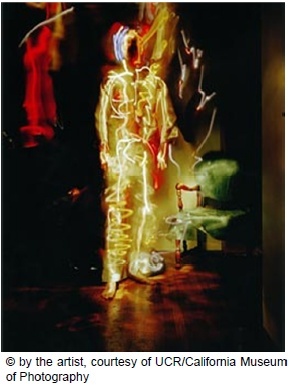
Blind photography: the very concept sounds like an oxymoron. But an intriguing and often striking exhibition of photographs in Riverside, California, argues that it emanates from the core of contemporary art. The show “Sight Unseen,” at the California Museum of Photography until Aug. 29, features everything from underwater scenes off Catalina Island, transvestites in New Orleans and Braille-enhanced black-and-whites as well as portraits, nudes, landscapes, travel shots, abstracts, collages, and everything else you might expect from a “sighted” photographer. Except the subtext and context is blindness: the photographers are legally blind, some born without sight or with limited vision, and others who have lost their vision over time. And that is why, argues the man who organized the show, they are at the very heart of art.
“The whole trajectory of modern art for the last 100 years has been toward the concept of mental construction, and blind photography comes from that place,” says the show’s “sighted” curator Douglas McCulloh, himself a photographer. “They’re creating that image in their head first – really elaborate, fully realized visions – and then bringing some version of that vision into the world for the rest of us to see.” A sample of the photographs posted by TIME. com received a huge amount of attention.
One participating photographer is Pete Eckert, an artist with multiple degrees in design and sculpture who only turned to photography after losing his vision in the mid-1980s. He opens the shutter on his camera and then uses flashlights, lasers, lighters, and candles to paint his scene on film. He explains: “The human brain is wired for optical input, for visualization. The optic nerve bundle is huge. Even with no input, or maybe especially with no input, the brain keeps creating images. I’m a very visual person, I just can’t see.” “Sighted photographers always talk about the difficulty of what they call ‘seeing’,” Eckert adds. “I tell them ‘If you can’t see, it’s because your vision is getting in the way.’”
Perhaps the most experienced blind photographers come from New York City’s Seeing With Photography Collective, which has been shooting blind since 1988 under the direction of Mark Andres. The Riverside exhibition features some collaborative group work, but also pieces by individual members. One of those is Sonia Soberats, who explains, “When I tell people I do photography, they don’t believe me. When a person achieves something that others think you can’t because you are blind, you feel it much more.” Another individually recognized collective artist is Steven Erra, who says, “I only see parts of things at a time, very small areas at one time. These pictures that we’re taking now concentrate on one area at a time. A sharpness, a blurriness, a sharpness, a blurriness, your eyes are always going from one to the other, which is how I view the world, too.”
McCulloh has been pursuing these blind photographers for more than a decade, and began pitching the idea of this show four years ago. But the time became right this year, he says because “I’m convinced of its importance. The main trigger is that I’ve seen a real groundswell of interest around the world in a whole lot of different places, including Tel Aviv, CzecDisponível em: . Acesso em: jun. 2012. (adaptado) hoslovakia, Mexico City, London, Los Angeles.... I felt like the movement was really there.” Thanks to crowds and critical acclaim, the exhibit seems likely to show again in Mexico City after leaving Riverside.
De acordo com o texto, os fotógrafos cegos caracterizam-se por
Questão 28 76477
FATEC 2012/1PSYCHOLOGY OF MONEY
Want Happiness? Don’t Buy More Stuff — Go on Vacation When it comes to spending money on things or experiences, the research is clear: doing brings more happiness than owning.
By Gary Belsky & Tom Gilovich | July 21, 2011
Given that it’s vacation season for many folks, we thought it a good time to devote this Mind Over Money post to a brief discussion of what personal finance is ultimately all about. Some people, of course, really enjoy counting their money, deriving great satisfaction simply from watching their bottom line grow, often quite removed from any thought of what they might do with their riches. But for most of us, money is just a token for what we can do with it — pay the mortgage or rent, send kids to college, buy a TV or travel to Italy. And for nearly all of us, money is finite; there isn’t enough to do all we want, so we must be selective. That raises a crucial question: if we want to maximize the happiness or satisfaction we get from our money, how should we spend it?
There’s been a lot of recent research on this subject, much of it conducted at Tom’s home institution, Cornell University. And the answer is clear. If you’re conflicted about whether to spend money on a material good (say, a computer) or personal experience (say, a vacation), the research says you’ll get much more satisfaction — and for longer — if you choose the experience. Most of us, it turns out, get more bang from the experiential buck. Indeed, when people are asked to recall their most significant material and experiential purchases over the previous five years, they report that the experience brought more joy, was a source of more enduring satisfaction and was more clearly “money well spent¨.
This might seem counter-intuitive. After all, when faced with a trade-off between doing and buying, many people opt for the material good because “it will still be there” long after the experience would have been enjoyed. In one sense that’s correct: The material good lasts while the experience is fleeting. But psychologically it’s the reverse. We quickly adapt to the material good, but the experience endures in the memories we cherish, the stories we tell and the very sense of who we are.
(http://moneyland.time.com Acesso em 25/08/2011. Adaptado.)
Indique a tradução correta para o substantivo research no segundo parágrafo do texto.
Questão 6 76455
FATEC 2012/1Gaddafi’s HIV Shakedown
By Mike Elkin
Zakia Saltani has been warned not to talk to the press. She doesn’t care. She has waited 13 years to tell her story, and the Libyan government’s threats can’t stop her now. “After what happened to my family, what more can they do?” she asks. “I am beyond fear.”
At her friend’s house in Benghazi, with the red-black-and green flag of the anti-Gaddafi rebellion spread proudly across her shoulders, she shows a framed photograph of her son, Ashur. He died of AIDS-related complications in May 2005, when he was 8. He had been one of more than 400 Libyan children who were admitted to the Al Fateh pediatric hospital in Benghazi 13 years ago with routine complaints like colds and earaches. They left with HIV. Like Ashur, roughly 60 have since died. Others are hanging on.
(Newsweek, 21.03.2011. Adaptado)
No primeiro parágrafo do texto, a afirmação de Zakia Saltani – “I am beyond fear” – representa
Questão 25 76417
FATEC 2012/2Fight the Violence!
Oct 14, 2011 6:53 PM EDT
What if gang violence in America could be reduced just by talking? Professor and activist David Kennedy talks with Ben Crair about his new book, Don’t Shoot, criticism of his plan, and the economics of gangs.
In 1995, David M. Kennedy went to Boston on behalf of* Harvard’s Kennedy School of Government to study violent crime. Like many American cities at that time, Boston was suffering a wave of homicides. After linking up with a special Boston Police Department task force, Kennedy and his team recognized that most of the killing was the work of a small handful of identifiable gang members. Rather than locking them all up, they tried something new: They met with the gang members and community leaders, offered them assistance in getting off the streets, and warned them that, if any single gang member committed another murder*, they would crack down* on the entire group. Crime dropped almost overnight, and Kennedy’s “Operation Ceasefire,” as it has come to be known, has been implemented in more than 70 cities, addressing issues from gun violence to drug markets to juvenile robberies. Now, Kennedy recounts his experiences in a new book, Don’t Shoot: One Man, a Street Fellowship, and the End of Violence in Inner-City America.
(Newsweek, 14.10.2011. Adaptado)
*on behalf of:em nome de
*murder: assassinato
*crack down: usar de repressão com punição severa
Assinale a alternativa que apresenta o motivo correto pelo qual David M. Kennedy foi a Boston.
Questão 18 75744
FDF 2012Brazilian judge orders construction of Amazon dam to stop
Tom Phillips, Thursday 29 September 2011
A Brazilian judge has ordered construction to be suspended on a controversial hydroelectric dam in the Amazon. In his ruling, Judge Carlos Castro Martins said that all working on the Belo Monte dam that interfered with the natural course of the Xingu river should be halted because of the risk that fish stocks would be damaged. The £7bn dam would reputedly be the third largest in the world, after China's Three Gorges and the Itaipu project on the Brazil-Paraguay border.
The injunction is the latest development in a decades-long battle against the Belo Monte dam, plans for which were conceived in the mid-1970's but subsequently shelved after protests. Brazil's government argues that the dam is essential to the energy needs of the country's booming economy. A full environmental licence for the construction was issued in June, with federal authorities promising a series of initiatives to lessen the social and environmental impact of the dam.
On Tuesday, activists from the anti-dam Xingu Para Sempre movement claimed the project had brought unprecedented chaos to the riverside town of Altamira, with thousands of impoverished migrants having arrived by boat or road in search of work. "Nothing good is coming to the region and all of our darkest prophecies are coming true," Antonia Melo, one of the movement's leaders, said.
Earlier this week, politicians from Altamira's townhall filed papers with the regional public prosecutor, asking for work on the dam to be interrupted. "The former president, Luiz Inacio Lula da Silva, publicly promised … that the project would bring major benefits to Altamira and 10 other towns around this mega-project," the document said. "But what we have so far seen are painful frustrations such as increased poverty, insecurity and social chaos." On Wednesday the judge issued his ruling to suspend building work.
While there has long been widespread opposition to the dam from environmentalists, social activists and even Hollywood figures such as the director James Cameron, Altamira's political leaders have been broadly supportive of Belo Monte in the past, arguing it could bring development to the region.
Norte Energia, the consortium behind Belo Monte's construction, is expected to appeal against the decision.
www.guardian.co.uk/environment/2011/ sep/29/brazilian-judge-monte-bello-dam Adaptado.
As obras de Belo Monte
Questão 19 50623
UCS Vestibular de Verão 2012SHADOW TRAIN
An Arizona Ghost Story retold by
S. E. Schlosser
[1] A young miner was on his way to Dos Cabezas, where he heard there was a good chance of finding gold, when
he found himself lost and alone in the plains just north of the Dragoon Mountains. In the hot sun of midday, his burro
died because of the heat and the miner knew that he would shortly follow if he did not find a place to hide from the
sun and something to drink.
[5] The landscape oscillated before his eyes, and he tried to keep on walking, determined not to drop. But the heat
of the desert invaded his body and he started to perambulate. Then he collapsed.
He was awakened by a constant chug-chug sound. He raised his head from the hard and dry ground and
looked around him. It sounded like a train was approaching. But that was impossible. There were no tracks in this
inhospitable location, and no town for miles. Clackity-clack. Clackity-clack. The sound came again, louder this time.
[10] Chug-chug- chug. Then he heard the sound of an engine. He was hallucinating, he decided.
The miner put his head on his arms and waited for death to come. As he was there, feeling extremely hot, he
seemed to hear the words of the old miner who had told him about the good mining sites in the north. The
grey-haired man had spoken of a shadow train that had appeared out of nowhere and ran just above the plains
where no railroad tracks had ever been placed. The shadow train had passed across the desert before his very
[15] eyes. It had disappeared into the distance while the old man watched, turning into a mirage and then vanishing into
the strong light of the sun.
At the time, the young miner thought the old man was a bit of a nut. It was an illusion caused by the heat, he
presumed. But with the constant chug-chug-chug becoming louder in his ears, he was not so sure. He raised his
head again, and saw something, approaching rapidly. He heard the sharp whistle of a train, once, twice. After a
[20] while, he could make out the shape of a black steam engine pulling two cars.
The whistle sounded sharply again as the train advanced toward him. The young miner wanted to jump out of
its path, but he could not lift himself. He closed his eyes and braced for the impact, but the train slowed down and
stopped just a few feet from his head. A jolly-faced conductor stepped out of the train and came over to him. The
conductor bent down and lifted him from the ground. Someone else whom he couldn't see caught his feet, and he
[25] was carried inside a passenger car. Kind faces surrounded him. "Water," he murmured, __________ before losing
consciousness.
He was wakened by the feeling of cold water onto his face. He opened his eyes and saw a tall man wearing a
sheriff's badge carefully pouring water from a pitcher over him. The man held a cup to his lips, careful not to give
him too much water at once. The miner had difficulty to drink it. After having some of it, when he was finally able to
[30] speak, he asked the sheriff what had happened.
"A farmer found you nearly dead about five miles out of town," the sheriff answered laconically.
"What town?" he asked cautiously.
The sheriff looked at him strangely. "That sun sure must have messed with your head, son, if you can't even
remember where you were going to," said the sheriff. "You're in Wilcox, Arizona."
[35] "It's a stop on the train, then?" he asked hesitantly.
"Train? There ain't no train around for miles," said the sheriff. "You'd better have some more water and rest a
bit. That sun's nearly sent you loco!"
The young miner laid back down thankfully and closed his eyes. He wasn't sure why the shadow train had
come to his rescue, but he was sure glad it had stopped for him.
[40] Years later, the Southern Pacific Railroad put a track right through Wilcox, Arizona, and real trains started
rolling through Arizona. But some say the shadow train still races through the plains at midday, where no track was
ever laid.
(Disponível em: . Acesso em 11 abr. 2011. – Texto adaptado.)
É possível afirmar que a frase The whistle sounded sharply again as the train advanced toward him. (linha 21) descreve o fato de que
06