


![[Marketing] Questao Topo - deslogado](https://storage.estuda.com.br/banners/0_6b7ebee90b03af1c560c73bb8bcce34a_banner_deslogado_70_dias.png)
Questões de Inglês
19.971 Questões
Questão 57 86311
UNIFOR 1ª Fase 2013/2Veja a figura abaixo:
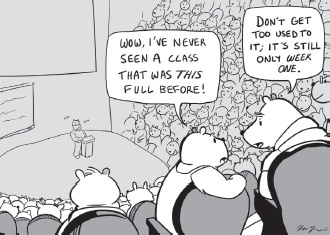
I. Both students are amazed with the huge number of classmates.
II. One of the students thinks the huge audience is impressive.
III. Neither of them is used to seeing such a crowded lecture.
IV. Either of them used to have such a crowded lecture.
V. One of them seems to have had crowded lectures.
Assinale a opção correta:
Questão 56 86310
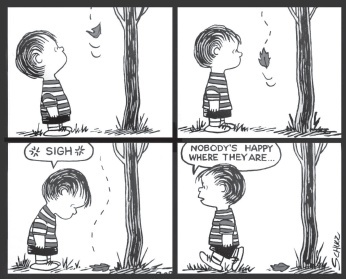
UNIFOR 1ª Fase 2013/2Veja a figura abaixo e escolha a opção correta:
Questão 95 75953
ENEM 2° Dia (Amarela) 2013Steve Jobs: A Life Remembered 1955-2011
Readersdigest.ca takes a look back at Steve Jobs, and his contribution to our digital world.
CEO. Tech-Guru. Artist. There are few corporate figures as famous and well-regarded as former-Apple CEO Steve Jobs. His list of achievements is staggering, and his contribution to modern technology, digital media, and indeed the world as a whole, cannot be downplayed.
With his passing on October 5, 2011, readersdigest.ca looks back at some of his greatest achievements, and pays our respects to a digital pioneer who helped pave the way for a generation of technology, and possibilities, few could have imagined.
Disponível em: www.readersdigest.ca. Acesso em: 25 fev. 2012.
Informações sobre pessoas famosas são recorrentes na mídia, divulgadas de forma impressa ou virtualmente.
Em relação a Steve Jobs, esse texto propõe
Questão 94 75952
ENEM 2° Dia (Amarela) 2013National Geographic News
Christine Dell’Amore
Published April 26, 2010
Our bodies produce a small steady amount of natural morphine, a new study suggests. Traces of the chemical are often found in mouse and human urine, leading scientists to wonder whether the drug is being made naturally or being delivered by something the subjects consumed. The new research shows that mice produce the “incredible painkiller” — and that humans and other mammals possess the same chemical road map for making it, said study co-author Meinhart Zenk, who studies plant-based pharmaceuticals at the Donald Danforth Plant Science Center in St. Louis, Missouri.
Disponível em: www.nationalgeographic.com. Acesso em: 27 jul. 2010.
Ao ler a matéria publicada na National Geographic, para a realização de um trabalho escolar, um estudante descobriu que
Questão 92 75950
ENEM 2° Dia (Amarela) 2013Do one thing for diversity and inclusion
The United Nations Alliance of Civilizations (UNAOC) is launching a campaign aimed at engaging people around the world to Do One Thing to support Cultural Diversity and Inclusion. Every one of us can do ONE thing for diversity and inclusion; even one very little thing can become a global action if we all take part in it.
Simple things YOU can do to celebrate the World Day for Cultural Diversity for Dialogue and Development on May 21.
1. Visit an art exhibit or a museum dedicated to other cultures.
2. Read about the great thinkers of other cultures.
3. Visit a place of worship different than yours and participate in the celebration.
4. Spread your own culture around the world and learn about other cultures.
5. Explore music of a different culture. There are thousands of things that you can do, are you taking part in it?
UNITED NATIONS ALLIANCE OF CIVILIZATIONS. Disponível em: www.unaoc.org. Acesso em: 16 fev. 2013 (adaptado).
Internautas costumam manifestar suas opiniões sobre artigos on-line por meio da postagem de comentários.
O comentário que exemplifica o engajamento proposto na quarta dica da campanha apresentada no texto é:
Questão 18 75795
FDF 2013Brazil: Slum campaign on human rights ahead of police operation
5 November 2012
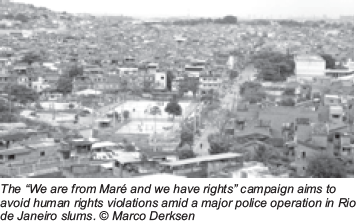
Tens of thousands of residents in one of Rio de Janeiro's biggest favelas are being targeted by Amnesty International and NGO partners to ensure they know their human rights ahead of a police operation to retake the area from armed criminal= gangs.
Beginning on 6 November, Amnesty International and local NGOs Redes de Desenvolvimento da Maré and Observatório de Favelas will distribute some 50,000 information packs to people living in slums in the Maré area of the Brazilian city. The campaign – “We are from Maré and we have rights” – is aimed at avoiding the kinds of human rights violations that have taken place during similar recent operations when Police Pacification Units (Unidade de Polícia Pacificadora, UPP) moved into Rio's favelas.
“We want to break with the notion that anything goes because there's a 'war' against organized crime – this includes putting an end to violating the rights of residents of the communities where the UPPs move in,” said Átila Roque, Amnesty International's Brazil Director. “Police operations to pacify high-crime areas can only be justified if they can guarantee the rights of all citizens, startingwith the slum-dwellers.”
The information packs that are being distributed by the NGOs include information on the slum-dwellers' rights and duties if they are approached by police officers – in the street or at home.Asign included in the pack lists police actions deemed unacceptable – including entering homes without a warrant, discriminating against individuals on any basis, or putting the lives of residents at risk by using firearms in densely populated areas.
The organizations recognize that Rio de Janeiro's police have a duty to carry out their jobs, but urge them to treat Maré residents with respect and civility. The campaign is part ongoing efforts by civil society groups to work together with Rio de Janeiro's slumdwellers to improve awareness about human rights. “The purpose of the campaign is to empower people in the favelas so they can play their part of in ensuring their own safety and that of their neighbours,” said Eliana Silva, Director of Redes de Desenvolvimento da Maré.
The federal and state governments have been working together to “pacify” high-crime areas in Rio de Janeiro's favelas, with the aim of installing 40 UPPs in high-crime areas by 2014. Besides bringing law and order to areas previously under the control of criminal gangs and militias – in some cases for upwards of two decades – the programme aims to bring much-needed social services to some of the city's most impoverished areas.
The Maré area – made up of 16 separate favelas – is home to 130,000 people, making it more populous than 80 per cent of Brazilian cities. “Our basic assumption is that the city should be for everyone. We can't tolerate a police officer treating residents differently on the basis of their colour, sexual preference, physical appearance or social class – whether it's in Maré or in better-off areas of the city,” said Jaílson Silva, Coordinator-General of Observatório de Favelas. “We want people to take ownership of the city and be aware of their rights as a first step towards everyone being able to circulate freely with security, beginning in their own neighbourhoods.”
www.amnesty.org/en/news/brazil-slum-campaign-human-rightsahead-police-operation-2012-11-05
No trecho do terceiro parágrafo - We want to break with the notion that anything goes because there's a 'war' against organized crime - a expressão anything goes equivale, em português, a
06