


![[Marketing] Questao Topo - deslogado](https://storage.estuda.com.br/banners/0_6b7ebee90b03af1c560c73bb8bcce34a_banner_deslogado_70_dias.png)
Questões de Inglês
19.971 Questões
Questão 29 237126
UESB Caderno 1 2013TEXTO:
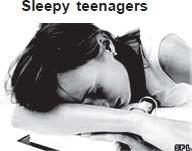
Teenagers are renowned for enjoying lengthy
lie-ins in the morning. But contrary to popular belief,
their reluctance to get out of bed may not be just down
to laziness alone.
[5] This bedroom is a battleground. Morgan’s 17, and
like most other teenagers, she struggles to surface.
Noelle Delaney, her mother, says: “Some days it is very
difficult…you know I have to go in there two, three times.
I have been known to pull her by her feet out of her bed.”
[10] Morgan replies:“It’s too early to get up in the morning,
especially in the winter when it’s quite dark out. It just
seems like you’re getting up in the middle of the night,
you just want to be back in bed.”
And that’s why sleep scientists studied Morgan
[15] and her friends for two weeks. These wrist-mounted
sensors monitored their every move — waking and
sleeping.Analysis of that data surprised the scientists.
They found that consistently the teenagers get just six
and a half hours sleep a night. Most adults need at least
[20] eight. When the clocks moved forward to British Summer
Time the youngsters got even less — just six hours a
night.
As Joanne Bower, from the University of Surrey,
says, “You’ve got something inside you called your
[25] circadian rhythm [body clock] which insures the same
thing happens the same time every day and one of those
things is the secretion of melatonin which is the hormone
that makes you sleepy. Now for an adult you expect
that to be early evening, in teenagers it happens much
[30] later so even if you put your teenager in bed at say ten
at night it may be that they don’t secrete their melatonin
until midnight, one o’clock, so they’re staring at the
ceiling just not sleepy.” Consistent sleep deprivation
can affect concentration, memory or even mood. The
[35] scientists behind this study say more research is needed
because, like Morgan, most teenagers have busy
lives — what they’re not getting is enough rest.
SLEEP teenagers. Disponível em: <www.bbc.co.uk/worldservice/learningenglish/language/wordsinthenews/>. Acesso em: 12 out 2012.
Considering language use in the text, it’s correct to say:
Questão 28 237124
UESB Caderno 1 2013TEXTO:
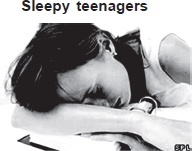
Teenagers are renowned for enjoying lengthy
lie-ins in the morning. But contrary to popular belief,
their reluctance to get out of bed may not be just down
to laziness alone.
[5] This bedroom is a battleground. Morgan’s 17, and
like most other teenagers, she struggles to surface.
Noelle Delaney, her mother, says: “Some days it is very
difficult…you know I have to go in there two, three times.
I have been known to pull her by her feet out of her bed.”
[10] Morgan replies:“It’s too early to get up in the morning,
especially in the winter when it’s quite dark out. It just
seems like you’re getting up in the middle of the night,
you just want to be back in bed.”
And that’s why sleep scientists studied Morgan
[15] and her friends for two weeks. These wrist-mounted
sensors monitored their every move — waking and
sleeping.Analysis of that data surprised the scientists.
They found that consistently the teenagers get just six
and a half hours sleep a night. Most adults need at least
[20] eight. When the clocks moved forward to British Summer
Time the youngsters got even less — just six hours a
night.
As Joanne Bower, from the University of Surrey,
says, “You’ve got something inside you called your
[25] circadian rhythm [body clock] which insures the same
thing happens the same time every day and one of those
things is the secretion of melatonin which is the hormone
that makes you sleepy. Now for an adult you expect
that to be early evening, in teenagers it happens much
[30] later so even if you put your teenager in bed at say ten
at night it may be that they don’t secrete their melatonin
until midnight, one o’clock, so they’re staring at the
ceiling just not sleepy.” Consistent sleep deprivation
can affect concentration, memory or even mood. The
[35] scientists behind this study say more research is needed
because, like Morgan, most teenagers have busy
lives — what they’re not getting is enough rest.
SLEEP teenagers. Disponível em: <www.bbc.co.uk/worldservice/learningenglish/language/wordsinthenews/>. Acesso em: 12 out 2012.
“You’ve got” (l. 24) is the same as you
Questão 29 221108
FACISA 2013/2TEXT C
ARE VAMPIRES FOR REAL?

Vampires don’t exist, but in the past, myths about bloodsucking ghosts were common. Throughout the world, archaeologists have found graves containing humans who were believed to be vampires. One of the most recent discoveries was made in Bulgaria during the excavation of a church in Sozopol near the Black Sea, where scientists found two skeletons around 700 years old with iron rods through their chests.
The belief in vampires originated long before modern times. The earliest known account of vampirelike creatures is 4,000 years old and stems from Mesopotamia. About 500 years ago, the belief in vampires swept across Eastern Europe, spreading to Western Europe at a later point in time.
Count Dracula was based on a real person. The most famous vampire in history is Bram Stoker’s Count Dracula, who was inspired by Prince Vlad Tepes Dracula, ruler of Wallachia in Romania in the mid-1400s. Tepes means “the impaler” and the prince earned his nickname through his preferred means of executing his enemies by penetrating the body with a pole and erecting it, thereby impaling his victim.
TEXT C tells us that Prince Dracula of Wallachia earned his nickname “Tepes” because he
Questão 23 221094
FACISA 2013/2TEXT A
INBOX HEROES

Once upon a time, receiving e-mail was a pleasant, even welcome experience. Now our inboxes buckle under the weight of an ever expanding morass of messages – many of which are ads and notifications sent by relentless machines rather than fellow human beings. […] These days, the best thing about e-mail isn’t getting it, it’s getting rid of it. Startups and established players alike are devising innovative tools for taming chaotic inboxes.[…] They’re free and work with your existing e-mail account, especially if it’s Gmail.
FIVE ROUTES TO AN ORDERLY INBOX
MAILBOX: When you don’t have time to deal with a message at this very moment, this app lets you banish it from your inbox – and then bring it back to the top at a time of your choice.[…]
MAILSTORM: It’s a specialized tool best used for deleting e-mail as swiftly as possible. You can use it to eradicate mail from your inbox in bulk – for instance, by deleting all the messages from a particular person – whether or not you’ve actually read them.
TENXER: Tenxer analyzes how long it takes you to respond to messages in Gmail. Then the service goads you into timelier communications through a bevy of stats and charts that track your progress toward faster responses.
ALTO: AOL’s ad-free service sucks e-mail from Gmail, Yahoo, AOL and other providers into one unified inbox. It automatically diverts not-so-vital missives such as ads and social-network notifications into stacks that you can peruse at your leisure or ignore altogether.
CLOZE: […] This ambitious app melds mail, Facebook, LinkedIn and Twitter. You can check out, in one place, all the conversations you’ve had in any medium with a particular person — and they all get a Cloze score based on factors like the freshness and frequency of your interactions with them.
Time, March 4th, 2013
Which of the following statements is TRUE with reference to TEXT A?
Questão 60 197049
IMEPAC 2013/1Health
Increase in diabetes brings a spike in related eye disease
Blood vessels can leak into the retina
By Nanci Hellmich
USA Today
The nation‟s rising level of diabetes is driving another health problem: a significant jump in adults with vision problems from a related condition called diabetic retinopathy.
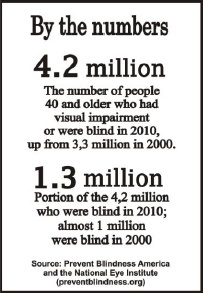
From 2000 and 2010, there was an 89% increase in the number of people with diabetic retinopathy, which affects the tiny blood vessels of the retina. The most severe forms can impair vision if not treated. About 7.7 million people ages 40 and older have diabetic retinopathy, the new estimates say.
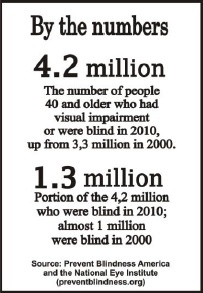
The numbers emerge from an analysis, out today, by a group of researchers and sponsored by Prevent Blindness America and the National Eye Institute.
“The number we are most alarmed about is the increase in diabetic retinopathy, which is largely due to the diabetes epidemic,” says Jeff Todd, chief operating officer of
Prevent Blindness America.
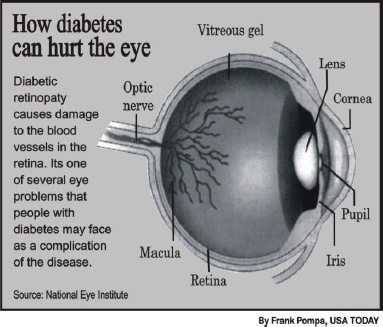
Almost 26 million people in the USA have diabetes, the Centers for Disease Control and Prevention says. In diabetic retinopathy, high blood sugar causes small blood vessels to swell and leak into the retina, blurring vision and sometimes leading to blindness. A government study in 2008 found that about 4.2 million adults had the disease, the leading cause of blindness in adults.
“You can treat and stop progression,” says Beatriz Muñoz, an associate professor of ophthalmology at the Wilmer Eye Institute at Johns Hopkins School of Medicine in Baltimore. But the disease can be “asymptomatic,” or without symptoms: “You may not know you have it,” she says, “So it‟s important to have regular eye exams.”
The vision analysis found that overall, the number of people over 40 with vision impairment and blindness has increased 23% in the past decade, partly because of more people with eye conditions such as cataracts.
Vision impairment is defined as having worse than 20/40 vision in the better eye even with glasses. In the USA, people are typically considered blind with vision of 20/200 or worse in their best eye.
If the trend remains the same, about 13 million in the USA will have visual impairment or be blind by 2050, the report says. “The increase we‟re seeing in eye diseases mirrors the increase in the aging population,” Todd says.
Estimates for eye conditions:
• 24.3 million people 40 and older have cataracts, a 19% jump from 2000. A cataract is a clouding of the eye‟s clear lens that appears with age. Surgery is effective in restoring vision. Muñoz says, but “there is no clear way to prevent it.”
• 2.7 million people ages 40 and older have open-angle glaucoma, the most common form of the disease, up 22%. Glaucoma causes damage to the optic nerve. Treatments can slow progression, she says.
• 2.1 million people ages 50 and older have late age-related macular degeneration, a 25% increase from 2000. Late AMD is the most severe form, and treatments can slow progression and prevent vision loss for some of the forms, Muñoz says.
USA Today, Wednesday, June 20, 2012, p. 6D.
The researchers have found out that in the past decade
Questão 56 197040
IMEPAC 2013/1INSTRUCTIONS - Read the following text carefully and then choose the correct alternatives that answer the questions or complete the statements placed after it. Attention: take your answers from the text!
Health
Increase in diabetes brings a spike in related eye disease
Blood vessels can leak into the retina
By Nanci Hellmich
USA Today
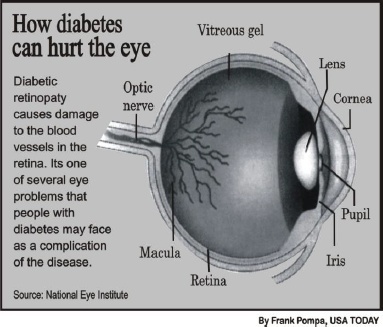
The nation‟s rising level of diabetes is driving another health problem: a significant jump in adults with vision problems from a related condition called diabetic retinopathy.
From 2000 and 2010, there was an 89% increase in the number of people with diabetic retinopathy, which affects the tiny blood vessels of the retina. The most severe forms can impair vision if not treated. About 7.7 million people ages 40 and older have diabetic retinopathy, the new estimates say.
The numbers emerge from an analysis, out today, by a group of researchers and sponsored by Prevent Blindness America and the National Eye Institute.
“The number we are most alarmed about is the increase in diabetic retinopathy, which is largely due to the diabetes epidemic,” says Jeff Todd, chief operating officer of
Prevent Blindness America.
Almost 26 million people in the USA have diabetes, the Centers for Disease Control and Prevention says. In diabetic retinopathy, high blood sugar causes small blood vessels to swell and leak into the retina, blurring vision and sometimes leading to blindness. A government study in 2008 found that about 4.2 million adults had the disease, the leading cause of blindness in adults.
“You can treat and stop progression,” says Beatriz Muñoz, an associate professor of ophthalmology at the Wilmer Eye Institute at Johns Hopkins School of Medicine in Baltimore. But the disease can be “asymptomatic,” or without symptoms: “You may not know you have it,” she says, “So it‟s important to have regular eye exams.”
The vision analysis found that overall, the number of people over 40 with vision impairment and blindness has increased 23% in the past decade, partly because of more people with eye conditions such as cataracts.
Vision impairment is defined as having worse than 20/40 vision in the better eye even with glasses. In the USA, people are typically considered blind with vision of 20/200 or worse in their best eye.
If the trend remains the same, about 13 million in the USA will have visual impairment or be blind by 2050, the report says. “The increase we‟re seeing in eye diseases mirrors the increase in the aging population,” Todd says.
Estimates for eye conditions:
• 24.3 million people 40 and older have cataracts, a 19% jump from 2000. A cataract is a clouding of the eye‟s clear lens that appears with age. Surgery is effective in restoring vision. Muñoz says, but “there is no clear way to prevent it.”
• 2.7 million people ages 40 and older have open-angle glaucoma, the most common form of the disease, up 22%. Glaucoma causes damage to the optic nerve. Treatments can slow progression, she says.
• 2.1 million people ages 50 and older have late age-related macular degeneration, a 25% increase from 2000. Late AMD is the most severe form, and treatments can slow progression and prevent vision loss for some of the forms, Muñoz says.
USA Today, Wednesday, June 20, 2012, p. 6D.
The text deals with
06