


![[Marketing] Questao Topo - deslogado](https://storage.estuda.com.br/banners/0_6b7ebee90b03af1c560c73bb8bcce34a_banner_deslogado_70_dias.png)
Questões de Inglês
19.971 Questões
Questão 52 2063161
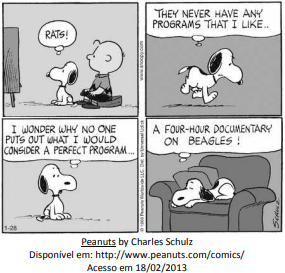
UnirG 2013/1Leia a tira a seguir e responda à questão.

Com base na interpretação da tira, conclui-se que os três primeiros personagens envolvidos
Questão 51 2063148
UnirG 2013/1Leia o texto a seguir para responder à questão
The Yearly International Buy Nothing Day

The end of November many countries worldwide experience the International Buy Nothing Day/No Shop Day. Buy Nothing Day is especially a day of protest by all of those who find that they have enough, and want to voice their opposition to the incessant trend towards 'always more.' Buy Nothing Day is particularly celebrated in countries that have a very high level of consumption.
The initiative for the Buy Nothing Day was taken in 1992, in Canada, by Ted Dave, who was working in the advertising world. By doing this, he wanted to perform an act against the constant appeal to overconsume, which advertisements pour out on us. His motto was: Enough is enough! Since then the idea of the Buy Nothing Day has been adopted by increasingly more countries. This year there will be activities in at least thirteen countries.
Participate by not participating!
The easiest way to become involved in the Buy Nothing Day is: Stay at home! Give yourself and your wallet a day of rest by not shopping. Some countries have special posters to put in your windows. Those who want to participate in this campaign in a more active way - and that is definitely much more fun - can contact the coordinating group in their own country.
Omslag, Workshop for Sustainable Development - The Netherlands
Disponível em: http://www.koopniets.nl/buynothingday.htm Acesso em: 28 out. 2012. (Adaptado).
Glossário:
to voice: verbalizar
trend: tendência
pour out: despejar
motto: lema
O nome da campanha “Buy Nothing Day” pode ser reescrito, sem alterar seu sentido original, da seguinte forma:
Questão 50 2063132
UnirG 2013/1Leia o texto a seguir para responder à questão
The Yearly International Buy Nothing Day
The end of November many countries worldwide experience the International Buy Nothing Day/No Shop Day. Buy Nothing Day is especially a day of protest by all of those who find that they have enough, and want to voice their opposition to the incessant trend towards 'always more.' Buy Nothing Day is particularly celebrated in countries that have a very high level of consumption.
The initiative for the Buy Nothing Day was taken in 1992, in Canada, by Ted Dave, who was working in the advertising world. By doing this, he wanted to perform an act against the constant appeal to overconsume, which advertisements pour out on us. His motto was: Enough is enough! Since then the idea of the Buy Nothing Day has been adopted by increasingly more countries. This year there will be activities in at least thirteen countries.
Participate by not participating!
The easiest way to become involved in the Buy Nothing Day is: Stay at home! Give yourself and your wallet a day of rest by not shopping. Some countries have special posters to put in your windows. Those who want to participate in this campaign in a more active way - and that is definitely much more fun - can contact the coordinating group in their own country.
Omslag, Workshop for Sustainable Development - The Netherlands
Disponível em: http://www.koopniets.nl/buynothingday.htm Acesso em: 28 out. 2012. (Adaptado).
Glossário:
to voice: verbalizar
trend: tendência
pour out: despejar
motto: lema
O principal objetivo da campanha é protestar contra
Questão 50 1549460
PUC-PR Inverno 2013Read the text below and answer question.
Will we ever grow replacement hands?
Over the past few weeks on the BBC News website we have looked at the potential for bionic body parts and artificial organs to repair the human body. Now we take a look at "growing-your-own".
There is a pressing need. A shortage of available organs means many die on waiting lists and those that get an organ must spend a lifetime on immunosuppressant drugs to avoid rejection.
The idea is that using a patient's own stem cells to grow new body parts avoids the whole issue of rejection as well as waiting for a donor.
Dr Anthony Atala, director of the Institute for Regenerative Medicine at the Wake Forest Baptist Medical Center in North Carolina, US, has made breakthroughs in building bladders and urethras.
He breaks tissue-building into four levels of complexity.
• Flat structures, such as the skin, are the simplest to engineer as they are generally made up of just the one type of cell.
• Tubes, such as blood vessels and urethras, which have two types of cells and act as a conduit.
• Hollow non-tubular organs like the bladder and the stomach, which have more complex structures and functions.
• Solid organs, such as the kidney, heart and liver, are the most complex to engineer. They are exponentially more complex, have many different cell types, and more challenges in the blood supply.
"We’ve been able to implant the first three in humans. We don't have any examples yet of solid organs in humans because its much more complex." Dr. Atala told the BBC.
Adapted from: http://www.bbc.co.uk/news/health 16679010 , june 2012.
Analyze the following sentence from the text:
“Solid organs, such as the kidney, heart and liver, are the most complex to engineer. They are exponentially more complex, have many different cell types, and more challenges in the blood supply.”
The expressions in bold print “the most complex” and “more complex” are examples of superlative and comparative structures. Select the alternatives that provide other examples of superlative and/or comparative sentences:
I. It has been selected as the best hospital in the state.
II. The treatment was highly expensive and extra medication was necessary.
III. The treatment is more effective on younger patients.
IV. Usually the effects of the medication are hard to notice
Questão 36 1366377
UFAL 2013A questão refere-se ao texto abaixo.
LAST KISS
Wayne Cochran, Joe Carpenter, Randall Hoyal & Bobby McGlon
Where, oh where, can my baby be? The Lord took her away from me. She's gone to heaven, so I’ve got to be good. So I can see my baby when I leave this world.
We were out on a date in my daddy’s car. We hadn’t driven very far. There in the road, straight ahead a car was stalled, the engine was dead. I couldn’t stop, so I swerved to the right. I'll never forget the sound that night. The screamin’ tires, the bustin’ glass. The painful scream that heard last.
Where, oh where, can my baby be? The Lord took her away from me. She's gone to heaven, so I’ve got to be good. So I can see my baby when I leave this world.
When I woke up the rain was pouring down. There were people standing all around. Something warm flowing through my eyes. But somehow I found my baby that night. I lifted her head, she looked at me and said. ‘Hold me darling, just a little while’. I held her close, I kissed her our last kiss. I found the love that I knew I had missed. Well now she's gone, even though I hold her tight. I lost my love, my life that night.
Where, oh where, can my baby be? The Lord took her away from me. She's gone to heaven, so I’ve got to be good. So I can see my baby when I leave this world.
Na canção Last Kiss, escrita em 1961 e regravada, entre outros, pela banda Pearl Jam em 1999, dadas as afirmativas seguintes
I. Houve um acidente automobilístico.
II. Um dos ocupantes do carro faleceu.
III. Eles se despediram, antes de um deles morrer.
IV. O namorado deseja reencontrar sua namorada quando morrer.
verifica-se que está(ão) correta(s)
Questão 35 1366376
UFAL 2013A questão refere-se à charge abaixo.
Na tirinha acima, Snoopy fica chateado porque
06