


![[Marketing] Questao Topo - deslogado](https://storage.estuda.com.br/banners/0_6b7ebee90b03af1c560c73bb8bcce34a_banner_deslogado_70_dias.png)
Questões de Inglês
19.971 Questões
Questão 74 107194
UFPR 2014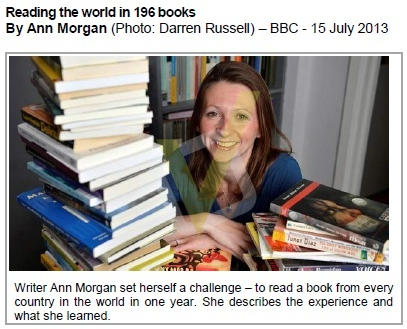
I used to think of myself as a fairly cosmopolitan sort of person, but my bookshelves told a different story. Apart from a few Indian novels and the odd Australian and South African book, my literature collection consisted of British and American titles. Worse still, I hardly ever tackled anything in translation. My reading was confined to stories by English-speaking authors.
So, at the start of 2012, I set myself the challenge of trying to read a book from every country (well, all 195 United Nations (UN) recognised states plus former UN member Taiwan) in a year to find out what I was missing. With no idea how to go about this beyond a sneaking suspicion that I was unlikely to find publications from nearly 200 nations on the shelves of my local bookshop, I decided to ask the planet’s readers for help. I created a blog called A Year of Reading the World and put out an appeal for suggestions of titles that Writer Ann Morgan set herself a I could read in English.
The response was amazing. Before I knew it, people all over the planet were getting in touch with ideas and offers of help. Some posted me books from their home countries. Others did hours of research on my behalf. In addition, several writers, like Turkmenistan’s Ak Welsapar and Panama’s Juan David Morgan, sent me unpublished translations of their novels, giving me a rare opportunity to read works otherwise unavailable to the 62% of Brits who only speak English. Even with such an extraordinary team of bibliophiles behind me, however, sourcing books was no easy task. For a start, with translations making up only around 4.5 per cent of literary works published in the UK and Ireland, getting English versions of stories was tricky.
But the effort was worth it. As I made my way through the planet’s literary landscapes, extraordinary things started to happen. In the hands of gifted writers, I discovered bookpacking offered something a physical traveller could hope to experience only rarely: it took me inside the thoughts of individuals living far away and showed me the world through their eyes. More powerful than a thousand news reports, these stories not only opened my mind to the nuts and bolts of life in other places, but opened my heart to the way people there might feel.
And that in turn changed my thinking. Through reading the stories shared with me by bookish strangers around the globe, I realised I was not an isolated person, but part of a network that stretched all over the planet. One by one, the country names on the list that had begun as an intellectual exercise at the start of the year transformed into vital, vibrant places filled with laughter, love, anger, hope and fear. Lands that had once seemed exotic and remote became close and familiar to me – places I could identify with. At its best, I learned, fiction makes the world real. (adapted from )
Identify the statements below about Ann Morgan as true (T) or false (F), according to the text.
( ) She decided to read nearly 200 books in a year, which included all the UN-recognized countries.
( ) She was sure she could find all the books she wanted to read at the local bookstore.
( ) She felt that she was missing something by not having read foreign publications.
( ) She created a blog to ask for suggestions of books she could read in English.
( ) She decided not to read a book from Taiwan because it was a former UN member.
Mark the alternative which presents the correct sequence, from top to bottom.
Questão 73 107193
UFPR 2014
I used to think of myself as a fairly cosmopolitan sort of person, but my bookshelves told a different story. Apart from a few Indian novels and the odd Australian and South African book, my literature collection consisted of British and American titles. Worse still, I hardly ever tackled anything in translation. My reading was confined to stories by English-speaking authors.
So, at the start of 2012, I set myself the challenge of trying to read a book from every country (well, all 195 United Nations (UN) recognised states plus former UN member Taiwan) in a year to find out what I was missing. With no idea how to go about this beyond a sneaking suspicion that I was unlikely to find publications from nearly 200 nations on the shelves of my local bookshop, I decided to ask the planet’s readers for help. I created a blog called A Year of Reading the World and put out an appeal for suggestions of titles that Writer Ann Morgan set herself a I could read in English.
The response was amazing. Before I knew it, people all over the planet were getting in touch with ideas and offers of help. Some posted me books from their home countries. Others did hours of research on my behalf. In addition, several writers, like Turkmenistan’s Ak Welsapar and Panama’s Juan David Morgan, sent me unpublished translations of their novels, giving me a rare opportunity to read works otherwise unavailable to the 62% of Brits who only speak English. Even with such an extraordinary team of bibliophiles behind me, however, sourcing books was no easy task. For a start, with translations making up only around 4.5 per cent of literary works published in the UK and Ireland, getting English versions of stories was tricky.
But the effort was worth it. As I made my way through the planet’s literary landscapes, extraordinary things started to happen. In the hands of gifted writers, I discovered bookpacking offered something a physical traveller could hope to experience only rarely: it took me inside the thoughts of individuals living far away and showed me the world through their eyes. More powerful than a thousand news reports, these stories not only opened my mind to the nuts and bolts of life in other places, but opened my heart to the way people there might feel.
And that in turn changed my thinking. Through reading the stories shared with me by bookish strangers around the globe, I realised I was not an isolated person, but part of a network that stretched all over the planet. One by one, the country names on the list that had begun as an intellectual exercise at the start of the year transformed into vital, vibrant places filled with laughter, love, anger, hope and fear. Lands that had once seemed exotic and remote became close and familiar to me – places I could identify with. At its best, I learned, fiction makes the world real. (adapted from )
According to the text, before her experience with the blog the author used to think of herself as a cosmopolitan person.
However, she realised that:
Questão 73 100699
FUVEST (USP) 2014To live the longest and healthiest life possible, get smarter. Institute for Health Metrics and Evaluation (IHME) data show that past a certain threshold, health and wealth are just weakly correlated. However, overall health is closely tied to how many years people spend in school. Mexico, for instance, has a fifth the per capita gross domestic product (GDP) of the United States, but, for women, more than 50 percent of the latter’s schooling.
In line with the trend, Mexico’s female adult mortality rate is only narrowly higher. Vietnam and Yemen have roughly equivalent per capita GDP. Yet Vietnamese women average 6.3 more years in school and are half as likely to die between the ages of 15 and 60. “Economic growth is also significantly associated with child mortality reductions, but the magnitude of the association is much smaller than that of increased education,” comments Emmanuela Gakidou, IHME’s director of education and training. “One year of schooling gives you about 10 percent lower mortality rates, whereas with a 10 percent increase in GDP, your mortality rate would go down only by 1 to 2 percent.”
Discover, May 31, 2013. Adaptado.
De acordo como texto, “about 10 percent lower mortality rates” é resultado de
Questão 71 100697
FUVEST (USP) 2014To live the longest and healthiest life possible, get smarter. Institute for Health Metrics and Evaluation (IHME) data show that past a certain threshold, health and wealth are just weakly correlated. However, overall health is closely tied to how many years people spend in school. Mexico, for instance, has a fifth the per capita gross domestic product (GDP) of the United States, but, for women, more than 50 percent of the latter’s schooling.
In line with the trend, Mexico’s female adult mortality rate is only narrowly higher. Vietnam and Yemen have roughly equivalent per capita GDP. Yet Vietnamese women average 6.3 more years in school and are half as likely to die between the ages of 15 and 60. “Economic growth is also significantly associated with child mortality reductions, but the magnitude of the association is much smaller than that of increased education,” comments Emmanuela Gakidou, IHME’s director of education and training. “One year of schooling gives you about 10 percent lower mortality rates, whereas with a 10 percent increase in GDP, your mortality rate would go down only by 1 to 2 percent.”
Discover, May 31, 2013. Adaptado.
O argumento central do texto é o de que níveis mais altos de escolaridade estão diretamente relacionados a
Questão 69 100695
FUVEST (USP) 2014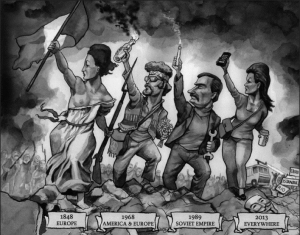
A wave of anger is sweeping the cities of the world.
The protests have many different origins. In Brazil people rose up against bus fares, in Turkey against a building project. Indonesians have rejected higher fuel prices. In the euro zone they march against austerity, and the Arab spring has become a perma-protest against pretty much everything.
Yet just as in 1848, 1968 and 1989, when people also found a collective voice, the demonstrators have much in common, In one country after another, protesters have risen up with bewildering speed. They tend to be ordinary, middle-class people, not lobbies with lists of demands. Their mix of revelry and rage condemns the corruption, inefficiency and arrogance of the folk in charge.
Nobody can know how 2013 will change the world-if at all. In 1989 the Soviet empire teetered and fell. But Marx's belief that 1848 was the first wave of a proletarian revolution was confunded by decades of flourishing capitalism and 1968 did more to change sex than politics.
Even now, thoug, the inchoate significance of 2013 is discernible. And for politicians who want to peddle the same stuff, news is not good.
The Economist, June 29, 2013. Adaptado.
Segundo o texto, os protestos de 2013, em diversos lugares do mundo,
Questão 20 99135
FCM PB Medicina 2014/2
Look at the picture below and answer:
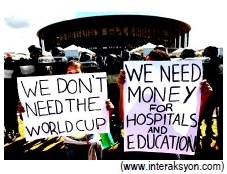
We can say the poster’s authors sound:
06