


![[Marketing] Questao Topo - deslogado](https://storage.estuda.com.br/banners/0_6b7ebee90b03af1c560c73bb8bcce34a_banner_deslogado_70_dias.png)
Questões de Inglês
19.971 Questões
Questão 43 111492
UEMA PAES 2014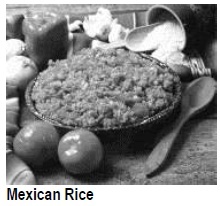
Mexican rice belongs to an unusual
category of Mexican dishes called dry
soups. To make a dry soup,
a starchy food such as rice, noodles, or
cut-up tortillas is cooked slowly in a soup
broth. Eventually the broth is completely
absorbed by the starch, leaving a "dry"
soup. Dry soups are served as a separate
course before the meat course.
1cup white rice, uncooked
2 tablespoons of vegetable oil
4 cups tomato juice
4 tablespoons butter or margarine
½ teaspoon ground cumin
1 teaspoon salt
½ green pepper, cleaned out and chopped
1 ½ cups chopped onion
2 large tomatoes, chopped, or 1 8 ounce can (1 cup) tomatoes cut up with a spoon
From: CORONADO, R. Cooking the Mexican Way. USA: Lerner Publications Company, 1982.
O texto Mexican Rice, por suas características de forma e por seu propósito comunicativo, é exemplo do gênero
Questão 41 111489
UEMA PAES 2014
This quintessential ready to move in home boasts an upgraded kitchen with granite counter-tops and updated appliances, new floors with baseboards throughout, and a playground protected by a white aluminum fence. Nestled in a wonderfully peaceful neighborhood and situated on a gorgeous preserve, perfect for bird watching in the winter time, this gem is sure to be a quick sale. Also located in the exclusive Estates of Pembroke Shores, a security guard gated community.
O texto, pelo seu propósito comunicativo, é
Questão 21 109760
UERJ 2014/2Brazilian protest songs: “Peace without a voice is no peace but fear”
I was born a year after the military coup in Brazil. The dictatorship that followed lasted from
1964 until 1985 - all my childhood and teenage years. But until I was 13 or 14 years old, I had
no clue of what was going on in my country. I lived in a small town and my parents were not
involved in politics. We listened to the radio, watched the news on TV and had a subscription to
[5] a national newspaper, but all the media were completely censored at that time. The fact that the
newspaper was sometimes printed with a blank space or a cake recipe in the middle of the news
never really caught my attention. It was always like that and I didn’t know any better.
I had my first glimpse of what it really meant to have a military government and what kind
of things were going on through songs. There was a song that I liked a lot, O bêbado e a
[10] equilibrista, although the lyrics didn’t make much sense to me: “My Brazil… / that dreams of the
return / of Henfil’s brother / and so many people that left / on rocket fins”. Henfil was a famous
cartoonist, but who was his brother? Who were the people who left? What were they singing
about? This was in 1979 and I was 13.
Thanks to this song by João Bosco and Aldir Blanc (sung by Elis Regina) and the questions I
[15] started to ask, I heard for the first time about all the artists, journalists and activists that had
been persecuted, imprisoned, tortured and exiled. Many had disappeared or been killed by the
military regime. This song became an anthem for the amnesty of political prisoners and activists
in exile, which was announced later in that same year.
In fact, due to the extreme censorship during the period of military dictatorship in Brazil, songs
[20] were one of the few ways to send political messages. Despite the tight surveillance of the censors,
they flourished, giving a voice to the resistance movement. Like Para não dizer que não falei das
flores, by Geraldo Vandré, which was interpreted as a call for armed struggle.
Words and phrases with double meanings were used to escape censorship and persecution. The
greatest master in this art was Chico Buarque de Holanda. His clever lyrics were often approved
[25] by the censors, who would only later realise what the songs were really about. But then, of
course, it was too late. That was the case with Apesar de você, which was censored only after it
had already become an anthem on the streets. At first sight, it appears to be a samba about a
lover’s quarrel. Actually, it was a sharp critique of the authoritarian regime and an act of direct
defiance aimed at the dictators.
[30] With the advent of democracy and the new freedom of expression in the late 1980s, protest
songs played less of a role in Brazil for a while, but in the 1990s they once again became a
powerful channel to voice social discontent. One of bands active in this period was O Rappa, with
the song A paz que eu não quero. The fight against social inequality, urban and police violence
and racial discrimination are the most common themes. Nowadays, the lyrics are explicit and the
messages are clear.
Mariângela Guimarães rnw.nl
The context often helps if one needs to guess the meaning of an unknown word. For example, the word lyrics appears in three sentences from the text:
although the lyrics didn’t make much sense to me: (l. 10)
His clever lyrics were often approved by the censors, (l. 24-25)
Nowadays, the lyrics are explicit (l. 34)
Based on these examples, lyrics is translated as:
Questão 19 109756
UERJ 2014/2Brazilian protest songs: “Peace without a voice is no peace but fear”
I was born a year after the military coup in Brazil. The dictatorship that followed lasted from
1964 until 1985 - all my childhood and teenage years. But until I was 13 or 14 years old, I had
no clue of what was going on in my country. I lived in a small town and my parents were not
involved in politics. We listened to the radio, watched the news on TV and had a subscription to
[5] a national newspaper, but all the media were completely censored at that time. The fact that the
newspaper was sometimes printed with a blank space or a cake recipe in the middle of the news
never really caught my attention. It was always like that and I didn’t know any better.
I had my first glimpse of what it really meant to have a military government and what kind
of things were going on through songs. There was a song that I liked a lot, O bêbado e a
[10] equilibrista, although the lyrics didn’t make much sense to me: “My Brazil… / that dreams of the
return / of Henfil’s brother / and so many people that left / on rocket fins”. Henfil was a famous
cartoonist, but who was his brother? Who were the people who left? What were they singing
about? This was in 1979 and I was 13.
Thanks to this song by João Bosco and Aldir Blanc (sung by Elis Regina) and the questions I
[15] started to ask, I heard for the first time about all the artists, journalists and activists that had
been persecuted, imprisoned, tortured and exiled. Many had disappeared or been killed by the
military regime. This song became an anthem for the amnesty of political prisoners and activists
in exile, which was announced later in that same year.
In fact, due to the extreme censorship during the period of military dictatorship in Brazil, songs
[20] were one of the few ways to send political messages. Despite the tight surveillance of the censors,
they flourished, giving a voice to the resistance movement. Like Para não dizer que não falei das
flores, by Geraldo Vandré, which was interpreted as a call for armed struggle.
Words and phrases with double meanings were used to escape censorship and persecution. The
greatest master in this art was Chico Buarque de Holanda. His clever lyrics were often approved
[25] by the censors, who would only later realise what the songs were really about. But then, of
course, it was too late. That was the case with Apesar de você, which was censored only after it
had already become an anthem on the streets. At first sight, it appears to be a samba about a
lover’s quarrel. Actually, it was a sharp critique of the authoritarian regime and an act of direct
defiance aimed at the dictators.
[30] With the advent of democracy and the new freedom of expression in the late 1980s, protest
songs played less of a role in Brazil for a while, but in the 1990s they once again became a
powerful channel to voice social discontent. One of bands active in this period was O Rappa, with
the song A paz que eu não quero. The fight against social inequality, urban and police violence
and racial discrimination are the most common themes. Nowadays, the lyrics are explicit and the
messages are clear.
Mariângela Guimarães rnw.nl
According to the author, Chico Buarque de Holanda was an expert in the art of writing songs with double meanings.
He did that with the following aim:
Questão 55 107874
EsPCEx 2° Dia 2014The Phenomenon of Candy Crush: Why Is the Game So Popular?
In 2012, Candy Crush was released on Facebook and was later converted to smartphone format for people to play on the go. In 2013, the game reached real prominence and became the most popular game on Facebook. It’s no surprise then that so many people play this game on their phones. Candy Crush Saga has changed the way many of us kill time on commutes, or even in the toilet. I don’t remember the last train journey I took where at least one person wasn’t playing Candy Crush on their phone. I’m sure almost every reader of this article will have either been invited or invited others to play Candy Crush via Facebook in an effort to get more lives or even levels.
Despite being incredibly similar to many games over the years, Candy Crush Saga has added new depth to the genre, with seemingly unlimited combinations of new scenarios and concepts. So, this mixture of simplicity and variety is what makes Candy Crush so unbelievably popular.
As a result, Candy Crush Saga shows no signs of slowing down. New levels are generally released via the Facebook version every three weeks, with new levels also being made frequently available for the smartphone version. With 6.7 million active users, the developers are rumoured to be earning $633,000 per day from Candy Crush users.
Adapted from http://metro.co.uk/2013/09/27/
In the sentence “I don’t remember the last train journey I took where at least one person wasn’t playing Candy Crush on their phone.” (paragraph 1), the author means
Questão 75 107195
UFPR 2014
I used to think of myself as a fairly cosmopolitan sort of person, but my bookshelves told a different story. Apart from a few Indian novels and the odd Australian and South African book, my literature collection consisted of British and American titles. Worse still, I hardly ever tackled anything in translation. My reading was confined to stories by English-speaking authors.
So, at the start of 2012, I set myself the challenge of trying to read a book from every country (well, all 195 United Nations (UN) recognised states plus former UN member Taiwan) in a year to find out what I was missing. With no idea how to go about this beyond a sneaking suspicion that I was unlikely to find publications from nearly 200 nations on the shelves of my local bookshop, I decided to ask the planet’s readers for help. I created a blog called A Year of Reading the World and put out an appeal for suggestions of titles that Writer Ann Morgan set herself a I could read in English.
The response was amazing. Before I knew it, people all over the planet were getting in touch with ideas and offers of help. Some posted me books from their home countries. Others did hours of research on my behalf. In addition, several writers, like Turkmenistan’s Ak Welsapar and Panama’s Juan David Morgan, sent me unpublished translations of their novels, giving me a rare opportunity to read works otherwise unavailable to the 62% of Brits who only speak English. Even with such an extraordinary team of bibliophiles behind me, however, sourcing books was no easy task. For a start, with translations making up only around 4.5 per cent of literary works published in the UK and Ireland, getting English versions of stories was tricky.
But the effort was worth it. As I made my way through the planet’s literary landscapes, extraordinary things started to happen. In the hands of gifted writers, I discovered bookpacking offered something a physical traveller could hope to experience only rarely: it took me inside the thoughts of individuals living far away and showed me the world through their eyes. More powerful than a thousand news reports, these stories not only opened my mind to the nuts and bolts of life in other places, but opened my heart to the way people there might feel.
And that in turn changed my thinking. Through reading the stories shared with me by bookish strangers around the globe, I realised I was not an isolated person, but part of a network that stretched all over the planet. One by one, the country names on the list that had begun as an intellectual exercise at the start of the year transformed into vital, vibrant places filled with laughter, love, anger, hope and fear. Lands that had once seemed exotic and remote became close and familiar to me – places I could identify with. At its best, I learned, fiction makes the world real. (adapted from )
Consider the following statements about the blog “A Year of Reading the World” and people’s reaction to it.
1. The blog was very successful in getting responses from people all over the world.
2. Some people posted books from their countries to Ann while others did hours of research.
3. Some writers sent her translations of their novels that had already been published in English.
4. Sixty-two per cent of the people that visited the blog and gave suggestions to Ann were British.
5. The blog made it quite easy for Ann Morgan to find books from all over the world.
Which of the statements above are TRUE, according to the text?
06