


![[Marketing] Questao Topo - deslogado](https://storage.estuda.com.br/banners/0_6b7ebee90b03af1c560c73bb8bcce34a_banner_deslogado_70_dias.png)
Questões de Inglês
19.971 Questões
Questão 50 258019
Unit-SE Medicina - Caderno 1 2014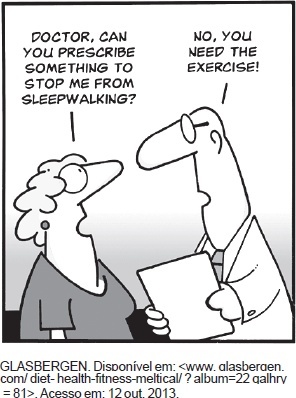
The equivalent of the woman’s question in Reported Speech is
The woman ______ the doctor if he ______ prescribe something to stop ______ from sleepwalking.
The alternative that completes the blanks correctly is
Questão 31 257963
Unit-SE Medicina - Caderno 1 2014TEXTO:
Life in the age of internet addiction

Just one more tweet, dad!
Anyone who spends their day staring at screens
can speak to the modern-day epidemic of eye fatigue.
But what is our digital obsession doing to our brains?
Researchers have noted a rise in something called Digital
[5] Attention Disorder — the addiction to social networks
and computers in general.
How does it work? More than 50 years ago,
psychologist B.F. Skinner was experimenting on rats
and pigeons, and noticed that the unpredictability of
[10] reward was a major motivator for animals. If a reward
arrives either predictably or too infrequently, the animal
eventually loses interest. But when there was anticipation
of a reward that comes with just enough frequency, the
animals’ brains would consistently release dopamine, a
[15] neurotransmitter in the brain that (basically) regulates
pleasure.
What does this have to do with the internet? Some
researchers believe that intermittent reinforcement — in
the form of texts, tweets, and various other social
[20] media — may be working on our brains the same way
rewards did on Skinner’s rats. “Internet addiction is the
same as any other addiction — excessive release of
dopamine,” says Hilarie Cash, executive director of the
reStart program for internet addiction and recovery, a
[25] Seattle-area rehab program that helps wean people off
the internet. “Addiction is addiction. Whether it’s
gambling, cocaine, alcohol, or Facebook.”
“The vast majority of the American population is
mildly addicted to technology, and our clinic treats only
[30] very serious cases,” she told me in a phone interview.
“Most of the people that come are young adult males
around the ages of 18 to 30 who spend a lot of time on
the internet. Their health is poor, their social relationships
have turned to crap, they have no social confidence or
[35] real-world friends. They don’t date. They don’t work.”
Internet and video game addiction starts young.
Most young men are given computer or video games
when they are five or six years old and therefore their
childhood development is profoundly wired for these
[40] activities. It’s quite different to drug addicts and alcoholics
who are usually exposed to drugs or alcohol closer to
the age of 15. Internet addicts usually have 15 to 20
years of addiction on them due to starting younger.
The problem isn’t just young men, either. “Women
[45] are getting addicted, too,” Cash told me. ”Although
women usually become addicted later in life and, more
often than not, directly to social media, while men are
more adept to becoming addicted to multiplayer games.
Women seem to juggle addiction and life better than
[50] men.”
Life in the age of internet addiction. Disponível em: . Acesso em:12 out. 2013.
Fill in the parentheses with T (True) or F (False).
It’s stated in the text:
( ) Too much use of digital devices can damage both our eyesight and our brains.
( ) Elderly people are the ones mostly affected by eye fatigue caused by digital obsession.
( ) An advantage of social networks is that they don’t cause any kind of mental disorder.
( ) Nowadays, more and more people are becoming addicted to the Internet.
According to the text, the correct sequence, from top to bottom, is
Questão 17 252704
UNITINS Tarde 2014/1Texto 1
INNOVATIONS
Researchers from Zymo-Genetics Inc., a Seattle biotechnology company, have identified three new compounds, each of which stimulates new bone growth in animals. If they prove to do the same in humans, these chemicals could become an important treatment for osteoporosis, which affects an estimated 15 million Americans.
Osteoporosis is caused by increased bone breakdown without new bone formation. Current treatments help retard bone loss, but they are unable to replace what is already gone. To find drugs that increase bone density, the researchers screened tens of thousands of compounds for their ability to build up bones. The researchers are now testing three candidates that are easy to make and can be put into pill form.
(Fonte: BUSINESS WEEK , April 12, 1999. p. 61.)
No texto 1, no primeiro parágrafo, a informação “15 million” refere-se ao
Questão 37 235091
UESB Caderno 1 2014TEXTO:
Is Shakespeare relevant today?
Some people, especially individuals who have been
assigned the works of Shakespeare as school
assignments, have wondered about whether or not
Shakespeare is still relevant. The relevance of
[5] Shakespeare and many other writers and artists who
worked in previous eras is also a popular topic among
educators and researchers who focus on literature. Many
people argue that the enduring popularity of Shakespeare
is a testimony to his relevance, and that additionally, he
[10] has made major contributions not only to the English
language, but to the way in which people think and
behave. Shakespeare has quite literally shaped society
in many ways, making Shakespeare relevant in a very
real way.
[15] From a purely linguistic standpoint, Shakespeare
is most definitely relevant. Shakespeare introduced
thousands of words and phrases to the English language,
along with new concepts and grammatical structures.
While Shakespeare’s language sometimes seems
[20] antiquated to modern eyes, it was quite daring and forward
thinking for the time, and Shakespeare literally coined
words to describe previously unimaginable situations and
events, thereby enriching the English language
immensely. People who wonder what makes
[25] Shakespeare relevant might want to consider that many
common phrases, from “primrose path” to “all’s well that
ends well,” come from Shakespeare’s works.
Is Shakespeare relevant today?. Disponível em:<www.wisegeek.org/is-shakespeare-relevant-today.htm#slideshow>. Acesso em: 12 out. 2013.
The most suitable Portuguese translation for the popular saying “all’s well that ends well” (l. 26-27) is
Questão 27 217667
FACISA 2014/2
Robots are on the march. Most of them work on assembly lines, building cars, making electronic devices and processing food, drugs and chemicals. These giant machines often operate in cages because of the danger they pose to anyone who gets in their way. But robots are spreading beyond the factory, a trend that will accelerate in 2014. […] Now sales of other sorts of robots are taking off. These “service” robots are […] not as powerful as industrial robots, but more flexible, decentralized systems that make individuals more productive.
Researchers in many countries are developing humanoid robots to act as care assistants for old people. That is still a distant goal. But two other forms of robot are making rapid progress. The first is the unmanned aerial vehicle or drone, which is essentially a flying robot. The second sort of robot to look out for is the robot on wheels, better known as the selfdriving car. Some 2014 models will be able to drive themselves in stop-go traffic, steering and maintaining a constant distance from the car in front. […]
The proliferation of robots is easily overlooked because many of them do not conform to the stereotypes of what a robot should look like. But they are already among us, and their numbers will grow in 2014.
Tom Standage, The World in 2014
The verb groups are developing and are making in TEXT B describe actions
Questão 56 196049
IMEPAC 2014/2INSTRUCTIONS - All the questions in this test are taken from the text below. Read it carefully and then choose the correct alternatives that answer the questions or complete the statements placed after it. The alternatives must be chosen in accordance with the content of the text.
Could a commonly prescribed antidepressant slow onset of Alzheimer's?
Thursday 15 May 2014 - 8am PST
New research from the Washington University School of Medicine in St. Louis, MO, and the University of Pennsylvania finds that a commonly prescribed antidepressant may be effective at slowing onset of Alzheimer's disease.
The problems with memory and cognition caused by Alzheimer's are strongly influenced by a build-up of plaques in the brain. The plaques consist of amyloid beta - a protein that is produced as part of normal brain activity. Patients with Alzheimer's disease, however, have elevated levels of amyloid beta, which results in the protein clumping together as plaques.
A previous study by senior author John Cirrito, PhD, assistant professor of neurology at Washington University, suggested that the production of amyloid beta can be reduced by the chemical messenger serotonin.
Most antidepressants work by stimulating the flow of serotonin in the brain, which prompted Cirrito and first author Dr. Yvette Sheline to investigate antidepressants as a tool to control amyloid beta production.
As part of a 2011 study, they tested a range of antidepressants in mice genetically altered to develop Alzheimer's as they age. The mice in the trial were young and had not yet developed the brain plaques that characterize the disease. The researchers found that the antidepressants successfully reduced amyloid beta production in the mice by an average of 25% after 24 hours.

"Until we can more definitively prove that these drugs help slow or stop Alzheimer's in humans, the risks aren't worth it," says Cirrito.
In their new study - published in the journal Science Translational Medicine - the researchers administered the antidepressant citalopram to older mice who already had plaques in their brain. They then tracked the growth of plaques in the mice for 28 days using a technique called "two-photon imaging."
They found that citalopram halted the growth of the existing plaques, while formation of new plaques was reduced by 78%.
In a second phase of the experiment, 23 human subjects between the ages of 18 and 50 received a single dose of citalopram. The participants were not cognitively impaired or depressed. Over the 24 hours following the administration of the citalopram, samples of spinal fluid were taken from the participants.
The spinal fluid samples showed that amyloid beta production had dropped in the human participants by 37%.
"Antidepressants appear to be significantly reducing amyloid beta production, and that's exciting," says Cirrito.
'There is still much more work to do'
"But while antidepressants generally are well tolerated," he continues, "they have risks and side effects. Until we can more definitively prove that these drugs help slow or stop Alzheimer's in humans, the risks aren't worth it. There is still much more work to do."
The next step for the team is to use mouse models again in an attempt to understand the molecular process that causes serotonin to halt the production of amyloid beta.
Dr. Sheline says the team also plans to study older adults who will be treated for 2 weeks with antidepressants.
"If we see a drop in levels of amyloid beta in their spinal fluid after 2 weeks," she explains, "then we will know that this beneficial reduction in amyloid beta is sustainable."
Last year, a study published in JAMA suggested that poor sleep quality may contribute to an increased build-up of amyloid beta plaques in the brains of older people. Meanwhile, a study published around the same time in the journal Neurology found an association between hardening of the arteries and the build-up of amyloid beta plaques in the brain.
Written by David McNamee http://www.medicalnewstoday.com/articles/276838.php (Accessed May 16, 2014)
The text discusses the possibility of antidepressants
06