


![[Marketing] Questao Topo - deslogado](https://storage.estuda.com.br/banners/0_6b7ebee90b03af1c560c73bb8bcce34a_banner_deslogado_70_dias.png)
Questões de Inglês
19.971 Questões
Questão 14 14017960
UFAM PSC 3 etapa 2025Responda à questão abaixo com base no texto a seguir:
Last month marked the world’s hottest July on record, US scientists say
This year could beat 2023 for the hottest year on record as 15-month ever recorded, elongating a string of monthly temperature highs that now stretch back for 15 consecutive months, US government scientists have announced. Last month was about 1.2C (2.1F) hotter than average across the globe, making it the hottest July on record, the National Oceanic and Atmospheric Administration (Noaa) said on Thursday. This means that every month for the past 15 months has beaten its previous monthly record. “The streak started in June 2023 and now exceeds the record streak heat streak extends, according to Noaa. The world just had its hottest July set over 2015 and 2016,” said Karin Gleason, monitoring section chief at Noaa’s National Centers for Environmental Information, who added that last month’s record was by a “photo finish” small margin over last July. The record warmth last month saw new July highs for Europe and Africa, while North America had its second hottest ever July. About a fifth of the world’s total land surface had new record temperatures in July, with only the very tip of South America having a cooler than average month Across the oceans, which have been experiencing exceptional surging levels of heat over the past year, last month was the second hottest July recorded, breaking a string of 15 consecutive record hot months. July saw searing heat for much of the globe, with heatwaves sweeping places such as southern Europe and large parts of the US. Last month also saw, unusually, the daily average global temperature record broken twice in two consecutive days. Noaa’s rankings differ slightly from the EU’s Earth-watching service Copernicus, which last week said that July was the second hottest such month on record. On Thursday Noaa said there was now a 77% chance that 2024 will be the hottest year on record, beating the existing record set only last year. The agency added that there was also a two-inthree chance of a La Niña climate event developing from September onwards, a periodic natural shift in conditions that often brings cooler temperatures than its reverse, El Niño, which has helped fuel recent temperature highs. “What is truly staggering is how large the difference is between the temperature of the last 13 months and the previous temperature records,” said Carlo Buontempo, director of the European Union’s Copernicus Climate Change Service following the daily record set on 21 July. “We are now in truly uncharted territory and as the climate keeps warming, we are bound to see new records being broken in future months and years.” Climate scientists have stressed the elevated heat is a clear sign of the influence of a climate crisis being driven by the burning of fossil fuels and a sign that efforts to keep the world to within a 1.5C temperature rise beyond pre-industrial times are insufficient. “With temperatures increasing this much, we need to do absolutely everything we can to reduce the emissions driving climate change more rapidly,” said Drew Shindell, a climate scientist at Duke University. “That means accelerating the phaseout of fossil fuels, reducing methane this decade, and tackling agricultural emissions as well. These things aren’t easy, but the consequences of not doing them are mounting so quickly that we are dooming ourselves to well over 1.5°C, with higher temperatures each year we delay.”
Fonte: https://www.theguardian.com/us-news/article/2024/aug/15/july-worldrecord-heat. Acesso em: 15.08.2024.
Sobre o texto, é CORRETO afirmar que:
Questão 26 13259606
UERJ 2 Exame 2025The dangers of preconceived judgement:
look beyond stereotypes
People often say “Don’t judge a book by its cover”, and it holds true in many aspects of life. We are all
guilty of making snap judgements about others based on their appearance, actions or even just a brief
encounter. But have you ever wondered why it’s important not to judge someone before getting to know
them? Do you ever consider that?
[5] Imagine that you are at a party and, out of the corner of your eye, you spot a person with a unique
hairstyle and an outfit that screams “fashion forward”. Your brain, always ready for action, instantly springs
into snap judgement mode. “They must be an avant-garde artist or a fashion model”, it enthusiastically
proclaims. This is thin slice judgement! It refers to the action of making lightning-fast judgements based
on minimal information. An example is when you are at a job interview, and the person in the hot seat
[10] glances at your handwriting before making a quick assessment of your personality. It sounds ludicrous,
but our brain has a way of magnifying minor details and turning them into grand narratives. As amusing
as it may seem, such judgements can have real-life consequences.
While snap judgements can provide an amusing story to share at parties, they can perpetuate stereotypes,
reinforce biases and limit our ability to see the true beauty in diversity. Instead of jumping to conclusions,
[15] it’s better to lean into curiosity. Ask questions, seek out diverse perspectives and recognize that everyone
has a unique story to tell. By embracing our inquisitive nature, we can uncover the richness of human
experiences and challenge our own biases.
Empathy is the secret weapon against prejudice. To truly understand someone, you must put yourself in
their shoes and see the world through their eyes. Actually, prejudice is when we form an opinion or make
[20] assumptions about someone without having all the facts. It’s like trying to write a book review after only
reading the first chapter. We should strive to give people a fair chance before passing judgement. Besides,
it’s essential to remember that nobody is perfect, and we should embrace diversity instead of assuming
we’re always right. Rather than acting as self-appointed judges, we should approach people with empathy
and understanding.
[25] Practicing self-compassion and recognizing our own imperfections can help us show more compassion
towards others. Harsh judgement can stem from a variety of factors, such as insecurity, fear or simply our
own experiences and biases, but it’s okay, we’ve all been there! What’s important is to take a step back and
reflect on why we are quick to judge. And, if we always do that, it’s time to think outside the box.
PATRICK TURNER
Adaptado de appgecet.co.in.
The expression from the text that means “imagine oneself in somebody else’s situation” is:
Questão 25 13259579
UERJ 2 Exame 2025The dangers of preconceived judgement:
look beyond stereotypes
People often say “Don’t judge a book by its cover”, and it holds true in many aspects of life. We are all
guilty of making snap judgements about others based on their appearance, actions or even just a brief
encounter. But have you ever wondered why it’s important not to judge someone before getting to know
them? Do you ever consider that?
[5] Imagine that you are at a party and, out of the corner of your eye, you spot a person with a unique
hairstyle and an outfit that screams “fashion forward”. Your brain, always ready for action, instantly springs
into snap judgement mode. “They must be an avant-garde artist or a fashion model”, it enthusiastically
proclaims. This is thin slice judgement! It refers to the action of making lightning-fast judgements based
on minimal information. An example is when you are at a job interview, and the person in the hot seat
[10] glances at your handwriting before making a quick assessment of your personality. It sounds ludicrous,
but our brain has a way of magnifying minor details and turning them into grand narratives. As amusing
as it may seem, such judgements can have real-life consequences.
While snap judgements can provide an amusing story to share at parties, they can perpetuate stereotypes,
reinforce biases and limit our ability to see the true beauty in diversity. Instead of jumping to conclusions,
[15] it’s better to lean into curiosity. Ask questions, seek out diverse perspectives and recognize that everyone
has a unique story to tell. By embracing our inquisitive nature, we can uncover the richness of human
experiences and challenge our own biases.
Empathy is the secret weapon against prejudice. To truly understand someone, you must put yourself in
their shoes and see the world through their eyes. Actually, prejudice is when we form an opinion or make
[20] assumptions about someone without having all the facts. It’s like trying to write a book review after only
reading the first chapter. We should strive to give people a fair chance before passing judgement. Besides,
it’s essential to remember that nobody is perfect, and we should embrace diversity instead of assuming
we’re always right. Rather than acting as self-appointed judges, we should approach people with empathy
and understanding.
[25] Practicing self-compassion and recognizing our own imperfections can help us show more compassion
towards others. Harsh judgement can stem from a variety of factors, such as insecurity, fear or simply our
own experiences and biases, but it’s okay, we’ve all been there! What’s important is to take a step back and
reflect on why we are quick to judge. And, if we always do that, it’s time to think outside the box.
PATRICK TURNER
Adaptado de appgecet.co.in.
In line 8, the term thin slice refers to judgement that is characterized as:
Questão 23 13259256
UERJ 2 Exame 2025The dangers of preconceived judgement:
look beyond stereotypes
People often say “Don’t judge a book by its cover”, and it holds true in many aspects of life. We are all
guilty of making snap judgements about others based on their appearance, actions or even just a brief
encounter. But have you ever wondered why it’s important not to judge someone before getting to know
them? Do you ever consider that?
[5] Imagine that you are at a party and, out of the corner of your eye, you spot a person with a unique
hairstyle and an outfit that screams “fashion forward”. Your brain, always ready for action, instantly springs
into snap judgement mode. “They must be an avant-garde artist or a fashion model”, it enthusiastically
proclaims. This is thin slice judgement! It refers to the action of making lightning-fast judgements based
on minimal information. An example is when you are at a job interview, and the person in the hot seat
[10] glances at your handwriting before making a quick assessment of your personality. It sounds ludicrous,
but our brain has a way of magnifying minor details and turning them into grand narratives. As amusing
as it may seem, such judgements can have real-life consequences.
While snap judgements can provide an amusing story to share at parties, they can perpetuate stereotypes,
reinforce biases and limit our ability to see the true beauty in diversity. Instead of jumping to conclusions,
[15] it’s better to lean into curiosity. Ask questions, seek out diverse perspectives and recognize that everyone
has a unique story to tell. By embracing our inquisitive nature, we can uncover the richness of human
experiences and challenge our own biases.
Empathy is the secret weapon against prejudice. To truly understand someone, you must put yourself in
their shoes and see the world through their eyes. Actually, prejudice is when we form an opinion or make
[20] assumptions about someone without having all the facts. It’s like trying to write a book review after only
reading the first chapter. We should strive to give people a fair chance before passing judgement. Besides,
it’s essential to remember that nobody is perfect, and we should embrace diversity instead of assuming
we’re always right. Rather than acting as self-appointed judges, we should approach people with empathy
and understanding.
[25] Practicing self-compassion and recognizing our own imperfections can help us show more compassion
towards others. Harsh judgement can stem from a variety of factors, such as insecurity, fear or simply our
own experiences and biases, but it’s okay, we’ve all been there! What’s important is to take a step back and
reflect on why we are quick to judge. And, if we always do that, it’s time to think outside the box.
PATRICK TURNER
Adaptado de appgecet.co.in.
The dangers of preconceived judgement: look beyond stereotypes (título)
The title of the text recommends a way of behaving in relation to stereotypes. An example of such recommendation is clearly expressed in:
Questão 23 13222103
UERJ 1 Exame 2025Are wild animals afraid of humans?
Crocodiles, sharks, snakes, tigers, lions are but a few of the animals that evoke a sense of fear in humans.
Attacks by these animals are always widely splashed across the media, giving further merit to these fears.
But are we actually more scared of them than they are of us? And do we perhaps have reason to be?
Wild animals are afraid of humans. Studies have shown that even apex predators change their eating
[5] patterns and habits when they perceive humans to be around. We are the only super predator that exists
on this planet. Through conditioning, animals have come to instinctually fear our very existence.
In Santa Cruz, California, a study was directed. The scientists wished to determine how much impact
the perception of human presence would have on the predators in the area, namely the mountain lion,
bobcat, opossum and skunk. The scientists broadcasted human voices in certain areas while they used
[10] the sound of tree frogs in other regions as a control. The results were alarming in that the predators
changed their habits more than expected, when they perceived humans to be present. Mountain lions
would leave their kill if they heard voices and deliberately avoided the areas where they believed there
was human activity. The skunk and opossum foraged less, and the bobcat became solely nocturnal.
Some might suggest that our upright stance and forward-facing eyes have animals understanding that
[15] we are a predator and a threat, but it is more than just how we look that has them running for the hills.
Through centuries of hunting and destroying their habitat their fear of us has become instinctual. We
are the annihilators, super destroyers of the earth and its wildlife. We have taught animals that we are the
most destructive and deadly species on the planet and this conditioned them to fear us.
The human population kills nine times as many carnivores as they kill each other and four times more
[20] middle food web animals than large carnivores do. We are one of the few animals capable of distorting
ecosystem functioning and eradicating species. In most scenarios, the mere presence of a human will
have wild animals darting away. Even in some extreme situations where animals show aggression, if
humans stand their ground and make noise, the result is often the animal showing one final act of
defiance before they move off back into their natural habitat.
[25] But although wild animals will choose to run away most of the time, rather than standing against or going
after us, this is not always the case. A threatened animal will fight against us to defend itself, and chances
are you, with your lack of claws, blunt teeth and squishy body, will come off second best. Despite our
destructive behavior, an unarmed human has almost no defense against an animal. Fear incites violence
and animals will react aggressively if they feel threatened. We might be the mighty super predator, but
[30] ultimately we are no match for Mother Nature when she chooses to fight back.
Adaptado de nayturr.com.
The main topic developed throughout the article can be summarized as:
Questão 64 16543645
FACERES Medicina 2024/2Use the comic strip bellow to answer the question:
Callous
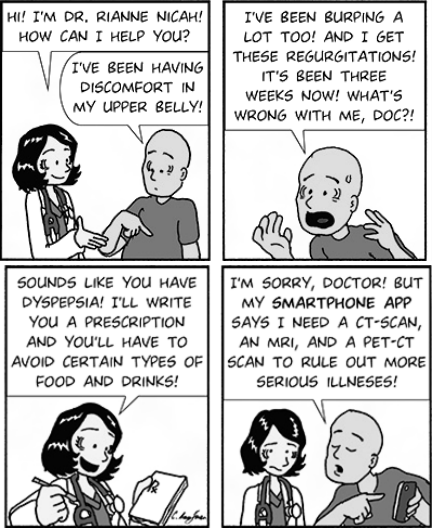
(https://www.callouscomics.com/index/tag/%20hospital)
According to the comic strip, in the stretch “But my smart phone App says I need (…)” the word but expresses:
06