


![[Marketing] Questao Topo - deslogado](https://storage.estuda.com.br/banners/0_6b7ebee90b03af1c560c73bb8bcce34a_banner_deslogado_70_dias.png)
Questões de Inglês
19.971 Questões
Questão 16 785200
USS (Univassouras) 2015/2Alzheimer’s breakthrough: ultrasound successfully treats disease in mice
Rodents found to have improved memories after ultrasound treatment, without any apparent damage to brain tissue
Scientists believe they may have found a new weapon in the fight against Alzheimer’s disease
– not in the form of a drug, but in focused beams of ultrasound.
While the approach has only been tested in mice, researchers said on Wednesday it proved
surprisingly good at clearing tangles of plaques linked to Alzheimer’s in the animals’ brains and
[5] improving their memory, as measured by tests such as navigating a maze.
In the past, high-energy ultrasound has been combined with injected microbubbles, which
vibrate in response to sound waves, to get drugs across the so-called blood brain barrier.
But the new research, published in the journal Science Translational Medicine, is the first
demonstration that ultrasound alone might have a beneficial effect on the memory-robbing
[10] condition. “Our research was very exploratory and we really didn’t expect to see such a massive
effect”, Juergen Goetz of the University of Queensland in Brisbane, one of the study authors,
said. “I’m really excited by this.”
After several weeks of treating mice that had been genetically altered to produce amyloid
plaques, the scientists found the ultrasound almost completely cleared the plaques in 75% of
[15] the animals, without apparent damage to brain tissue.
While there is still some debate as to whether plaques are a cause or a symptom of Alzheimer’s,
the experiment did find that the treated mice had improved memory, as measured by three
different tests, compared with untreated ones.
Goetz stressed that his research was at a very early stage and it would be several years before it
[20] could be tested in people. Several hurdles must be overcome first, including long-term checks
for side effects in animals and much more research into whether the approach will work with
thicker skulls and larger brains. While mice studies can give us an indication of how a treatment
may affect humans, they are only indications, as there are inherent differences between the
species, and between the model and the actual human disease.
[25] Dementia, of which Alzheimer’s is the most common form, affects close to 50 milion people
worldwide and that number is set to reach 135 milion by 2050, according to Alzheimer’s Disease
International, a non-profit campaign group.
theguardian.com
The news story reports new effects on the brain mice tested in a recent research.
The novelty of the study consists of the fact below:
Questão 73 737062
FAI 2015/2Instilling empathy among doctors pays off for patient care
Sandra G. Boodman
The patient was dying and she knew it. In her mid-50s, she had been battling breast cancer for years, but it had spread to her bones, causing unrelenting pain that required hospitalization. Jeremy Force, a first-year oncology fellow at Duke University Medical Center who had never met the woman, was assigned to stop by her room last November to discuss her decision to enter hospice.
Employing the skills he had just learned in a day-long course, Force sat at the end of her bed and listened intently. The woman wept, telling him she was exhausted and worried about the impact her death would have on her two daughters. “I acknowledged how hard what she was going through was,” Force said of their 15-minute conversation, “and told her I had two children, too” and that hospice was designed to provide her additional support. A few days later, he ran into the woman in the hall. “You’re the best physician I’ve ever worked with,” Force remembers her telling him. “I was blown away,” he says. “It was such an honor.”
Force credits “Oncotalk,” a course required of Duke’s oncology fellows, for the unexpected accolade. Developed by medical faculty at Duke, the University of Pittsburgh and several other medical schools, “Oncotalk” is part of a burgeoning effort to teach doctors an essential but often overlooked skill: clinical empathy. Unlike sympathy, which is defined as feeling sorry for another person, clinical empathy is the ability to stand in a patient’s shoes and to convey an understanding of the patient’s situation as well as the desire to help.
Clinical empathy was once dismissively known as “good bedside manner” and traditionally regarded as far less important than technical acumen. But a spate of studies in the past decade has found that it is no mere frill. Increasingly, empathy is considered essential to establishing trust, the foundation of a good doctor-patient relationship. Studies have linked empathy to greater patient satisfaction, better outcomes, decreased physician burnout and a lower risk of malpractice suits and errors.
While some people are naturally better at being empathic, said Mohammadreza Hojat, a research professor of psychiatry at Jefferson Medical College in Philadelphia, empathy can be taught. “Empathy is a cognitive attribute, not a personality trait,” said Hojat, who developed the Jefferson Scale of Empathy, a tool used by researchers to measure it. Empathy courses are rarely required in medical training; however, interest in them is growing, experts say, and programs are underway at Jefferson Medical College and at Columbia University School of Medicine. Columbia has pioneered a program in narrative medicine, which emphasizes the importance of understanding patients’ life stories in providing compassionate care.
One doctor’s experience
Andy Lipman has taken the Duke course twice: first as an oncology fellow in 2004 and last year as a practicing oncologist in Naples, Fla., when he felt in need of a “booster shot.” Oncology, he said, “is a full-contact” specialty with a high burnout rate. Among the most important lessons Lipman said he learned during both sessions was to let go of “my own medical agenda, the desire to fix something or make something happen in that visit.” He learned to pace himself, monitor his reactions and talk less. One technique Lipman routinely employs is taking 15 seconds before entering an exam room to ask himself, “What is needed here?”
On the day he was interviewed, Lipman said, he used what he has learned with a patient with end-stage cancer. She was scheduled for a brief appointment but began weeping loudly as she told Lipman how alone she felt. “I engaged, I expected the emotional response and I hung in there,” he said of the meeting, which lasted 45 minutes. “It felt good to me,” Lipman said, and he hoped it gave his patient some comfort.
(http://us.cnn.com. Adaptado.)
The word “unlike” as used in the fragment “Unlike sympathy, which is defined as feeling sorry for another person” in the third paragraph introduces into the sentence the idea of
Questão 57 714763
URCA 2° Dia 2015/1In the comic strip below, Garfield:
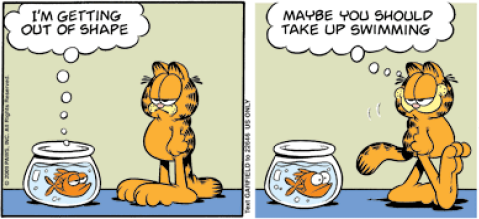

From: http://www.asparatu.com/garfieldcomic Accessed on 10/29/14
Questão 56 714759
URCA 2° Dia 2015/1 Being physically active lowers your risk for two types of cancer: colon and breast. Research shows that:
• Physically active people have a lower risk of colon cancer than do people who are not active;
• Physically active women have a lower risk of breast cancer than do people who are not active;
• Some findings suggest that your risk of endometrial cancer and lung cancer may be lower if you get regular physical activity compared to people who are not active.
If you are a cancer survivor, research shows that getting regular physical activity not only helps give you a better quality of life, but also improves your physical fitness.
As you age, it's important to protect your bones, joints and muscles. Not only do they support your body and help you move, but keeping bones, joints and muscles healthy can help ensure that you're able to do your daily activities and be physically active. Research shows that doing aerobic, musclestrengthening and bonestrengthening physical activity of at least a moderatelyintense level can slow the loss of bone density that comes with age.
If you have arthritis, research shows that doing 130 to 150 (2 hours and 10 minutes to 2 hours and 30 minutes) a week of moderateintensity, lowimpact aerobic activity can not only improve your ability to manage pain and do everyday tasks, but it can also make your quality of life better.
Muscle-strengthening activities can help you increase or maintain your muscle mass and strength. Slowly increasing the amount of weight and number of repetitions you do will give you even more benefits, no matter your age. If you're a physically active middleaged or older adult, you have a lower risk of functional limitations than people who are inactive. Aerobic and musclestrengthening activities can help improve your ability to do the everyday activities, such as climbing stairs, grocery shopping, or playing with your grandchildren.
Regular physical activity can help keep your thinking, learning, and judgment skills sharp as you age. It can also reduce your risk of depression and may help you sleep better. Research has shown that doing aerobic or a mix of aerobic and musclestrengthening activities 3 to 5 times a week for 30 to 60 minutes can give you these mental health benefits.
From: http://www.cdc.gov/physicalactivity/everyone/health/. Accessed on 10/18/2014
The pronoun It (last paragraph) refers to:
Questão 63 637386
UFN Inverno 2015How to learn a foreign language on a budget
You don’t need expensive lessons to start – try smartphone apps, foreign TV and radio, online guides and your local library
Kerstin Hammes
Wednesday 18 February 2015

You don’t have to break the bank to enjoy the value of learning another language.
[1] While the benefits that come from learning a second
language may in theory be priceless, many are put off by
visions of shelling out huge amounts on expensive
resources, tuition or immersion courses. The good news
[5] is that it is actually possible to learn on a budget. Here are
a few tips for spending less and learning more:
Start online
Many new language learners now start with
smartphone apps like Duolingo and Memrise which are
[10] free. These apps start you off with vocabulary and basic
sentences in minutes, and their game-like interface is
ideal for anyone whose last contact with a foreign
language was a terrifying oral school exam. But you
should also make sure that you get plenty of natural input
[15] in your target language. Tune in to international radio
stations on TuneIn Radio. (…)
Where to get materials for free
For real results, a step-by-step course will help you
build up skills. If you like online learning, my best tip is
[20] to check out whether your target country’s international
TV or radio channel offers a structured language course.
These courses are produced by broadcasting
professionals and offer well-designed courses going from
beginner to advanced level. They feature multimedia
[25] materials and even soap operas from big names like
Deutsche Welle, TV5 Monde and Russia Today. If you
prefer materials aimed at English native speakers, the
BBC’s GCSE Revision area Bitesize has some of the
most effective online revision aids I have seen for Irish,
[30] Welsh, French, Spanish, and German. (…) Don’t forget
that pen and paper are also cheap and invaluable language
learning tools. Use them to keep track of new words,
write down new sentences in full and create your own
flash cards. (…)It’s also a good idea to visit your local
[35] library and let them surprise you. Libraries have access
to a large inter-library loan network, so they can get hold
of most courses you want. They also have huge amounts
of travel guides and phrasebooks to keep you inspired.
Share your goal with others
[40] The internet has good enough resources to let you
achieve a decent level in most languages from the
comfort of your home, but for many of us, learning in
isolation is difficult and boring. Even if it’s scary to walk
into a new room of language lovers, leave the house and
[45] connect with other learners right from the start. Making
just one friend who shares your goal or interest in another
language can make the difference between a fad that you
drop after 12 weeks and a new habit for life. (…)
Spend only where it pays off
[50] If you do decide to take your language learning
further, consider investing in small group or one-to-one
tuition. When you hire a language teacher, the money you
spend should buy you unrivalled personal attention. The
accountability that comes with lessons creates a boost of
[55] ongoing motivation that is almost impossible to find for
free.
Most private tutors will offer you a free or cheap trial
lesson. These don’t mean there is a hidden obligation to
buy. Instead, a good tutor will want to learn as much as
[60] possible about you before charging you money. They are
all different and what is simple and comfortable for one
person might be difficult for the next. (…) Once you get
started, it’s easy to get past the idea that studying a
foreign language comes with a big financial burden.
[65] Remember to take your time and think of your new
language as something you will be learning for life, not
just for the next six months. There is only one way to fail
at language learning, and that is to stop completely.
http://www.theguardian.com/education/2015/feb/18/learn-foreign-languagebudget-app-online-library (Adapted).
No trecho “While the benefits that come from learning a second language may in theory be priceless, many are put off by visions of shelling out huge amounts on expensive resources, tuition or immersion courses”, a expressão sublinhada é sinônimo de
Questão 29 472224
UNIPE 2015/2TEXTO:
A baby born infected with human immunodeficiency
virus in Los Angeles, who received treatment within a
few hours after birth, is still showing no signs of the
disease a year later, doctors announced at the
[5] Conference on Retroviruses and Opportunistic Infections
in Boston. The child’s mother was not taking her HIV
medication while she was pregnant.
Although it’s too early to know for certain whether
the child is just in remission, doctors say the baby’s
[10] vitals are displaying differently compared with patients
with suppressed HIV. The baby is currently in foster care.
This is the second baby doctors believe to be cured
of the disease with very early treatment. Another child
from Mississippi received similar treatment when her
[15] mother was discovered to be HIV-positive during labor.
The child is now 3 1/2 years old and appears to be cured,
even though her mother was not administering the baby
her HIV medication at follow-up.
SIFFERLING, Alexandra. Disponível em: <www.time.com/12982/doctorsbelieve-a-second-baby-is-cured-of-hiv/>. Acesso em: 13 maio 2015.
This baby is now
06