


![[Marketing] Questao Topo - deslogado](https://storage.estuda.com.br/banners/0_6b7ebee90b03af1c560c73bb8bcce34a_banner_deslogado_70_dias.png)
Questões de Inglês
19.971 Questões
Questão 80 6548839
FAMECA 2015Leia o texto abaixo para responder à questão.
The Biological Basis of Learning and Individuality
Elementary aspects of the neuronal mechanisms important for several different types of learning can now be studied on the cellular and even on the molecular level. Researchers agree that [some] forms of learning and memory require a conscious record. These types of learning are commonly called declarative or explicit. Those forms of learning that do not utilize conscious participation are referred to as non-declarative or implicit.
Explicit learning is fast and may take place after only one training trial. It often involves association of simultaneous stimuli and permits storage of information about a single event that happens in a particular time and place; it therefore affords a sense of familiarity about previous events. In contrast, implicit learning is slow and accumulates through repetition over many trials. It often involves association of sequential stimuli and permits storage of information about predictive relations between events. Implicit learning is expressed primarily by improved performance on certain tasks without the subject being able to describe just what has been learned, and it involves memory systems that do not draw on the contents of the general knowledge of the individual.
The existence of two distinct forms of learning has caused the reductionists among neurobiologists to ask whether there is a representation on the cellular level for each of these two types of learning process. Canadian psychologist Donald O. Hebb boldly suggested that associative learning could be produced by a simple cellular mechanism. He proposed that associations could be formed by coincident neural activity: “When an axon of cell A ... excite[s] cell B and repeatedly or persistently takes part in firing it, some growth process or metabolic change takes place in one or both cells such that A’s efficacy, as one of the cells firing B, is increased.” According to Hebb’s learning rule, coincident activity in the presynaptic and postsynaptic neurons, is critical for strengthening the connection between them (a so-called pre-post associative mechanism).
(Scientific American, julho de 2014.)
According to the text, implicit learning
Questão 9 6402501
EFOMM 2015Five stranded snorkellers rescued from tiny island off Australia after their huge SOS message was spotted by helicopter.
(Adam Withnall / Wednesday 23 April 2014)
Five snorkellers stranded on a tiny island off
the east coast of Australia have been rescued after
scrawling a giant SOS message into a nearby
sandbank.
[05] The group had been stuck out at sea for more
than nine hours after their boat’s anchor failed and
it drifted away.
They had been swimming around a remote
sandbar near Wigton Island, Queensland, when the
[10] vessel started shifting - with their mobile phones,
clothes, water and sunscreen all still on board – and
it had moved beyond reach before they had time to
react.
Speaking to the Courier-Mail about the ordeal
[15] yesterday, Lyn Forbes-Smith described how she, a
female friend and three male friends were facing
the prospect of a long, cold night surrounded by
ocean when they finally spotted an approaching
rescue helicopter.
[20] “We had sort of made plans about what we’d
do on the rock for the evening,” she said.
“We had reef walkers on thankfully, but we
had no food, water, cream, no hats, not much at all.
We just looked for the highest ground, we looked
for rocks where five of us could huddle together
[25] because we didn’t really want to separate, and we
wanted to be out of the wind as best as possible.”
Ms Forbes-Smith explained that they were
concerned the sandbar – and their message – would
[30] go under with the tide, but that they were
“reasonably confident” someone would come
looking when friends realised they had not
returned.
The group had set off from Keswick Island
[35] towards Wigton Island at around 8am for the
snorkelling trip, and it was around 5pm when they
first saw signs of help approaching.
Another member of the group, Craig Gilbert,
told ABC News of their joy at spotting an RACQ
[40] rescue helicopter.
“We saw the helicopter and we thought, 'Oh,
you beauty' - and then it disappeared and we
thought, 'Oh no - we better look out for our beds
for the night' - then it came back probably 20
minutes later,” he said.
Rescue helicopter crew member Damien
[45] Kross said the five were treated for sunburn and
dehydration, but were otherwise “fine”.
“They were a little bit dehydrated but we
winched them to safety and brought them back here
to Mackay on the mainland] for just to have a
[50] quick medical attention and they were all fine.”
(Adapted from The Independent / Friday 11 July 2014)
Complete the sentences with too many, too much or enough.
Then, choose the correct alternative.
1- I've been to rather __________ parties recently.
2 - You're spending far ________ time on your computer.
3 - Stop. You're asking me _______ questions.
4 - Help! I've got _________ luggage.
5 – Oh, sorry, I didn't call you. I didn't have _________ time.
Questão 10 6309670
UVA 2015/1TEXTO
NUMBER 34, RED
Several years ago, an elderty man walked into a gambling house in a Westem city, sat dowm at the roulette table and placed a few chips on number 34. The whee! spun, slowed down and stopped.
“Number 34, red. There you are, sir”, said the croupler.
The old man left his chips on 34. The wheel spun again, and again stopped on 34. The croupier looked questioningly at the okd man, but he remained silent, his head down, his finger pointing to 34.
“Number 34, red”, said the croupier monotonousiy when the wheel stopped at 34 for the third time.
By this time a crowd had gathered — whispering in amazement at the old man's growing stack of chips. And now, for five consecutive times, the finger continued to point at the winning number 34. Then the croupler announced:
“Sorry, ladies and gentiemen, but there will be no further play at this table.” Tuming to the old man, he added: “You have broken the bank, sir. Please collect your - ." He halted in wide-eyed astonishment.
Onty then did he realize why the old man had neither moved nor spoken since the first spin of the wheel. A dead man had broken the bank!
The old man ...
Questão 15 5748016
UNIEVA Demais Cursos 2015/2Leia a tira a seguir.
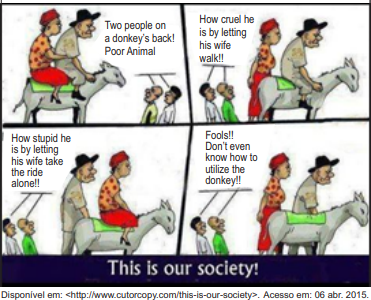
According to the comic strip,
Questão 20 5735742
UNIEVA Medicina 2015/2Read the following text to answer question.
Shopping on the Internet will have a disastrous effect on American cities and states, warn researchers from the University of California, Berkeley. They will lose billions of dollars in sales taxes because people are buying goods from outoftown, outof state, or even from abroad.
American cities and states rely heavily on local sales taxes. Sales by telephone and mail already cost states around $ 3 billion in lost taxes each year. But the Internet could bring about a new hemorrhage of revenues, warns Nathan Newman ofthe University's Center for Economic Research. “At the push of a button, consumers will have access to the lowest-priced goods nationwide and, with the added bonus of avoiding sales taxes, interstate sales may explode over the Internet, leaving state and local government finances in tatters”, he says.
New Scientist, 26 August 1995.
Considering the vocabulary and the linguistic structure of the text,
Questão 13 5735575
UNIEVA Medicina 2015/2Read the following short passage.
Anyone who remembers the polio epidemics of the 1950s, when many children died and thousands more were seriously crippled, understands the importance of immunization.
According to the text, immunization has the effect of
06